 +86-791-8686-1216



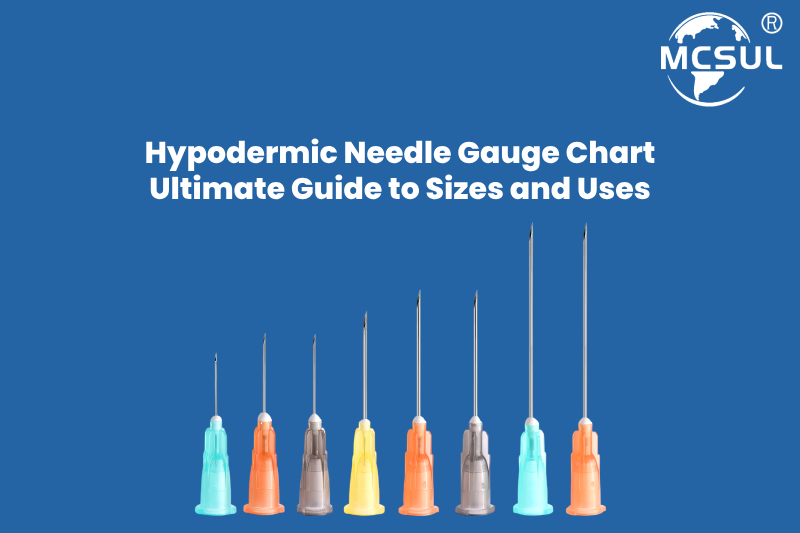
Choosing the right hypodermic needle is important for safe and effective medical procedures. Whether you work in a hospital, clinic, laboratory or medical device business understanding needle sizes helps you make better decisions. But how do you know which needle size is right for a specific use? A hypodermic needle gauge chart makes this easier. It illustrates the relationship between needle diameter and various needle gages, and helps you compare common hypodermic needle sizes. This inforamtion helps you understand needle thickness, fluid flow, injection requirements and patient comfort.
One important thing to remember is that a higher gauge number means a thinner needle while a lower gauge number means a thicker needle.
In this guide you will learn how the hypodermic needle gauge system works. Explore common hypo needle sizes understand needle measurements and see how different gauges are used in medical settings.
What Is a Hypodermic Needle Gauge?
Hypodermic needle gage is a measurement system used to denote the outside diameter of the needle. It lets you know if a needle is thick or thin.
The gauge number works in reverse. The lower the gage number, the wider the needle; the higher the gage number, the narrower the needle.
For example :-
- 18G needle : Has a wider diameter and allows faster fluid flow in suitable applications.
- 21G needle : Has a medium-sized diameter and is commonly used for several medical procedures.
- 25G needle : Is thinner and may be used for certain injections.
- 30G needle : Has a very small diameter and is used in selected applications requiring a fine needle.
The hypodermic needle gage system permits a comparison of needle sizes and selection of the proper size for the procedure to be performed.
Hypodermic Needle Gauge Chart: Sizes and Diameters
The following hypodermic needle gauge size chart provides a general reference for common needle gauges and their approximate outer diameters.
Complete Hypodermic Needle Gauge Size Chart
| Needle Gauge | Approx. Outer Diameter (mm) | Approx. Diameter (inches) |
|---|---|---|
| 14G | 2.11 | 0.083 |
| 16G | 1.65 | 0.065 |
| 18G | 1.27 | 0.050 |
| 19G | 1.07 | 0.042 |
| 20G | 0.91 | 0.036 |
| 21G | 0.82 | 0.032 |
| 22G | 0.72 | 0.028 |
| 23G | 0.64 | 0.025 |
| 24G | 0.56 | 0.022 |
| 25G | 0.51 | 0.020 |
| 26G | 0.46 | 0.018 |
| 27G | 0.41 | 0.016 |
| 28G | 0.36 | 0.014 |
| 29G | 0.33 | 0.013 |
| 30G | 0.31 | 0.012 |
| 31G | 0.26 | 0.010 |
| 32G | 0.23 | 0.009 |
Note: These are approximate reference dimensions. Actual dimensions can vary by needle standard, manufacturer, and product design. Always check the manufacturer’s specifications before selecting a needle.
How to Read a Hypodermic Needle Gauge Chart
You can read the chart by matching the gauge number with its approximate outer diameter.
For example if you compare a 20G and a 25G needle, the 20G needle has a larger outside diameter. The 25G needle is thinner.
This difference can affect :-
- How easily a fluid passes through the needle.
- The force needed to push fluid through the needle.
- The type of injection or procedure for which the needle is suitable.
- The level of tissue disruption during needle insertion.
Remember needle gage is just one factor in selecting a needle. Also consider the needle length, wall thickness, bevel design and properties of the medication or fluid.
Common Hypodermic Needle Sizes and Their Uses
Hypodermic needles sizes come for different medical needs. The right choice depends on the type of procedure, the injection site, the thickness of the fluid and the flow rate you need.
Let’s have a closer look at some common needle gages.
18G & 20G Needles
The 18G and 20G needles are quite large in diameter. They allow a faster flow of fluid than a thinner needle under like condition.
These sizes might be helpful for you:
- Drawing medication from vials.
- Movement of fluids.
- Procedures that require a larger needle size.
- Selected IV applications according to clinical protocols.
21G and 22G Needles
The most common sizes are 21G and 22G needles. They offer a compromise between thickness of needle and flow of fluid.
Typical applications are
- Venipuncture and blood collection.
- Injections in the muscle.
- Administration of drugs.
- Clinical procedures, as a whole.
A 21G needle has an outer diameter of about 0.82 mm, while a 22G needle is about 0.72 mm.
23G and 25G Needles
The 21G and 22G needles are larger in diameter than the 23G and 25G needles. These are used for some procedures where a thinner needle is more suitable.
Common applications:
- Intramuscular injection
- Injections under the skin
- Some practices of vaccination.
- Medical procedures requiring smaller diameter needles.
26G and 27G Needles
26G and 27G needles are the thinnest needles used for some injections and procedures.
These sizes are as follows:
- Injection of drugs under the skin.
- Procedures intradermal.
- Certain specific injections.
- Fine needle procedures.
29G & 30G Needles
29G and 30G have a very small outer diameter. They are used in applications which require fine needles and compatible injection equipment.
Typical applications are:
- Specific insulin delivery devices
- Appropriate drug administration.
- Some intradermal procedures.
- Medical and cosmetic uses.
The appropriate needle size will depend on the specific drug, the depth of the injection, the patient’s needs and the instructions for the device.
Understanding Hypodermic Needle Measurements
When you compare hypodermic needle measurements, gauge is not the only factor you should consider.
Three important measurements help you understand the overall needle design.
1. Needle Gauge
Gauge describes the outer diameter of the needle. It helps you identify whether a needle is thick or thin.
For example a 21G needle is wider than a 25G needle.
2. Needle Length
Needle length describes the distance from the needle tip to the base of the needle hub.
Common needle lengths include:-
- 8 mm
- 12 mm
- 16 mm
- 25 mm
- 32 mm
- 38 mm
The required length depends on the injection site, tissue depth and intended procedure. A longer needle does not automatically mean a better result.
3. Inner Diameter and Wall Thickness
The inner diameter is the hollow space inside the needle through which fluid passes.
Wall thickness describes the thickness of the needle material between its inner and outer surfaces.
Two needles with the same gauge may have different inner diameters because manufacturers can produce different wall designs.
For example thin-wall needles can have a larger inner opening than regular-wall needles with the same outer diameter. This can affect fluid flow.
For this reason you should check both the outer diameter and inner diameter when comparing needle specifications
How to Choose the Right Hypodermic Needle Size
You will need to choose the right hypodermic needle size based, on the procedure and the product specifications.
Here are five important things to look at.
Think about Injection Type
Different injection techniques might need different needle sizes.
Intramuscular, subcutaneous and intradermal injections require different depths. Needle gage and size should be appropriate for procedure.
Check the Medication or Fluid Thickness
The ease with which the fluid passes through the needle will depend on its thickness.
For thicker fluids a larger internal diameter may be required. Thinner fluids are often able to pass through smaller needle openings.
However the medication instructions and clinical protocol should guide your final choice.
Review the Injection Site
The injection site affects the needle length you need.
For example, an injection into muscle requires a different approach from one delivered into the fatty tissue below the skin.
Patient age, body size, and tissue depth also matter.
Balance Patient Comfort and Fluid Flow
Thinner needles may reduce tissue displacement during insertion. However a smaller inner diameter can increase resistance when pushing fluid through the needle.
The comfort of the patient should be balanced with the required flow rate and properties of the medication.
Check Syringe Compatibility
Always check that the needle fits the syringe with safety needle or injector you plan to use.
Verify the type of connection (Luer Lock, Luer Slip, etc.) and the manufacturer’s product specifications.
Compatible connection allows secure fit while in use.
Hypodermic Needle Gauge vs Needle Length : What Is the Difference?
Gauge and length describe two different parts of a hypodermic needle. Gauge tells you how wide or narrow the needle is. Length tells you how long the needle is.
For example a 23G × 25 mm needle has a 23-gauge diameter and a length of 25 mm.
When ordering or comparing medical needles, you should always check both measurements.
A needle can have the correct gauge but an unsuitable length for the intended procedure. Therefore reviewing both specifications helps you avoid selection errors.
Why Does Hypodermic Needle Diameter Matter?
Hypodermic needle diameter affects fluid movement, insertion and the type of procedure a needle can support.
A bigger diameter means more room for the fluid to flow through. This can help with a faster flow if other things remain the same.
A smaller diameter creates a narrower opening. Useful for procedures that need a fine needle but the flow of fluid could be slower.
Needle diameter also affects the amount of tissue displaced during insertion.
However, diameter alone does not determine patient comfort or procedure performance. Other important factors are needle length, bevel design, wall thickness, injection technique and drug characteristics.
Common Mistakes to Avoid When Selecting Hypo Needle Sizes
Selecting the wrong needle can affect procedure performance and patient safety. Avoid these common mistakes :-
- Choosing by gauge number alone : Be sure to check actual diameter and intended use.
- Ignoring needle length : Gauge and length serve different purposes.
- Assuming all needles have the same inner diameter : Wall thickness can change the internal opening.
- Using color as the only identification method : Hub colors can repeat across different gauge sizes. Always check the printed gauge and product label.
- Ignoring syringe compatibility : Check connection type before use.
- Product Quality Oversight : Sterility check, package integrity check, material specifications and regulatory compliance.
How MCSUL Supports Hypodermic Needle Requirements
Hypodermic needles used in healthcare or medical device applications require consistent quality specifications.
MCSUL designs, produces and supplies medical devices that deliver solutions for a variety of healthcare needs.
When evaluating hypodermic needles you should consider:
- Exact diameter and gage specifications.
- Length of needle and uniformity of design.
- Quality of materials and manufacturing.
- Sterile packaging for applicable single use products.
- Product and quality compliance documentation.
- Dependable supply for your purchasing needs.
If you are looking for medical needles for your business, take a look at MCUL’s available medical device solutions to see relevant product options.
Conclusion
The hypodermic needle gage chart helps you compare needle sizes and diameters and their common medical uses. From large 18G needles to fine 30G needles. Every size has different clinical and technical needs.
Don’t just look at the gage number when selecting a needle. Think about the length of the needle, the internal diameter, the thickness of the wall, the properties of the fluid, compatibility with the syringe and the procedure to be performed.
Whether you’re a healthcare professional, medical device buyer, or distributor, knowing the accurate hypodermic needle measurements helps you make informed product decisions.
If you are looking for medical devices, visit the product range at MCSUL and go through the specifications to select the ones that best meet your needs.
FAQ About Hypodermic Needle Gauge Chart
1. What Is a Hypodermic Needle Gauge Chart?
A hypodermic needle gauge chart shows different needle sizes and their approximate outer diameters. It helps you compare needle thickness, from larger 14G needles to finer 30G needles, and understand which sizes may suit different medical applications.
2. What Are the Different Hypodermic Needle Sizes?
Common hypodermic needle sizes range from 14G to 32G. Lower gauge numbers indicate thicker needles, while higher gauge numbers indicate thinner needles. Common sizes include 18G, 21G, 22G, 23G, 25G, 27G, and 30G.
3. Does a Higher Gauge Mean a Thicker or Thinner Needle?
A higher gauge means a thinner needle. For example, a 30G needle has a smaller outer diameter than a 21G needle. This reverse numbering system helps you understand hypodermic needle sizes when comparing products.
4. What Is the Diameter of a 21G Hypodermic Needle?
A 21G hypodermic needle has an approximate outer diameter of 0.82 mm (0.032 inches). It is a commonly used needle size for applications such as blood collection and medication administration, depending on clinical requirements.
5. What Is the Difference Between 23G and 25G Needles?
A 23G needle is thicker than a 25G needle. A 23G needle has an approximate outer diameter of 0.64 mm, while a 25G needle measures around 0.51 mm. The appropriate choice depends on the procedure and fluid requirements.
6. What Are 26G and 27G Needles Used For?
26G and 27G needles are fine-gauge needles used in selected subcutaneous, intradermal, and other specialized injection procedures. Their suitability depends on the medication, injection site, required needle length, and device instructions.
7. What Is the Difference Between Needle Gauge and Needle Length?
Needle gauge measures the outer diameter or thickness of a needle, while needle length measures the distance from its tip to the hub. For example, a 23G × 25 mm needle has a 23-gauge thickness and a 25 mm length.
8. Which Hypodermic Needle Size Is Best for Injections?
There is no single best hypodermic needle size for every injection. The correct size depends on the injection route, medication thickness, injection site, patient characteristics, and required fluid flow. Always follow clinical guidelines and medication instructions.
9. Does Hypodermic Needle Diameter Affect Fluid Flow?
Yes. A larger internal needle diameter generally allows fluid to flow more easily, while a smaller internal diameter can increase flow resistance. Needle wall thickness, fluid viscosity, and injection pressure also affect flow.
10. How Do You Choose the Right Hypodermic Needle Size?
To choose the right hypodermic needle size, consider the required gauge, needle length, medication viscosity, injection route, and syringe compatibility. Always check the manufacturer’s specifications and applicable clinical guidelines before selecting a needle.