 +86-791-8686-1216


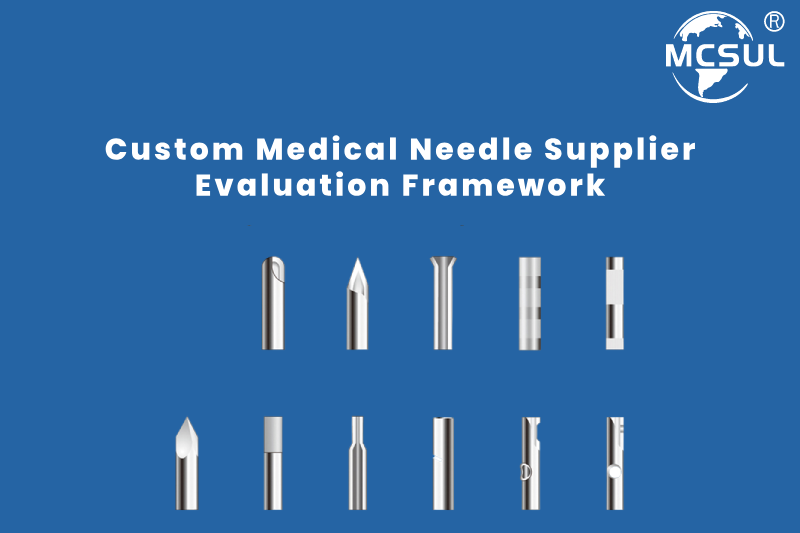
Choosing a custom needle supplier is not like buying a stock item off a shelf. A custom project means a new gauge. Or new tip geometry. Or a hub built just for your device. If the manufacturer gets one dimension wrong, the whole downstream product can fail.
This guide breaks the decision into three parts. Design. Quality. Precision. You will learn what to ask at each step. You will also find out what identified standards should support every claim a provider makes. Use this framework for any custom needle project, not just a one-time check.
This framework works whether you buy for a hospital, a device brand, or a distributor. It also works whether your supplier sits down the road or across the world. The steps stay the same. Only the paperwork and shipping details change.
What Is the Custom Medical Needle Manufacturing Process and Why Does It Matter?
The custom medical needle manufacturing process starts with a client’s own spec, not a catalog part. A buyer might need a non-standard gauge. A shorter shaft with a unique bevel angle and a coating that no stock line offers.
Following that the procedure proceeds through numerous phases. Tube drawing comes first. Point grinding comes next. Then hub molding, assembly, sterilization and packaging. Each step must match the client’s drawing. Not just an industry average.
This matters because a custom needle usually feeds into a bigger device. Think of a drug delivery pen. Or a diagnostic kit. Or a specialty surgical tool. If the needle misses spec, the whole assembly can fail final testing. A custom needle manufacturer with real OEM/ODM experience will ask detailed questions about your end use. This happens before they even quote a price.
What Happens During Each Production Stage?
Tube drawing is the process of making thin, hollow tubes from raw steel. The base gauge and wall thickness are set.
The point is sharpened to a point. Controls insertion force and patient comfort .
A hub molding attaches the plastic or metal fitting. This part must be identical to the connector on your device.
Assembly, sterilization and final packing complete the process. Quality check should be done at each stage not at the end.
What Design Requirements Should a Custom Needle Meet Under FDA QSR Rules?
Medical needle custom design requirements under FDA QSR now flow through a renamed rule. On February 2, 2026, the FDA’s old Quality System Regulation (QSR) was replaced. The new rule is called the Quality Management System Regulation (QMSR). It lives under 21 CFR Part 820. The QMSR points straight to ISO 13485:2016 for most requirements. It no longer spells everything out in FDA’s own words.
For design work, this means a supplier should run formal design controls. That covers design inputs, design outputs, verification, and validation. It also covers a design history file. These procedures ensure that the needle you requested is indeed constructed. Every single time.
A hypodermic needle sold in the U.S. also falls under a specific device rule. Most single-lumen hypodermic needles sit under 21 CFR 880.5570. This is a Class II device. Ask any custom needle supplier how their design process maps to these steps. Don’t just ask if they hold a certificate.
How Should a Supplier Document Custom Design Changes?
A trusted supplier logs every dimension change in a formal document. Not a casual email thread. This includes gauge, wall thickness, bevel angle, and hub fit.
Each change should get a version number. It should also get a sign-off and a linked test result. Without this paper trail, a “custom” design can quietly drift between production batches.
How Does a Custom Needle Tolerance Control Manufacturer Ensure Precision?
A custom needle tolerance control manufacturer holds tight, measured limits. This covers outer diameter, wall thickness, and tip geometry. Not loose visual checks. Precision is not just a marketing term. It is a number tied to a named standard.
ISO 9626:2016 sets the rules for rigid stainless steel needle tubing. It includes sizes from 3.4 mm (10 gauge) to 0.18 mm (34 gauge). Any custom gauge outside a standard catalog size should still trace back to this standard’s test methods.
ISO 7864:2016 covers the finished needle itself. It applies to sizes from 0.18 mm to 1.2 mm. This includes bond strength between hub and tube. It also covers lumen flow rate and a visual check for defects.
| Precision Parameter | What It Controls | Governing Standard |
| Outer diameter (gauge) | Consistent fit with hub and syringe nozzle. | ISO 9626:2016 |
| Wall thickness | Fluid flow rate and needle strength. | ISO 9626:2016 |
| Bevel angle and tip finish | Insertion force and patient comfort. | ISO 7864:2016 |
| Hub-to-tube bond strength | Prevents separation during use. | ISO 7864:2016 |
| Straightness and roundness | Smooth, accurate insertion. | ISO 9626:2016 |
Ask for the actual tolerance sheet for your specific gauge. Not just a general spec claim. A manufacturer with real precision control will hand this over without hesitation.
What Quality System Certifications Should You Verify Before Signing?
A qualified custom needle supplier should hold ISO 13485:2016 certification. This is the core quality management standard for medical device makers worldwide. This standard now sits at the center of the FDA’s own QMSR too. So one certificate does double duty across markets.
Beyond ISO 13485, check for a few more things:
- CE marking : Needed to sell finished needles in Europe.
- FDA registration : Confirms facility is approved for U.S. distribution.
- Cleanroom classification : Needles should be made in a controlled, monitored space.
- Batch traceability records : Every lot should link back to raw material and test data.
Ask to see current, unexpired certificates directly. Our own certificates page is a useful example. It shows the level of detail a serious supplier should give you upfront.
Looking for a custom needle manufacturer with a verified quality system?
Contact us today for a custom quote built around your specific gauge, tip, and hub design.
Get a Free Quote →Why Choose an OEM Hypodermic Needle China Manufacturer for Custom Projects?
An OEM hypodermic needle China manufacturer often gives you a strong mix of things. Price. Capacity. Design flexibility. A small domestic shop often can’t match this mix. China’s needle manufacturing hubs run large automated lines. They also keep skilled tooling teams on hand for custom work. Not just standard catalog runs.
MCSUL is one example. It is the new brand name for the company once known as KDL. The brand changed in 2026. Based in Nanchang, Jiangxi, the company runs both specimen collection and custom needle product lines. Its OEM/ODM services cover gauge, length, hub style, coating, and packaging changes.
When comparing China-based OEM partners, weigh several factors together. Not price alone.
| Evaluation Factor | Why It Matters |
| OEM/ODM design flexibility | Confirms they can build your exact spec, not a close substitute. |
| Certified quality system | ISO 13485:2016 and QMSR alignment protect your regulatory filings. |
| Tolerance and test data | Confirms precision claims with real numbers, not marketing copy. |
| Export experience | Smooths customs, labeling, and shipping for your country. |
| Sample and trial process | Lets your team confirm fit and feel before a bulk order. |
Who Are the Top Custom Medical Needle Suppliers Right Now?
Several named suppliers lead the custom medical needle supplier market today. Each one brings a different strength.
| Supplier | Key Strength | Certifications |
| MCSUL (formerly KDL) | OEM/ODM flexibility on gauge, hub, and coating for specimen collection and custom needle lines | ISO 13485:2016, CE |
| Connecticut Hypodermics | U.S.-based precision custom hypodermic needle and component builder | ISO 13485, FDA registered |
| Nipro | Full in-house R&D, sterile packaging, and inspection for large OEM orders | ISO 13485, FDA, CE |
| B. Braun | Long-standing European manufacturer with a broad needle and infusion device range | ISO 13485, CE |
| BD (Becton, Dickinson and Company) | Large global footprint and deep clinical brand recognition | ISO 13485, CE, FDA |
MCSUL focuses on two core lines: specimen collection and custom needles. It offers OEM/ODM support for gauge, length, hub style, and coating changes. Connecticut Hypodermics leans on decades of custom precision work for U.S. device brands. Nipro and B. Braun run large, vertically integrated plants. BD brings global reach and strong clinical trust.
No single supplier wins on every factor. Weigh design flexibility, certifications, and lead time together. Match the supplier to your gauge, your volume, and your target market.
What Mistakes Do Buyers Make When Evaluating Custom Needle Suppliers?
The most common mistake is simple. Buyers judge a supplier on price alone. They check design and quality evidence later, if at all. Other frequent mistakes include:
- Skipping the sample stage. A spec sheet is not proof the part performs.
- Assuming one certificate covers everything. ISO 13485, CE, and FDA registration cover different markets and rules.
- Ignoring the design history file. A supplier should show how your spec was verified. Not just built.
- Overlooking tolerance sheets. “Precision” without a number tied to ISO 9626 or ISO 7864 is just a claim.
- Forgetting export experience. A great factory with no customs know-how can stall your whole timeline.
Avoid these mistakes early. It saves time, money, and risk down the road.
Custom Needle Supplier Evaluation Checklist
Use this list for any new custom needle project. Run it again once a year for existing suppliers.
- Supplier holds current ISO 13485:2016 certification.
- Design process follows formal design controls under the FDA’s QMSR (21 CFR Part 820).
- Tolerance sheet provided for your exact gauge and tip geometry.
- Finished needle tested against ISO 7864:2016.
- Tubing tested against ISO 9626:2016.
- Device classification confirmed. Most hypodermic needles fall under 21 CFR 880.5570, Class II.
- OEM/ODM flexibility confirmed for your specific gauge, hub, or coating change.
- Sample batch tested by your own team before the bulk order.
- Export documentation and lead times confirmed in writing.
- Batch traceability records available for every lot.
Key Takeaways
- Evaluate a custom needle supplier on three parts: design, quality system, and manufacturing precision.
- The FDA’s QSR is now the QMSR under 21 CFR Part 820. It took effect February 2, 2026. It points to ISO 13485:2016 for most requirements.
- Tolerance claims should tie back to ISO 9626:2016 for tubing and ISO 7864:2016 for the finished needle.
- Most single-lumen hypodermic needles are Class II devices under 21 CFR 880.5570.
- OEM hypodermic needle China manufacturers can offer strong design flexibility. Always verify certificates and tolerance data directly.
- Never skip the sample and trial stage. Not even when the paperwork looks strong.
Final Thoughts
A custom medical needle is a small part with a big job. Getting the design, the quality system, and the manufacturing tolerance right all at once is hard. But it is what separates a reliable supplier from a risky one. Start with the standards. Confirm ISO 13485:2016 with FDA’s QMSR. Confirm ISO 9626:2016 and ISO 7864:2016. Make sure the paperwork is real and current. Then ask for a tolerance sheet and a physical sample. Do this before you commit to a bulk order. When design, quality, and precision all check out together, your custom needle project starts on solid ground.