 +86-791-8686-1216



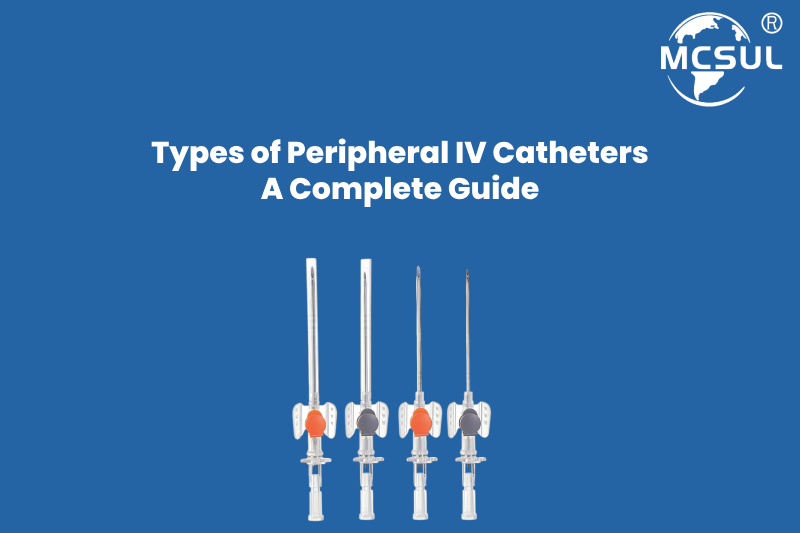
The right IV catheter is important when a patient needs fluids, medicines or blood through a vein. Peripheral IV catheters are a common medical device used in hospitals and clinics. They help you put fluids and medicines directly into a patient’s bloodstream. But do you know that there are different types of peripheral IV catheters? Each type is different in design, size and use.
Choosing the right catheter is based on the patient’s age, size of the vein, treatment needs, and how long the IV therapy will be needed. This guide will assist you to understand the different types of peripheral IV catheters if you are a nurse, doctor, medical student or a medical device buyer.
Learn about peripheral IV catheter sizes, gauges, materials, uses and safety features. You will also learn how to select the appropriate IV catheter and how to avoid common problems.
What Is a Peripheral IV Catheter?
A peripheral IV catheter is a thin, flexible tube that is inserted into a vein. It helps you to give fluids, medicines and other treatments directly into your blood.
The hand or arm is a common site for peripheral IV catheters.
The most common peripheral IV catheters have two main components:
- A small plastic tube that stays in the vein.
- A sharp needle to help you get the tube into the vein.
Once the catheter is where it needs to be, you pull the needle out. The soft plastic tube stays in the vein and allows you to give the treatment that you need.
Why Do You Need a Peripheral IV Catheter?
You may need a peripheral IV catheter for many types of medical care.
Common uses include:
- Giving fluids to patients who need hydration.
- Giving medicines directly into the bloodstream.
- Providing blood transfusions when the catheter is suitable.
- Administering fluids and medicines during surgery.
- Supporting emergency treatment.
- Using contrast agents in some medical scans.
- Providing short-term IV care.
The right peripheral IV catheter will help you deliver safe treatment and meet your patient’s needs.
Different Types of Peripheral IV Catheters
Not all IV catheters are created equal. Different peripheral IV catheter types are made for different medical needs.
Some offer short-term treatment, while others provide long-term access to a vein. Others have safety features to protect healthcare workers.
Let’s review the various types of peripheral IV catheters and their indications.
1. Short Peripheral IV Catheters
Short peripheral IV catheters are among the most common IV devices used in hospitals. You will often see them in emergency rooms, operating rooms and general hospital wards. These catheters have a short, soft plastic tube attached to a hub. A needle helps you place the tube into a suitable vein.
Key Features
- Short and flexible design.
- Available in different IV catheter gauges.
- Made for use in peripheral veins.
- Can connect to suitable IV tubes and equipment.
- Available with or without safety features.
When Should You Use a Short Peripheral IV Catheter?
You can use a short peripheral IV catheter if your patient needs fluids, medicines or other short-term IV treatments. Sizes of peripheral IV catheters vary depending on the size of the patient’s veins and the treatment requirements.
2. Extended-Dwell Peripheral IV Catheters
What if your patient requires IV access for longer than a standard short IV catheter will allow?
A peripheral IV catheter for extended dwell may be considered.
These catheters are longer than the typical short peripheral IV catheters. They are placed in peripheral veins and may stay in place for a longer period of time.
Key Features
- Longer than standard short IV catheters.
- Flexible tube design.
- Made for longer-term peripheral IV access.
- May help patients with difficult veins.
- Available in different designs and sizes.
When Should You Consider an Extended-Dwell IV Catheter?
If your patient requires long-term IV therapy or has hard-to-access veins, you might want to think about using an extended-dwell IV catheter. Before selecting, check the patient’s condition, the type of medicine and the catheter instructions.
3. Midline Catheters
Midline catheters are longer than regular peripheral IV catheters. They help to provide IV access for some longer treatments.
A midline catheter is typically placed into a vein in your upper arm. Its tip remains in a peripheral vein and does not reach a central vein.
Key Features
- Longer than standard peripheral IV catheters.
- Usually placed in an upper-arm vein.
- Available with one or more channels.
- Used for certain longer IV treatments.
- Require a check to make sure the medicine is safe for peripheral use.
When Should You Choose a Midline Catheter?
If your patient needs longer IV access and the prescribed treatment is suitable for a peripheral vein, you might want to consider a midline catheter.
Keep in mind, a midline catheter is not a short peripheral IV catheter. The length, position and purpose are different.
4. Winged Infusion Sets (Butterfly Needles)
You may know winged infusion sets by another name: butterfly needles.
These devices have a small metal needle with two flexible wings. The wings help you hold and control the needle during use.
Key Features
- Small metal needle.
- Flexible wings for better handling.
- Available in different needle sizes.
- Used for blood collection and some short infusion procedures.
When Should You Use a Butterfly Needle?
You may use a butterfly needle when collecting blood or giving certain short-term treatments.
However, there is an important difference between butterfly needles and peripheral IV catheters.
A butterfly needle does not leave a soft plastic tube inside the vein after you remove the needle. This is why it is not considered a standard indwelling peripheral IV catheter.
5. Safety Peripheral IV Catheters
Your safety is just as important as your patient’s safety.
Safety peripheral IV catheters have special features that help protect healthcare workers from accidental needle injuries.
These catheters include a safety system that covers or locks the used needle after removal.
Key Features
- Built-in needle safety system.
- Helps reduce accidental needle injuries.
- Available in different sizes.
- Designed for safer IV insertion.
- Different safety designs are available.
Why Should You Choose a Safety IV Catheter?
When you use a safety IV catheter, you can reduce the risk of accidental contact with a used needle.
These catheters are useful in hospitals, clinics, emergency rooms, and other places where healthcare workers perform IV procedures.
Peripheral IV Catheter Sizes and Gauges: What Should You Know?
Selecting the correct size peripheral IV catheter is an important aspect of IV therapy.
IV catheters come in a variety of gauges. The gauge tells you how big the catheter is.
Here is one simple rule to keep in mind:
The lower the gauge, the larger the catheter. The higher the gauge number, the smaller the catheter.
An 18G IV catheter is bigger than a 20G or 22G catheter.
Understanding IV catheter gauges helps you pick the right size for your patient’s veins and treatment needs.
Common Peripheral IV Catheter Gauge Sizes
| IV Catheter Gauge | Common Uses |
|---|---|
| 14G | Major injuries and rapid fluid delivery |
| 16G | Fast fluid delivery and some surgeries |
| 18G | Blood transfusions and surgery |
| 20G | Routine IV fluids and medicines |
| 22G | Patients with small or weak veins |
| 24G | Babies, children, and patients with very small veins |
These are common examples, not fixed rules. You should choose the right peripheral IV catheter gauge based on your patient’s needs and your hospital’s guidelines.
How Does IV Catheter Gauge Affect Flow Rate?
The size of your IV catheter can affect how quickly fluids flow into a vein.
A larger catheter usually allows fluids to flow faster than a smaller catheter under similar conditions.
However, other factors also affect the flow rate, such as:
- Catheter length.
- Inner diameter of the catheter.
- Type of fluid.
- Pressure used during infusion.
- IV tubing and equipment.
- Patient vein condition.
Choose a catheter appropriate to the procedure and one that is unlikely to cause undue harm or discomfort to the patient.
Different Materials Used in Peripheral IV Catheters
Ever wonder what goes into peripheral IV catheters?
The material is important for the catheter’s flexibility, strength and safety.
IV catheters are made by medical device manufacturers out of a variety of plastics and other materials.
The three common materials are:
1. Polyurethane (PUR)
Polyurethane is a material that is used to make medical catheters.
It is noted for its strength and flexibility.
Main Features
- Flexible material.
- Good strength.
- Used in different catheter designs.
- Suitable for many medical uses.
2. Fluorinated Ethylene Propylene (FEP)
FEP is a type of plastic used in some medical tubes and catheters.
Main Features
- Good chemical resistance.
- Smooth surface.
- Flexible design.
- Used in selected medical devices.
3. Polytetrafluoroethylene (PTFE)
PTFE is another material used in some medical devices.
It is known for its resistance to chemicals and its ability to decrease friction.
Main Features
- Strong chemical resistance.
- Low-friction surface.
- Good heat resistance.
- Used in selected medical products.
Why Should You Check the IV Catheter Material?
When choosing a peripheral IV catheter, you need to look beyond the material name.
You should also check its strength, flexibility, safety, quality and intended use.
These details will help you decide if a catheter is right for your medical needs.
Key Components of a Peripheral IV Catheter
Knowing the main parts helps you understand how the device works. These are the common parts of a typical peripheral IV catheter.
1. Catheter Tube
This is the soft plastic tubing left in the vein after the needle is removed.
2. Introducer Needle
This is the sharp needle that helps you place the catheter into the vein. You remove it after the catheter is in place.
3. Needle Hub
The needle hub holds the needle and gives you a place to grip it during insertion.
4. Catheter Hub
The catheter hub is the end that attaches to the IV tubing, extension sets or other appropriate equipment.
5. Flashback Chamber
This clear chamber helps you see blood return during insertion.
6. Injection Port
Some IV catheter designs include an injection port. It gives you another access point for suitable medicines.
7. Safety Mechanism
Safety IV catheters have a special part that helps cover or lock the used needle after insertion.
Not every peripheral IV catheter has all these parts. The design may change from one product to another.
How to Choose the Right Peripheral IV Catheter
There are many types and sizes of peripheral IV catheters, so which do you choose?
You have to consider your patient’s condition, treatment and vein size.
There are six important things to consider.
Check Your Patient’s Age and Vein Condition
The age of your patient and the condition of their veins can affect your choice of IV catheter.
For example, infants, children, and patients with small or weak veins may require a smaller gauge catheter.
You should always check the vein before choosing a catheter.
Check the Medicine or Fluid
Not every medicine or fluid can be given through a peripheral IV catheter.
Some medications can damage the vein or the tissue around the vein if they leak out of the vein.
Before choosing a catheter, check the medicine strength, pH and other safety information.
Some treatments may require central venous access instead.
Think About the Required Flow Rate
Does your patient need fluids quickly?
If so, a larger-bore peripheral IV catheter may be needed.
But you also want to make sure the patient’s vein will take the catheter you pick without damage.
Consider How Long the Patient Needs IV Treatment
The expected treatment time can help you choose the right peripheral IV catheter.
For short-term treatment, a standard short peripheral IV catheter may be suitable.
For longer treatments, you may want an extended-dwell or midline catheter.
Look for Safety Features
When evaluating IV catheter designs, see if they have a needle safety system.
Safety IV catheters can protect you and other healthcare workers from accidental needlesticks.
Think About Your Healthcare Setting
Your IV access needs may change depending on where you work.
For example, an emergency room may have different needs from a general hospital ward or an operating room.
Always consider the needs of the patient, the equipment available, and the hospital guidelines when choosing a peripheral IV catheter.
Common Uses of Peripheral IV Catheters
Peripheral IV catheters are widely used in healthcare.
They can be used for a variety of treatments depending on the catheter and the patient’s condition.
Giving Fluids and Electrolytes
If patients require hydration or fluid replacement, fluids may be delivered via peripheral IV catheters.
Giving Medicines
Peripheral IV catheters are used to administer drugs directly into the bloodstream if the drugs are safe to be administered peripherally.
Blood Transfusions
Blood and blood products can be given via an appropriate peripheral IV catheter.
The size of the catheter should be appropriate to the condition of the patient and the requirements of the transfusion.
Emergency Treatment
In an emergency, quick access to a vein may be key.
When needed, healthcare workers administer fluids and medications with peripheral IV catheters.
Care During Surgery
Peripheral IV catheters can be used to administer fluids and appropriate drugs during surgery.
Medical Scans
Some medical scans require contrast agents to provide doctors with a clearer picture of parts of the body.
These agents can be administered as needed through an appropriate peripheral IV catheter.
Conclusion
Knowing the different types of peripheral IV catheters can help you select the right device for your patient’s needs.
The catheter size, material, design, and intended use should be considered when choosing a short peripheral IV catheter, an extended-dwell catheter, or a safety IV catheter.
You should also understand the influence of peripheral IV catheter gauge on fluid flow, and of catheter material on device performance.
Most importantly, use proper insertion and care practices to minimize the risk of IV catheter complications.
With the right knowledge and careful selection, you can help make IV treatment safer and improve patient care.
Looking for Reliable IV Access Devices?
Explore MCSUL’s butterfly-type peripheral IV catheter, browse our IV infusion range, or discuss OEM/ODM support with our team.