 +86-791-8686-1216


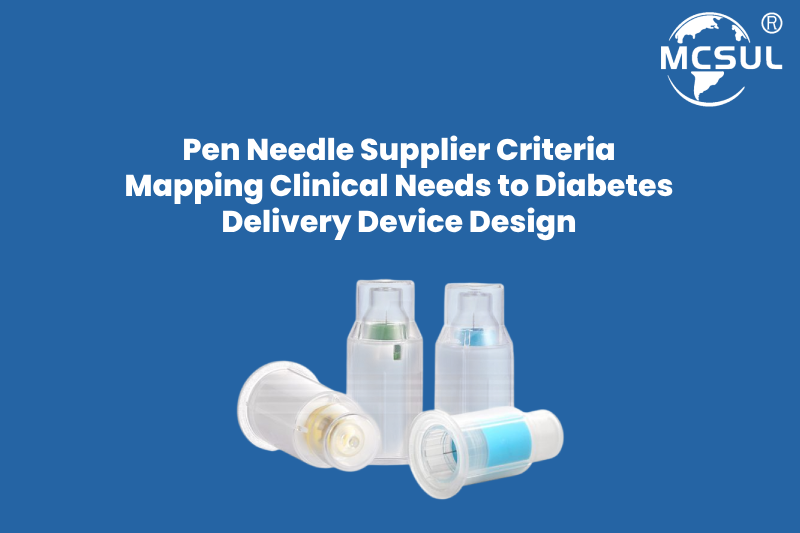
Choosing a pen needle supplier is rarely just a procurement decision. Every specification, from gauge and wall thickness to tip geometry, lubrication, and hub fit, has a direct line back to a patient’s injection experience. Get the sourcing wrong, and the consequences show up as dosing errors, patient discomfort, complaints, or costly rework. Get it right, and the device becomes invisible to the person using it, which is exactly the goal. This guide breaks down the pen needle supplier criteria that actually matter, and how each clinical requirement maps to a specific design or manufacturing decision, whether you’re sourcing standard insulin pen needles or building out a full private-label diabetes care line.
Why Supplier Selection Criteria Matter More Than the Spec Sheet Suggests
A spec sheet can tell you the gauge and length of a needle. It won’t tell you whether the manufacturer can hold that tolerance across a million-unit run, whether their silicone coating process is validated, or whether their quality system will survive an FDA or MDR audit. Procurement teams that stop at the spec sheet often discover the real differentiators only after a batch is already in the field. If you want a deeper walkthrough of the evaluation process itself, our custom medical needle supplier evaluation guide covers it step by step.
The criteria below are grouped the way a clinical and quality team would actually evaluate a supplier: design fit, manufacturing consistency, regulatory standing, and commercial flexibility. Together, they form a practical set of pen needle supplier criteria you can apply to any manufacturer under consideration.
1. Needle Design Specifications: Core Pen Needle Supplier Criteria
Gauge and Length: A Core Pen Needle Supplier Criterion
Thinner gauges (32G–34G) and shorter lengths (4mm–5mm) have become the clinical standard for most adult and pediatric insulin patients, driven by evidence that they reduce injection pain without compromising dosing in the majority of body types. A supplier should be able to explain, not just quote, why their gauge and length range covers the clinical population you’re serving. Our ultra-fine pen needles breakdown is a useful reference if you’re comparing gauge options across a product line.
Thin-Wall Needle Technology
Thin-wall construction increases the internal lumen without increasing the outer diameter, which lowers injection force and speeds up delivery, especially relevant for viscous formulations like some GLP-1 and biologic therapies. If your device portfolio includes higher-viscosity drugs, ask suppliers directly whether their needle wall technology has been validated against those formulations.
Tip Geometry and Lubrication
A five-bevel tip design and consistent silicone lubrication are what separate a “smooth” injection from a painful one. This is also one of the harder things to verify from a spec sheet, so ask for penetration force testing data, not just marketing claims.
Hub Design and Pen Compatibility: A Supplier Selection Criterion
Hub fit determines whether the needle seats correctly across the range of pen injectors your patients actually use. This is also where OEM insulin pen needle design custom hub color options come into play: many distributors request color-coded hubs by gauge to reduce dosing errors and support brand differentiation on packaging. A supplier with narrow or proprietary hub tolerances can quietly limit which pens your device works with, which becomes a real problem if you’re supplying multiple markets or private-label programs. Our safety insulin pen needles and standard insulin pen needle lines are built to broad pen compatibility standards for exactly this reason.
2. Manufacturing Quality: A Pen Needle Supplier Evaluation Criterion
Manufacturing quality is where pen needle supplier criteria stop being theoretical and start showing up in real defect rates. Clinical performance is only as good as lot-to-lot consistency. Key questions to ask any supplier:
- Is manufacturing certified to ISO 13485, and is that certification current and scoped to pen needles specifically (not just general medical devices)?
- What is the sterility assurance level (SAL), and how is it validated per batch?
- What in-process controls exist for needle sharpness, coating thickness, and hub bonding?
- Can they provide full lot traceability from raw material to finished, packaged unit?
Manufacturers like MCSUL that operate under ISO 13485-certified systems typically build these checks into every production stage rather than relying solely on final inspection. That structural difference is often what separates a supplier who can scale reliably from one who can’t. If you’re comparing multiple OEM pen needle manufacturer China ISO options, certification scope is one of the fastest ways to shortlist candidates.
3. Regulatory and Compliance Standing: Non-Negotiable Pen Needle Supplier Criteria
Depending on your target markets, a supplier needs current registrations across the relevant frameworks: FDA 510(k) or listing, EU MDR technical documentation, and any country-specific registrations (China NMPA, and others). This is also where insulin pen needle custom labeling FDA compliance becomes relevant for private-label buyers. Labeling language, symbols, and lot-coding requirements vary by market, and a supplier’s regulatory team should be able to walk you through what changes and what doesn’t. Ask for:
- Current regulatory certificates, not just a claim of compliance
- Documented change-control history (has the device changed since approval, and was it re-validated?)
- Willingness to support your own regulatory submissions with technical files
A supplier that hesitates to share this documentation upfront is signaling how an audit conversation will go later. Our insulin pen needle procurement evaluation guide has a more detailed checklist for this stage.
Not sure how your current supplier stacks up against these criteria?
Get a side-by-side spec comparison and sample units sent to your team, free of charge.
Request Free Pen Needle Samples →4. Packaging and Safety: An Overlooked Pen Needle Supplier Requirement
Packaging and safety mechanisms round out the pen needle supplier criteria list, and they’re often the last thing buyers check before it’s too late to change course. It’s part of the sterile barrier and part of the safety profile. Evaluate:
- Peel-strength and seal-integrity testing data
- Whether passive or active sharps-safety mechanisms are available, and how they’ve been validated for accidental needle-stick prevention
- Carton and unit labeling that meets your target market’s language and regulatory requirements
An insulin pen needle OEM sterile packaging solution should also account for shipping and shelf conditions across the markets you’re distributing into, not just the manufacturing site. For a safety-mechanism-first option, our safety insulin pen needles line pairs sharps protection with validated sterile packaging out of the box, and pairs well with our insulin syringe range for buyers sourcing a full diabetes care assortment.
5. Capacity and Customization: The Commercial Pen Needle Supplier Criteria
For distributors and private-label buyers, capacity and flexibility often matter as much as the needle itself:
- Can the supplier support private label / OEM packaging without long minimum order thresholds?
- What’s their actual production capacity versus stated capacity? Ask for evidence, not assurances
- Do they offer customization on gauge/length assortments, hub color, or only fixed catalog SKUs?
This is an area where manufacturers with in-house tooling and mold design, such as KDL, tend to offer more flexibility than suppliers who are reselling a third party’s fixed product line, since customization requests don’t require renegotiating with an upstream factory. If you’re building a broader diabetes portfolio, it’s worth reviewing our full diabetes care product range alongside pen needles.
Putting It Together: A Practical Evaluation Framework
When comparing suppliers side by side, it helps to score each one against the same pen needle supplier criteria rather than relying on impressions from a sales call:
| Criteria | What to Ask For |
|---|---|
| Clinical fit | Gauge/length range, thin-wall data, penetration force testing |
| Manufacturing quality | ISO 13485 scope, SAL validation, lot traceability |
| Regulatory standing | Current certificates, change-control records, labeling compliance |
| Safety | Sharps-safety validation, packaging seal data |
| Commercial fit | MOQs, private-label capability, hub customization options |
No single supplier will lead on every dimension. The goal is matching the criteria that matter most for your patient population and market against what each candidate can actually document, not just claim.
Key Takeaways
- Design first, price second. Gauge, wall thickness, tip geometry, and hub fit all trace back to patient comfort and dosing accuracy, so evaluate these before comparing cost per unit.
- ISO 13485 and SAL validation aren’t optional. Ask for current, scoped certificates and batch-level sterility data, not verbal assurances.
- Regulatory documentation should be available on request. A supplier that hesitates to share certificates or change-control history is a warning sign, not a formality.
- Packaging is part of the safety profile. Seal integrity and sharps-safety validation matter as much as the needle itself.
- Flexibility separates manufacturers from resellers. In-house tooling enables hub color customization, private labeling, and lower MOQs, something pure resellers usually can’t offer.
- Use the same pen needle supplier criteria across every candidate so comparisons are based on evidence, not sales-call impressions.
Final Thought
Applying clear pen needle supplier criteria is ultimately a clinical decision wearing a procurement hat. The manufacturers worth shortlisting can walk you through why their design choices exist. They don’t just hand you a catalog. If you’re evaluating suppliers for a private-label program or a new market registration, request documentation first. Ask for technical files and sample units before any commercial conversation. Start with our insulin pen needles or safety insulin pen needles product pages. You can also get in touch directly to request samples.