 +86-791-8686-1216


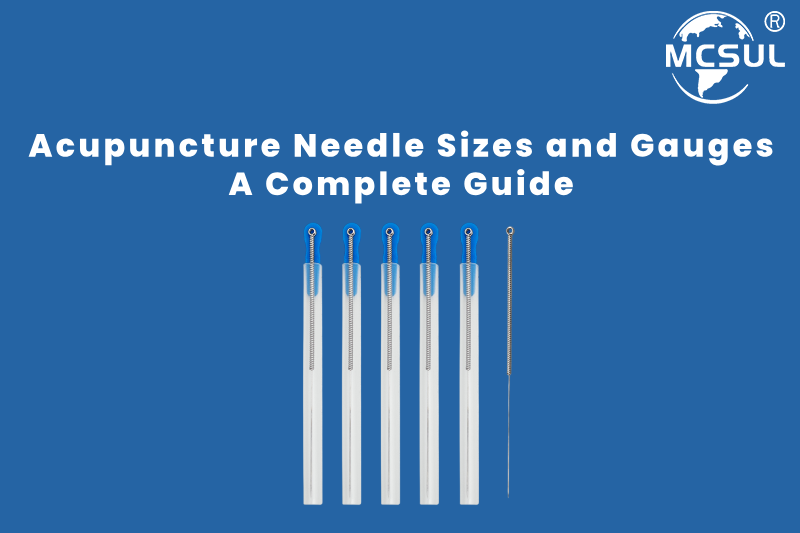
The first thing someone usually thinks about when they walk into an acupuncture clinic is, of course, the needles. How large are they? Will they sting? One acupuncture needle size is different from another needle . How? Those are valid questions, and the answers are more important than most people realize.
Acupuncture needle size is no small detail. It affects the treatment’s sensation, needle depth, and session effectiveness. Whether you’re a patient who is curious about your treatment or a healthcare buyer interested in buying acupuncture needles in bulk, the first thing you need to know is the various needle sizes and gauges.
This guide explains everything from gauge numbers to needle lengths in plain, simple language.
What Makes an Acupuncture Needle Different from Other Needles?
Before diving into acupuncture needle size, it helps to know what sets needles apart.
Acupuncture needles are solid, rather than a hypodermic needle that is used for injections. There is nothing liquid in them. Their job is to stimulate specific points on the body, called acupoints, to promote healing, relieve pain, and restore balance.
Acupuncture needles are solid and very fine. When used properly, they cause very little discomfort. Most patients feel a mild pressure or tingling sensation, not a sharp pain like a regular injection.
The two things that define any acupuncture needle are the following:
- Gauge — how thick or thin the needle is
- Length — how deep the needle can reach
Both of these change depending on where on the body the needle is being placed and what the treatment is trying to achieve.
Understanding Gauge in Acupuncture Needles
Gauge refers to the thickness of the needle. The higher the gauge number, the thinner the needle. This works the opposite of how most people expect.
For example:
- A 32-gauge needle is thinner than a 26-gauge needle.
- Thinner needles are less noticeable.
- Thicker needles can be used for deeper or more stimulating treatments.
Here’s a quick breakdown of common acupuncture needle gauges:
| Gauge | Diameter (mm) | Common Use |
| 36G | 0.20 mm | Sensitive areas, face, children |
| 34G | 0.22 mm | Delicate acupoints, shallow treatment |
| 32G | 0.25 mm | General use, most common |
| 30G | 0.30 mm | Standard adult treatment |
| 28G | 0.35 mm | Deeper tissue, stronger stimulation |
| 26G | 0.45 mm | Heavy muscle areas, sports therapy |
Most acupuncturists use 32G or 30G needles for their day to day treatments. These needles are a happy medium between comfort and power.
For the face, ears or very sensitive patients such as children or older individuals, thinner gauges like 34G or 36G are best.
Thick gauges such as 26G or 28G are better for deep muscle areas such as the back, hips or thighs.
Acupuncture Needle Lengths: What You Need to Know
Just like gauge, needle length plays a big role in treatment. Length is measured in millimeters (mm) or cun (a traditional Chinese unit).
Common lengths used in practice include:
- 13 mm (0.5 cun) — For very shallow points, ears, face, scalp
- 25 mm (1 cun) — Most popular length; used for most body points
- 40 mm (1.5 cun) — For deeper points on limbs and back
- 50 mm (2 cun) — Thick muscle areas like glutes and thighs
- 75 mm (3 cun) — Rarely used; deep tissue work only
The rule is simple: the thicker and meatier the area, the longer the needle needed to reach the right depth. For example, the face needs a 13 mm needle, while the lower back may need a 50 mm or longer needle.
The Most Common Acupuncture Needle Sizes by Body Area
One of the best ways to learn how to choose acupuncture needle sizes is to think in terms of location on the body. Different parts of the body need a different combination of gauge and length.
Face and Head
- Gauge: 34G–36G
- Length: 13–25 mm
- Why: The skin here is thin, and there isn’t much tissue underneath. Smaller the needle, less the bruising and pain.
Neck and Shoulders
- Gauge: 32G–34G
- Length: 25–40 mm
- Why: Medium depth is needed, but precision still matters near sensitive structures like veins and nerves.
Arms and Hands
- Gauge: 32G–34G
- Length: 13–25 mm
- Why: Acupoints on the hands are shallow. Short, thin needles work best here.
Chest and Abdomen
- Gauge: 32G
- Length: 25–40 mm
- Why: Medium gauge and length mean it can be inserted safely without hitting organs.
Lower Back and Hips
- Gauge: 28G–30G
- Length: 40–75 mm
- Why: Deep muscle layers require longer needles. A thicker gauge gives more stimulation to the tissue.
Legs and Feet
- Gauge: 30G–32G
- Length: 25–50 mm
- Why: There are shallow and deep points on the legs, so it depends on the exact point.
Handle Types: What Else Matters When Choosing Acupuncture Needles
The gauge, length, and design of the handle all affect the performance of an acupuncture needle. There are two basic types of handles on most acupuncture needles:
Handle of stainless steel This handle is the most usual type. It provides a firm, non-slip grip and is compatible with most needle insertion techniques. The stainless steel handle acupuncture needle is the standard in clinics around the world because it is durable and easy to sterilise.
Wire Handle Coil This type has its coiled wire around the handle, giving more flexibility in insertion. Some practitioners prefer this design for techniques involving rotation and manipulation of the needle.
The handle doesn’t affect the needle’s depth; that’s based on length, but it does change how the practitioner holds and controls it.
Disposable vs. Reusable Acupuncture Needles
Disposable acupuncture needles are the standard in modern clinical practice. This is critical for safety and regulatory compliance.
Each needle is sterile-packaged, used once, and then safely discarded. This removes the risk of cross-contamination between patients, a major concern in any environment where needles are used.
There are still some traditional settings that use reusable needles, but they must be rigorously sterilized and are less common today. Most regulatory agencies around the world today recommend or require single-use needles.
When sourcing acupuncture needles for a clinic or healthcare facility always look for:
- CE or ISO certification
- Individual sterile packaging
- Clear labeling of gauge and length
- Medical-grade stainless steel
You can also check out KDL’s range of special needles for various clinical applications including special use cases in acupuncture.
How to Choose the Right Acupuncture Needle Size
Selecting the appropriate acupuncture needle size depends on three factors: the patient’s body type, the treatment area, and the required depth of stimulation.
Here’s a simple guide:
| Patient Type | Recommended Gauge | Recommended Length |
| Child or older | 34G–36G | 13–25 mm |
| Average adult (sensitive) | 32G–34G | 25–40 mm |
| Average adult (general use) | 30G–32G | 25–40 mm |
| Athletic build, deep tissue | 26G–28G | 40–75 mm |
| Face or scalp treatment | 34G–36G | 13–25 mm |
Tip: If you are unsure, use a thinner gauge and shorter length. You can always adjust for the next session according to the patient’s response.
For practitioners treating a wide variety of patients, it is a good idea to keep multiple sizes on hand. A minimum of three different gauges and three different lengths should be kept to cover most treatment scenarios.
Tips for Safe and Effective Acupuncture Needle Use
Proper needle handling is important for both practitioners and facility managers who buy supplies.
Always check the packaging before use. Ensure that the needle is labeled with the appropriate gauge and length and that the foil seal is intact. The needle is no longer sterile due to the damaged packaging.
Use the right gauge for the area. Thick needles are more painful to the patient in sensitive areas. If the needle is too fine for deep muscles, the effect of the treatment can be reduced.
Insert at the correct angle. The majority of the acupuncture points are needled perpendicularly. An oblique angle is necessary for certain locations on the scalp or face. “When selecting needle length, consider the angle of insertion.”
Never reuse a single-use needle. A used needle may be bent or dulled at the end. Even a small bend can make it less comfortable to enter and less accurate.
Dispose of needles properly. Used needles should always go into an approved sharps container. That is standard operating procedure for all needle-based medical procedures, including those with hypodermic needles and safety needles.
Common Mistakes When Selecting Acupuncture Needle Sizes
Even experienced practitioners can err at times. Here are the mistakes to stay away from:
- Using the same gauge for all patients – Body size, tissue density and sensitivity are very different. One size doesn’t fit all.
- Selecting a length based on habit, not anatomy – Always check the needle length again based on the area being treated.
- Disregard of handle type – Working with delicate tools can be less accurate if the handles are slippery.
- Purchasing needles without sterility certification – Being sterile puts patients at risk and may be against the law in your area.
- Not adjusting acupuncture needle size to treatment type – You might use a different gauge for pain control than for relaxation, even on the same patient.
Why Needle Quality Matters as Much as Size
Size matters, but quality is important too. A badly produced needle can cause unnecessary pain, break during insertion or lose its sterility even if the right acupuncture needle size.
High-quality acupuncture needles are made of surgical-grade stainless steel, coated for smooth insertion, and individually packaged in sterile conditions. KDL’s acupuncture needles are of international quality standards and provide reliable performance in a range of gauge and length options.
For clinics that buy needles at volume, it’s worth partnering with manufacturers that provide consistent quality control, not just competitive pricing. The needle is the point of direct contact with the patient and should never be the point at which standards are allowed to slip.
Key Takeaways
- Gauge describes needle thickness; higher gauge = thinner needle.
- Common acupuncture gauges range from 26G to 36G.
- The length determines how deep the needle goes.
- Common lengths range from 13 mm to 75 mm.
- Thin gauges (34G–36G) work best for the face, scalp, and sensitive patients.
- Thicker gauges (26G–28G) are for deep muscle work.
- Short needles (13–25 mm) are sufficient for superficial points.
- Needles of longer length (40-75 mm) are needed for deeper tissue areas.
- Always use sterile, single-use, certified acupuncture needles.
- The handle type, stainless steel vs. coil wire, affects grip and technique, not depth.
- Choose a needle suitable for the body type and area of treatment for best results.
Final Thoughts
The size and gauge of acupuncture needles may seem like a technical issue, but once you understand the basics, the correct choice is obvious. A thin, short needle for sensitive areas. A longer, thicker needle for going into deep tissue. Always sterile. Always single use.
For clinicians, having these details helps offer better treatment. It explains why different needles can be used for different sessions depending on what is being treated for the patients. And for healthcare buyers it shows exactly what to look for when sourcing quality acupuncture supplies.
It’s not a small detail; finding the right needle is the beginning of every successful acupuncture treatment.