 +86-791-8686-1216


Buying medical devices means paying attention to the smallest details. If you source port access needles, that is especially true. A small difference in gauge, length, or design can affect how the product performs in daily clinical use. So where do you start?
This guide explains port access needle procurement in clear, simple language. You will learn what to check, what to ask, and how to compare a port access needles manufacturer or supplier with confidence.
What Are Port Access Needles?
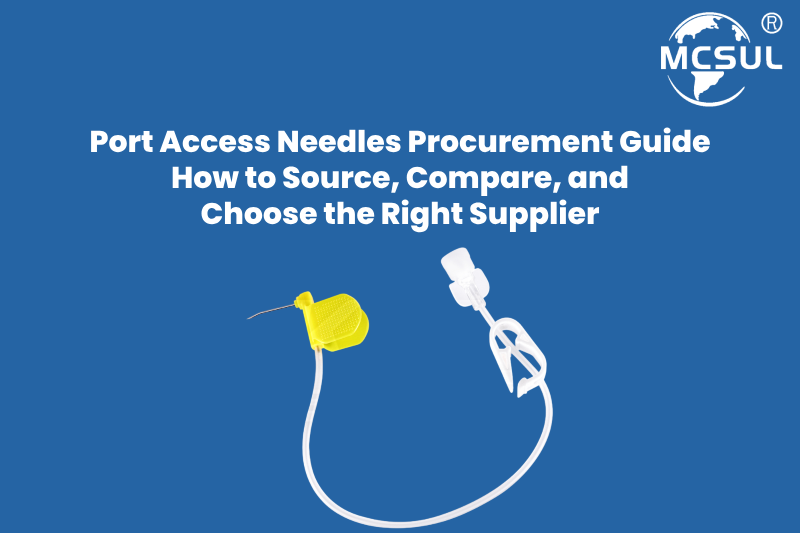
Port access needles are specialized needles. Clinicians use them to reach an implanted vascular access port. The needle passes through the skin and the port’s silicone septum. It then allows fluids or medication to be delivered, or blood to be drawn.
Most designs use a non-coring, or Huber, point. This tip is angled so that it does not cut a core out of the septum. As a result, the septum can be punctured many times.
Why does product choice matter? Buyers need consistent quality and the right specs for these needles that are used with implanted ports. Be careful about where you source your medical devices it’s good for your brand and your patients.
Key Components and Design Features
Most port access needles share a few basic parts. Here is a quick overview:
- Needle: The non-coring, Huber-point needle that enters the port.
- Wings: Small plastic wings that help the user hold and secure the needle.
- Extension tubing: A flexible tube that connects the needle to a syringe or infusion set.
- Clamp: A clamp that closes the tubing to control flow.
- Connector: A connector, often a Luer lock, that attaches to other devices. Some sets use a needle-free connector for safer access.
Designs also vary. For example, needles come as straight or 90-degree bent types. Some also include a safety mechanism. In addition, gauge and length can change from one model to another. For a closer look at one common configuration, read our guide to the 20G Huber needle with connector.
Common Applications of Port Access Needles
Port access needles are used in several settings. Common examples include:
- Chemotherapy and other long-term infusion therapy
- Blood sampling from an implanted port
- Delivery of nutrition or fluids
- Contrast media injection, where the port and needle allow it
Note: Clinical use always depends on the product’s intended use and the local guidelines. Buyers should confirm these details with their clinical and regulatory teams.
What Should You Consider When Procuring Port Access Needles?
This is the most important part of the process. Procurement is not only about unit price, good port access is required. Instead, it looks at specifications, quality, documentation and total cost together. Let’s look at each area in turn.
Product Specifications and Requirements
First, know what you need. Sharp specs for port access needles – no expensive mistakes down the road. Consider the following:
- Needle Specifications: Gage, Length, Point Type. Designs must also be given as bent or straight.
- Dimensions: Tubing and wings size and entire device size.
- Configuration: With or without extension tubing, clamps, Y-site or safety devices.
- Materials: Needle material, tubing material and any material requirements for your market.
- Packaging requirements: Single-unit packaging, sterile barrier type, and outer carton details.
- Customization needs: Branding, labeling, color, or design changes.
Pro tip: Write your requirements in one clear document. Then share the same document with every supplier. This makes the comparison fair and simple. If you need help choosing between designs, our guide on selecting a disposable safety Huber needle explains gauge, length, and safety features. You can also read how injection site design affects access configuration in infusion sets.
Product Quality and Consistency
Quality is not only about one good sample. It is about receiving the same result in every batch. Therefore, ask how the manufacturer keeps its output consistent.
Look at these areas:
- Manufacturing consistency: Are processes controlled and repeatable?
- Quality-control processes: How are raw materials and finished goods checked?
- Inspection procedures: Are incoming, in-process, and final inspections carried out?
- Applicable quality requirements: Does the manufacturer follow a recognized quality standard?
Also ask how problems are handled. For example, find out how batches are traced and how complaints are managed. A reliable port access needles supplier will answer these questions openly. For a similar checklist focused on oncology use, see our chemotherapy Huber needle procurement guide.
Regulatory and Quality Documentation
Documentation is a key part of medical device sourcing. Requirements differ by country and by intended use. For this reason, buyers should verify what applies to their own target market.
Common documents may include:
- A quality management system certificate, such as ISO 13485
- Product registration or clearance documents for your target market
- Test reports and product specifications
- Sterilization and packaging documentation
- Labeling and instructions for use
You can review our certificates and compliance information to see what documentation we can provide.
Important: Regulatory requirements change from market to market. Please confirm the exact requirements with your regulatory advisor before you buy.
MOQ, Pricing, and Total Procurement Cost
Many buyers focus only on the unit price. However, the lowest price does not always mean the lowest cost. Look at the bigger picture:
- MOQ: Minimum order quantity for standard and custom products.
- Volume pricing: How the cost changes with your size of order.
- Packaging: Custom packs, labels and cartons charges.
- Tooling & customization costs: Initial costs for new molds/designs.
- Shipping: Freight, insurance and duties of importation.
- Lead time: Time needed for samples and mass production.
- Continuing order costs: How prices vary for reorders.
Because these costs add up, ask for a clear and itemized quote. As a result, you can compare suppliers on the same basis.
Why Work With a Port Access Needles Manufacturer?
When you are looking for Port Access Needles, apart from unit price, you should also consider manufacturer’s quality of products, manufacturing capabilities, customization capabilities, OEM/ODM capabilities, documentation, production capacity, MOQ, lead times, etc.
Direct contact with a manufacturer can also facilitate the communication of technical requirements, management of product customization, packaging and labeling, and planning of recurring orders. If you are new to this process, our sourcing solutions page explains how we support buyers.
How to Evaluate a Port Access Needles Manufacturer or Supplier
Choosing a partner is as important as choosing the product. The right port access needles manufacturer will support you for years. The following five areas will guide your port access needle supplier selection.
Manufacturing Capability
First, find out what the supplier can actually produce. Does the company make the product in-house, or does it outsource key steps? In-house capability often means better control over quality and timing. In addition, ask about the equipment and the cleanroom conditions used in production.
Quality Management System
Next, take a look at the supplier’s quality processes. Good quality management systems should include documentation, training, inspection and corrective actions. An audit, on-site or remote, can also be requested. Finally, check how changes to materials or processes are communicated to you.
Production Capacity and Lead Time
Can the supplier support both your first order and your future orders? Capacity matters when your demand grows. Therefore, ask about monthly output and typical lead times. It is also wise to ask how the supplier handles urgent or seasonal demand.
Experience With Medical Device Customers
Experience reduces risk. Ask whether the supplier has worked with similar products, markets, and customer requirements. For example, a supplier already servicing regulated markets will already have a better understanding of documentation needs. Provide examples or references where possible.
Communication and Technical Support
Clear communication saves time. This is especially true for OEM and ODM projects. When drawings and specifications change, you need fast and accurate answers. So notice how the supplier responds during the quotation stage. That response time often predicts the level of support you will receive later. You can also visit our technical support page for product questions.
Why Consider MCSUL for Port Access Needles Procurement?
MCSUL is a medical-device manufacturer with expertise in medical puncture needles and syringes, and custom medical-device solutions and OEM/ODM manufacturing capacity. The company provides support for product development, production, quality processes, documentation and global supply requirements.
Have Specific Port Access Needle Requirements?
Share your product specifications, quantity, packaging, and customization requirements with our team to discuss the right manufacturing solution for your project.
Discuss Your Requirements →Port Access Needles OEM and ODM Procurement
Many buyers choose custom manufacturing. Two common models are OEM and ODM. Understanding the difference helps you plan your port access needles sourcing strategy. You can learn more on our OEM/ODM services page.
When Should You Consider OEM Port Access Needles?
OEM manufacturing means the manufacturer makes the product according to your design and specifications. You then sell it under your own brand. This model suits you when you already have a defined design, drawings, and requirements.
Port access needles OEM projects are also useful when you want to control branding, packaging, and labeling. Consequently, OEM is a popular choice for distributors and medical device brands.
When Is ODM a Better Option?
ODM means the manufacturer provides an existing or supplier-developed design. You can then adjust it to your needs. This option works well when you want to launch faster or lack a full design. For example, you can start from an existing butterfly-type safety Huber needle and adapt the wings, tubing, or packaging.
ODM port access needles is also helpful if you need technical support during the development. Here, the engineering team of the supplier is a valuable partner. Generally ODM can reduce the development time and effort.
What to Discuss With an OEM/ODM Manufacturer
Before the project starts, prepare a clear list of topics. Discuss the following points early:
- Product specifications and drawings
- Materials
- Packaging and labeling
- Customization details
- Sampling process
- Testing and validation requirements
- Production quantities
- Delivery requirements
Good preparation prevents delays. Moreover, it helps both sides understand the project from day one.
Questions to Ask Before Choosing a Port Access Needles Supplier
A checklist makes your decision easier. Use the questions below when you talk to each supplier. They also work well for custom port access needles projects.
Product and Specification Questions
- Which gauges, lengths, and configurations are available?
- Can the product be adjusted to my specifications?
- What materials are used in the needle, tubing, and wings?
Quality and Documentation Questions
- Which quality management system does the factory follow?
- What inspections are done before shipment?
- Which documents can you provide for my target market?
Manufacturing and Capacity Questions
- Do you manufacture the product in-house?
- What is your monthly production capacity?
- Can you support repeat orders without delays?
Pricing, MOQ, and Lead-Time Questions
- What is the MOQ for standard and custom products?
- How does pricing change with volume?
- What are the lead times for samples and mass production?
OEM/ODM and Customization Questions
- Do you offer OEM and ODM services?
- Are there tooling or setup costs for custom designs?
- How do you manage design changes and approvals?
How to Request a Quote for Port Access Needles
The more specific the question, the more specific the answer. When you send an RFQ, give the supplier enough information to get a proper reply. This will allow for faster and more suitable quotes.
Product Specifications
Share your gauge, length, needle type, tubing details, and materials. Include sketch of a simple example with clear specifications also prevent misunderstandings later.
Required Quantity and MOQ
Please advise your expected initial order and your annual requirements. This allows the supplier to offer suitable volume pricing. It shows if your quantity is MOQ or not too.
Packaging and Labeling Requirements
Describe the packaging and labeling of the product. Include the language, branding and any labeling requirements specific to the market. Need custom packaging sooner? Let us know.
Delivery Location and Timeline
Tell the supplier where you want the goods delivered and when you want them. Final price as per shipping terms. My Incoterm of choice is CIF Shanghai.
OEM/ODM Requirements
Finally, specify if you need OEM, ODM or normal products. Describe any design changes or testing requirements. What documents do you need for your market.
Key Takeaways
- Define your port access needle specifications clearly before you contact suppliers.
- Look beyond the unit price, and compare MOQ, packaging, shipping, and lead time.
- Verify the documentation that applies to your target market.
- Evaluate each supplier’s manufacturing capability, quality system, and capacity.
- Use OEM or ODM when you need branding, customization, or design support.
- Use a checklist and a detailed RFQ to compare quotes fairly.
Final Thoughts
Sourcing medical devices involves consistency, accuracy, and trust, and it starts with asking the right questions. Once you know what you are looking for, port access needles procurement is a much simpler and stress-free process.
The good port access needles supplier ships more than a product. It meets your specs, maintains quality from one batch to the next and is transparent every step of the way. With standard products or custom port access needles through OEM or ODM, thoughtful planning protects your patients, your brand and your budget.
So take your time, compare suppliers with the same checklist and check the documentation for your target market. Got questions about specs or your next project? Our team is ready to help. If you spend a few more minutes preparing now, you could have a smoother, more reliable supply chain later.