 +86-791-8686-1216


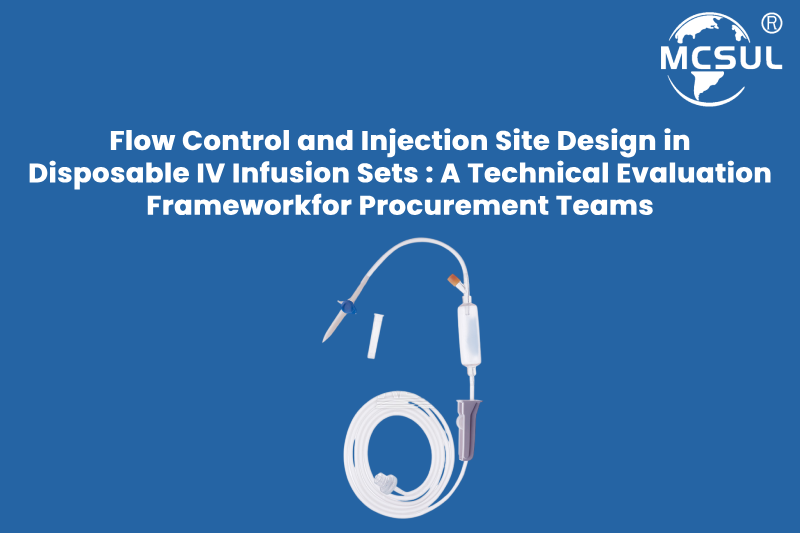
For hospitals, medical-device distributors, healthcare providers, and OEM buyers, selecting a disposable IV infusion sets involves more than comparing unit prices. Flow-control performance, injection-site design, tubing configuration, connectors, sterilization, packaging, and supplier documentation can all influence whether a product meets the intended specification.
A practical procurement process should therefore evaluate the infusion set as a complete fluid-delivery system rather than focusing on a single component.
This guide explains the major design and procurement considerations for disposable IV infusion sets, with particular attention to flow control and injection-site configuration.
Why Flow Control and Injection Site Design Matter in Disposable IV Infusion Sets
Flow Rate Is More Than a Roller Clamp Specification
In gravity infusion, several factors can influence delivered flow, including tubing dimensions, drop factor, fluid characteristics, hydrostatic head, downstream resistance and the design of the flow-control component.
For this reason, procurement teams should avoid evaluating a roller clamp or flow regulator in isolation. Instead they should consider the complete assembled set under defined test conditions.
Specifications should clearly identify the required flow-control mechanism, applicable flow range, drop factor, tubing characteristics, and relevant performance tolerances.
Injection Sites Affect Usability
An injection site provides an access point for medication administration within the infusion pathway. So the technical specification should therefore include its location, connection design, sealing characteristics, and material compatibility.
Rather than simply requesting an “injection port,” buyers should define the required access configuration and compatibility with the intended administration process.
Why Component-Level Specifications Are Not Enough
An infusion set contains multiple interconnected components. A change in tubing, connector, injection site, filter or flow-control component can affect the overall configuration.
Procurement teams should consequently evaluate samples as complete assemblies and establish acceptance criteria before approving production.
Anatomy of a Disposable IV Infusion Set
A typical disposable IV infusion set can include several components working together:
Spike and Protective Cap
The spike provides the connection between the infusion set and the fluid container. Protective components help maintain the condition of the connection point before use.
Drip Chamber
The drip chamber allows visual observation of fluid movement and drop formation. Buyers should also specify drop factor because it is relevant to gravity-infusion calculations.
Tubing
Tubing forms the primary fluid pathway. Buyers should specify appropriate material, length, dimensions, flexibility, and compatibility with the intended fluids and application.
Flow-Control Components
A set may use a roller clamp, flow regulator, or another flow-control configuration. The appropriate choice depends on the intended application and required performance specification.
Injection Site and Connector
The injection site provides access to the fluid pathway where applicable, while the distal connector provides the connection to the downstream device or access point. In addition, optional components can include in-line medication filters, three-way connectors, and different needle configurations.
Flow Control Design: What Procurement Teams Should Evaluate in Disposable IV Infusion Sets
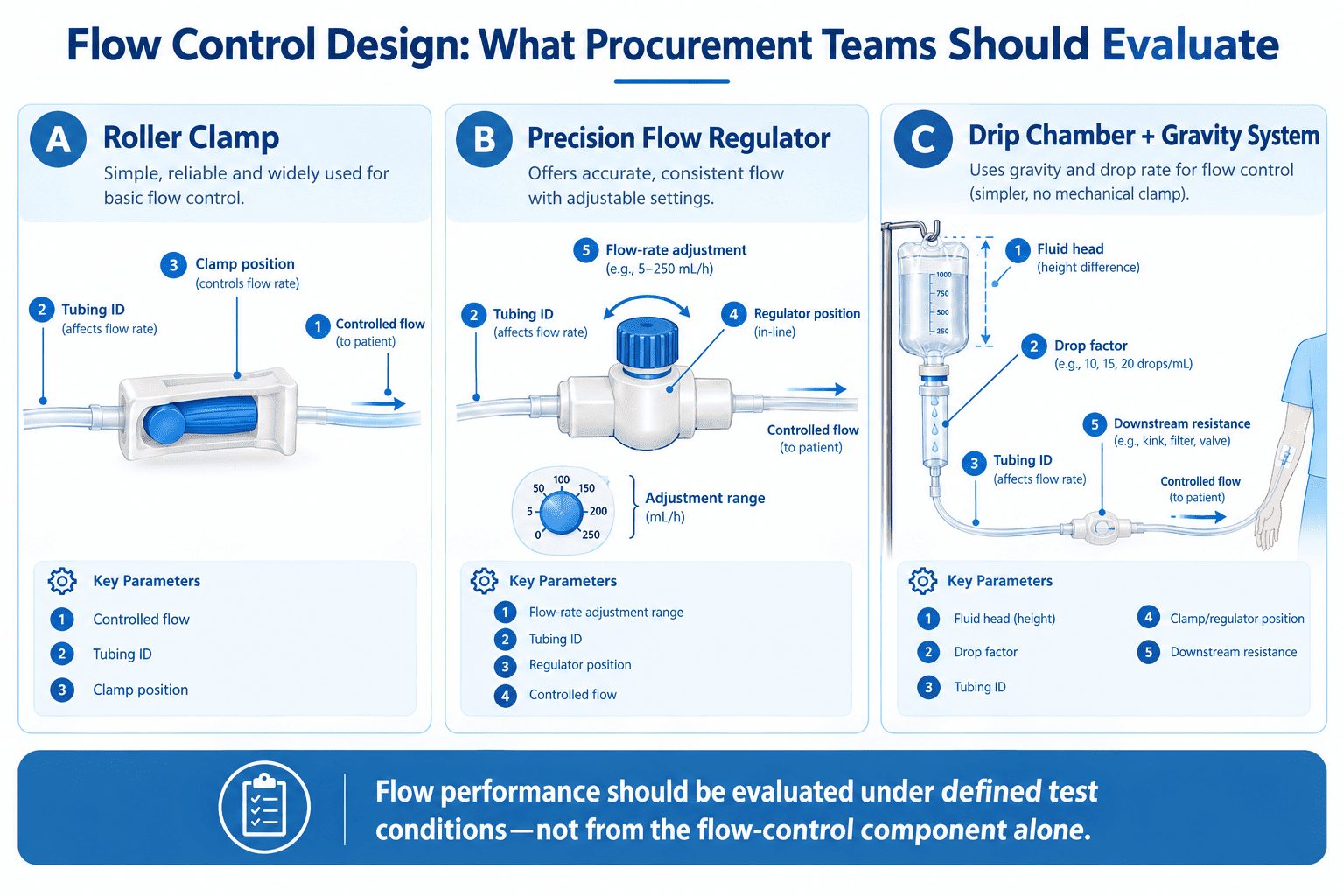
Roller Clamp Versus Precision Flow Regulator
| Evaluation factor | Roller clamp | Precision flow regulator |
|---|---|---|
| Basic flow adjustment | Yes | Yes |
| Fine adjustment | Depends on design | Designed for more controlled adjustment |
| Application | General gravity infusion | Applications requiring specified flow control |
| Specification complexity | Relatively simple | Requires defined flow-rate range |
| Procurement focus | Clamp performance | Calibration/flow performance and range |
Roller clamps provide a straightforward means of adjusting gravity flow. In contrast, a precision flow regulator can provide a defined adjustment mechanism where the application requires a specified flow range.
Procurement teams should base their decision on the intended use rather than assume that one configuration works for every application.
Flow-Rate Range and Accuracy
A technical specification should define the desired flow range and the conditions under which teams evaluate performance.
Where flow performance is important, buyers should document parameters such as the test fluid, pressure or head conditions, temperature where applicable, and acceptable tolerance.
Drop Factor and Drip-Chamber Performance
Drop factor is an important parameter in gravity infusion. A basic calculation is:
Flow rate (mL/h) = Drops per minute × 60 ÷ Drop factor (drops/mL)
Because configurations can differ, procurement teams should confirm the specified drop factor instead of assuming that all infusion sets use the same value.
Tubing Dimensions
Tubing geometry can influence resistance within the fluid pathway. So specifications should identify the required tubing material and dimensions, and buyers should verify them against the intended application.
Injection Site Design in Disposable IV Infusion Sets: A Procurement Checklist
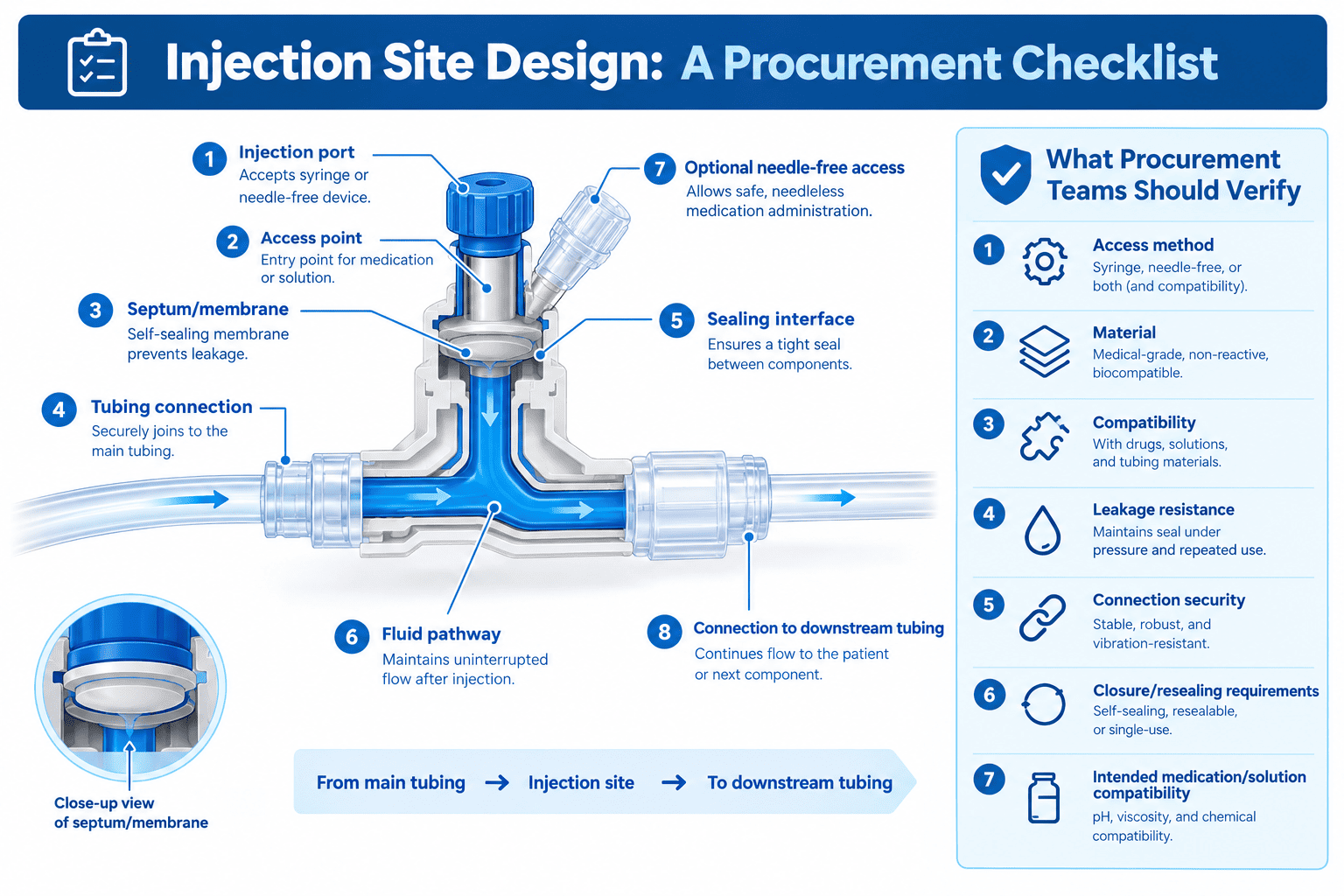
Injection Site Location
The position of the injection site can influence accessibility and workflow. Buyers should consider how staff will access the site during the intended use of the complete infusion set.
Access Configuration
Procurement specifications should identify whether the required design uses a particular access method and whether associated devices must be compatible with the site.
Sealing and Leakage Resistance
Connection integrity and sealing characteristics are important evaluation points. Where a needle-free access point is required, buyers can review configurations such as needle-free connectors built to reduce clotting and support forward flushing. So, where applicable, procurement testing should establish acceptance criteria for leakage and connection performance.
Material Compatibility
Buyers should consider materials used in the injection site alongside the solutions or medications expected to contact the fluid pathway. They should also review supplier documentation where material compatibility is a purchasing requirement.
Vented vs. Non-Vented Infusion Sets
The type of fluid container largely determines the choice between vented and non-vented configurations.
Vented Configuration
Rigid infusion containers generally require vented or air-intake configurations, because air must enter the container as fluid leaves it.
Non-Vented Configuration
Collapsible infusion bags commonly use non-vented sets. So the container can collapse as fluid flows out.
Procurement Specification
The RFQ should clearly identify the intended container type and whether it needs a vented or non-vented configuration.
Materials, Sterilization and Packaging
Buyers should consider material selection together with the application, regulatory requirements and supplier documentation.
Potential medical-device materials may include PVC, TPU, silicone, and stainless-steel components depending on the specific configuration. Connector hardware, such as rotating luer connectors, is also worth reviewing where high pressure resistance is a requirement.
Sterilization and packaging are equally important. Buyers should request information covering the sterilization method, sterile-barrier packaging, shelf life, labeling, and batch traceability.
For example, MCSUL lists its current plastic-spike infusion-set range as sterile, single-use, and non-pyrogenic, with EO or gamma sterilization options and a stated five-year shelf life. The manufacturer also lists medical-grade silicone, PVC, TPU, and SUS304 stainless-steel material options.
Why Choose MCSUL Plastic-Spike IV Infusion Sets
For procurement teams seeking a configurable gravity-infusion platform, buyers can evaluate plastic-spike IV infusion sets according to the same system-level criteria described above.
We at MCSUL’s published configuration includes components such as the plastic spike, air filter or air-intake device, drip chamber, tubing, flow-stop clip, three-way connector, injection port, flow regulator, in-line medication filter, and external Luer connector.
Configuration Options
MCSUL lists the product range in both vented and non-vented configurations. Needle configurations include single-wing, double-wing, and wingless options.
This type of configurable platform can be relevant when procurement teams need to align the infusion set with different container types, administration requirements, or market specifications.
OEM and Private-Label Supply
For distributors and medical-device brands, customization can also be an important supplier-selection criterion. At MCSUL our infusion-set offering supports custom labeling, packaging, private branding, bulk orders, and sample orders for qualification testing.
Buyers can incorporate these capabilities into an RFQ alongside technical requirements, rather than evaluate them separately from the product specification.
How to Build an IV Infusion Set Procurement Specification
A clear RFQ can reduce ambiguity between buyers and suppliers.
Define the Application
Start by identifying the intended infusion application, container type, and relevant operating requirements.
Specify Flow Control
Document the required flow-control mechanism, drop factor, flow range, and applicable performance conditions.
Specify the Injection Site
Identify the required injection-site configuration, location, access method, material requirements, and compatibility criteria.
Define Tubing and Connectors
Specify tubing material, dimensions, length, connector configuration, and any filter requirements.
Define Sterilization and Packaging
Include sterilization method, sterile packaging format, shelf-life requirements, labeling, and traceability expectations.
Supplier Qualification Checklist
Before placing a production order, procurement teams should evaluate more than the product datasheet.
Technical Documentation
Request:
- Product specifications and drawings
- Material documentation
- Applicable test reports
- Flow-performance information
- Leakage and connection testing
- Sterilization documentation
Quality and Regulatory Documentation
Review the supplier’s applicable quality-system and product documentation for the destination market. MCSUL manufactures its plastic-spike infusion sets under ISO 13485 quality systems and lists CE compliance for the product range.
Sample Approval
A pre-production sample evaluation, therefore, allows buyers to verify configuration, dimensions, packaging, labeling, and other acceptance criteria before committing to larger quantities.
Common Procurement Mistakes With Disposable IV Infusion Sets
Choosing on Unit Price Alone
A lower unit price does not necessarily represent the lowest overall procurement cost. Instead, packaging, testing, qualification, customization, logistics, and batch consistency can also affect the purchasing decision.
Treating All Infusion Sets as Interchangeable
Disposable IV infusion sets can differ in tubing, flow control, venting, injection sites, filters, connectors, and needle configurations. So the RFQ should reflect these differences.
Failing to Specify Vented or Non-Vented Design
Buyers should establish container compatibility before supplier selection to avoid receiving a configuration unsuitable for the intended container.
Approving Production Without Sample Validation
Sample approval provides an opportunity to identify configuration, or documentation issues before mass production.
A Practical Evaluation Framework
A useful procurement process divide in five stages:
1. Application → 2. Configuration → 3. Performance → 4. Quality → 5. Supplier Qualification
At the application stage, define the intended use and container. Next, specify components such as the spike, tubing, injection site, filter and connector. Then establish performance requirements for flow and connection integrity.
Finally, review quality documentation, sterilization, packaging, traceability, manufacturing capability and customization requirements.
Conclusion
Procurement teams should evaluate flow control and injection-site design as part of the complete disposable IV infusion set, rather than as isolated components.
A robust procurement specification should cover the spike, drip chamber, tubing, flow-control mechanism, injection site, filters, connectors, venting configuration, materials, sterilization, packaging, documentation and supplier capabilities.
For buyers evaluating configurable solutions, MCSUL’s plastic-spike infusion sets provide vented and non-vented configurations, multiple needle options, component choices, and OEM/ODM and private-label support according to the manufacturer’s published specifications.
The strongest procurement approach is therefore to define measurable requirements first, evaluate complete-set samples, and select a supplier capable of consistently meeting the approved specification.