 +86-791-8686-1216


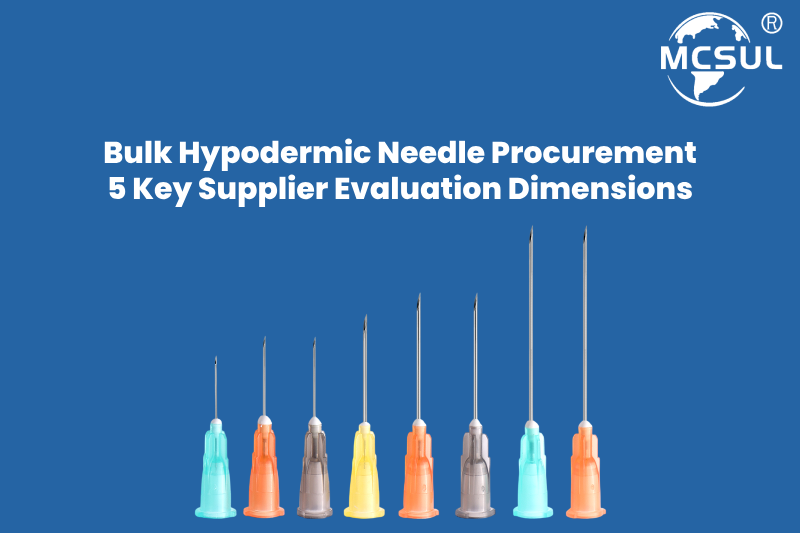
Hospitals, distributors, GPOs, veterinary supply chains, and medical device brands all face the same challenge. They need a manufacturing partner that can support bulk hypodermic needle procurement without compromising safety, consistency, or delivery timelines. Unlike a one-off purchase, bulk hypodermic needle sourcing involves long-term contracts and recurring container-load shipments. The supplier relationship also has to hold up under regulatory scrutiny year after year.
This guide breaks down the five dimensions that matter most for bulk hypodermic needle procurement when you evaluate a manufacturer for large-volume orders: production capacity, quality management systems, regulatory compliance, raw material and design engineering, and total cost of ownership. Maybe you’re a hospital procurement officer negotiating an annual contract. Maybe you’re a distributor building a private-label line, or an OEM buyer sourcing components for a finished device. Either way, these criteria help you separate manufacturers who can genuinely support wholesale hypodermic needles from those who simply list “bulk available” on a product page.
Who Needs a Bulk Hypodermic Needle Sourcing Strategy
Bulk hypodermic needle purchasing decisions rarely rest with a single person. This article speaks directly to the teams who actually make that call:
- Hospital and healthcare network procurement teams manage multi-year supply agreements. They need predictable bulk hypodermic needle supply for inpatient and outpatient care.
- Medical distributors and wholesalers resell to clinics, pharmacies, and home-care providers. They need consistent bulk hypodermic needle orders fulfilled on schedule.
- Group purchasing organizations (GPOs) negotiate on behalf of multiple facilities. A single supplier failure here can disrupt care across an entire network.
- Veterinary product distributors source disposable hypodermic needles for veterinary medicine at scale for clinics and agricultural use.
- Private-label brands and OEM buyers want a manufacturing partner capable of custom packaging and branding alongside high-volume output.
If your organization falls into any of these categories, the framework below fits your risk profile. It centers on supply continuity, regulatory exposure, and landed cost.
Dimension 1: Production Capacity for High-Volume Hypodermic Needle Purchasing
The first filter in any large-volume hypodermic needle sourcing decision is simple. Can the factory actually produce what you need, when you need it? A supplier’s website might advertise “bulk hypodermic needle manufacturer” status. But the real question is their hypodermic needle OEM monthly output capacity — the number of finished, sterilized, packaged units they can realistically ship per month without pulling capacity from other clients.
When you evaluate capacity, ask for specifics rather than general assurances:
- What is the factory’s rated monthly output per needle gauge and length?
- How many automated assembly and packaging lines does the factory dedicate to hypodermic needles, versus sharing with syringes or other disposables?
- What is the sterilization throughput (EO or gamma)? Sterilization is frequently the bottleneck in high-volume hypodermic needle purchasing, even when molding and assembly capacity looks sufficient.
- Can the supplier show historical fulfillment of orders similar in size to yours, with references or shipment records?
A manufacturer that can’t answer these questions with hard numbers isn’t ready yet for procuring hypodermic needles in bulk at an enterprise level. It’s also worth touring a working disposable hypodermic needle bulk factory floor, or requesting video documentation of one. Automated tip-grinding, silicone coating, and assembly lines signal true scale. A trading company that simply repackages third-party stock can’t show you the same thing.
Dimension 2: Quality Management System for Bulk Hypodermic Needle Supply
Production volume means nothing if quality is inconsistent. Any credible bulk hypodermic needle procurement agreement rests on the supplier’s documented quality management system (QMS). At minimum, look for:
- ISO 13485 certification, the international standard specific to medical device quality management.
- ISO 7864 compliance, the dedicated standard governing sterile hypodermic needles for single use. It covers dimensions, point geometry, flow rate, and freedom from defects. A bulk hypodermic needle manufacturer ISO 7864 certified line should produce test reports on demand, not just show you a certificate on a wall.
- Batch-level traceability, so every carton traces back to raw material lot, molding run, and sterilization cycle.
- In-process quality checks, including tip sharpness testing, bend and breakage resistance, and silicone lubrication uniformity. The factory should run these at defined intervals, not only at final inspection.
Anyone sourcing hypodermic needles in bulk should request a copy of the supplier’s Certificate of Analysis (CoA) template and a sample Device History Record (DHR) for a recent batch. Suppliers confident in their QMS share this documentation readily. Suppliers who hesitate are signaling risk.
Dimension 3: Regulatory Compliance When Sourcing Hypodermic Needles in Bulk
Regulatory compliance carries the most legal and financial exposure in any bulk hypodermic needle procurement decision. A shipment held at customs, a recalled lot, or a non-compliant CE marking can cost far more than any unit-price savings. Verify these compliance markers:
- FDA 510(k) clearance (or exemption status) for the U.S. market.
- CE marking under the EU Medical Device Regulation (MDR) for European distribution.
- Compliance with ISO 7864, the harmonized needle-specific standard most regulators reference.
- Country-specific registrations, such as NMPA in China or ANVISA in Brazil, if you distribute into markets with local requirements.
- A documented recall and corrective/preventive action (CAPA) process. Even well-run factories occasionally need to show how they respond to a quality event.
Buyers purchasing hypodermic needles in bulk for cross-border distribution should also confirm the supplier’s export documentation history. Ask about customs clearance records, prior shipment manifests, and familiarity with the destination country’s import requirements for sterile medical devices. A manufacturer well-versed in wholesale hypodermic needles exports will already have these templates ready.
Dimension 4: Raw Material and Design Engineering Behind Wholesale Hypodermic Needles
Procurement conversations skip this dimension most often, yet it directly determines clinical performance and patient comfort. Two sub-areas deserve close attention.
Needle Raw Material for Bulk Purchase of Hypodermic Needles: 304 vs. 316 Stainless Steel
Manufacturers typically build needle cannulas from either 304 or 316 stainless steel, and the choice affects cost and performance. Hypodermic needle raw material 304 vs 316 stainless steel comparisons generally come down to corrosion resistance and rigidity. 316 stainless steel contains molybdenum, which gives it superior corrosion resistance. That matters for needles exposed to certain drug formulations or extended shelf storage. Standard single-use hypodermic needles more commonly use 304 stainless steel, since cost efficiency matters most and corrosion exposure stays minimal given the short contact time. When you evaluate a supplier for bulk hypodermic needle purchasing, ask which grade they use by default and whether they can switch grades for your application. A factory that stocks only one grade may not flex enough for a diversified product line.
Bevel Geometry and Tip Design for Bulk Hypodermic Needle Orders
Hypodermic needle bevel geometry types standard in the industry include the regular bevel (short bevel), the intradermal bevel (a long/short combination for shallow injections), and multi-facet or “back-cut” bevels engineered to reduce coring and improve penetration force. A manufacturer that produces multiple bevel geometries and can explain the trade-offs between them for different clinical use cases shows a level of engineering maturity that trading companies typically can’t match. This matters if you assemble a broad catalog across insulin therapy, vaccination, phlebotomy, and general injection use. A single bevel design simply doesn’t serve every application equally well.
Raw material grade and bevel geometry together separate a commodity supplier from an engineering-capable partner. Confirm both before you lock into a multi-year bulk hypodermic needle supply contract.
Dimension 5: Total Cost of Ownership in Large-Volume Hypodermic Needle Sourcing
Unit price is the easiest number to compare, and the least reliable one to base a decision on. A responsible approach to bulk hypodermic needle orders evaluates total cost of ownership, which includes:
- Minimum order quantities (MOQs) and how they scale with unit pricing. Some suppliers offer steep discounts only above thresholds that don’t match realistic reorder cycles.
- Freight and logistics costs, particularly for ocean freight shipments, where container utilization and port-of-origin fees significantly affect landed cost.
- Defect and rejection rates. A marginally cheaper unit price disappears quickly if 2–3% of a shipment fails incoming inspection.
- Payment terms and currency risk, especially for international large-volume hypodermic needle sourcing arrangements.
- Packaging and labeling customization fees. These vary widely: some suppliers treat private labeling as a core service, while others charge premium setup fees for every SKU variation.
The most cost-effective supplier for high-volume hypodermic needle purchasing rarely quotes the lowest unit price. Instead, look for the lowest all-in cost per delivered, compliant, ready-to-distribute unit across the full contract term.
Bulk Hypodermic Needle Procurement Checklist for Supplier Evaluation
Bring these five dimensions together into one practical checklist for procuring hypodermic needles in bulk:
- Verify monthly output capacity by gauge and length. Confirm sterilization throughput separately from molding capacity.
- Collect current ISO 13485 and ISO 7864 certificates, plus sample CoA and DHR documentation.
- Check FDA and CE compliance status for your target markets, along with export documentation history.
- Confirm raw material grade (304 or 316 stainless steel) and available bevel geometry options for your clinical use cases.
- Build a full landed-cost model covering MOQ tiers, freight, defect allowances, and customization fees, not just a per-unit quote.
Run a prospective supplier through all five dimensions instead of defaulting to price alone. This is what separates a durable bulk hypodermic needle procurement partnership from one that creates supply risk six months into the contract.
Final Thoughts
Bulk hypodermic needle procurement is ultimately a risk-management exercise as much as a purchasing one. Production capacity tells you whether a supplier can meet your volume. Quality systems and regulatory compliance tell you whether they can meet it safely and legally. Raw material and design engineering tell you whether the product will actually perform as intended in clinical use. Total cost of ownership tells you whether the relationship stays financially sustainable long-term. Buyers who evaluate all five together, rather than chasing the lowest unit price in isolation, put themselves in a far better position to build a stable, scalable supply chain.
If you’re comparing manufacturers for a large-scale contract right now, take a look at KDL’s hypodermic needle range. Our guides on choosing the correct hypodermic needle for a given patient population and sourcing needles and syringes at scale offer a closer look at how these evaluation dimensions play out with a real OEM-capable factory.