 +86-791-8686-1216


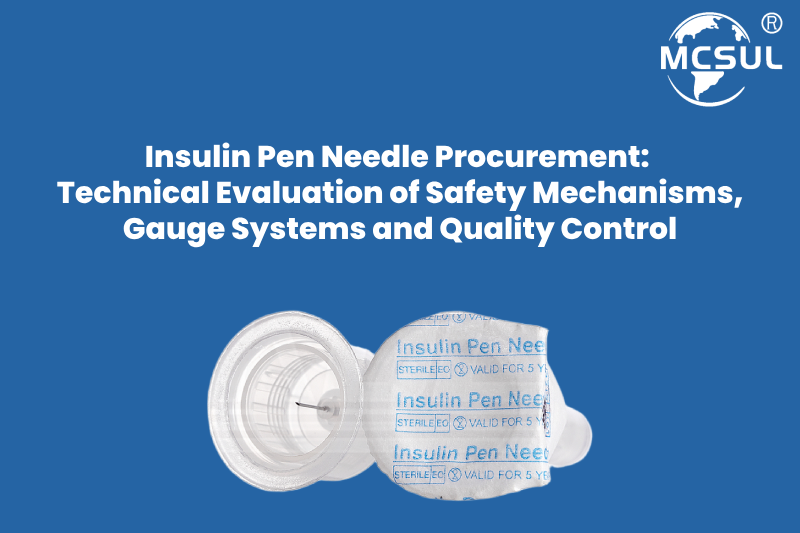
Insulin pen needles look simple. A short, thin-walled needle attached to a hub, used millions of times a day by people managing diabetes. But for a procurement or quality team, “simple” is exactly where the risk hides. These devices go to hospitals, pharmacy chains, and distribution networks. A poorly ground bevel, an inconsistent gauge tolerance, or a weak safety mechanism doesn’t show up on a spec sheet. It shows up later, as a patient complaint, a compliance flag, or a recall.This guide sets out a practical framework for insulin pen needle procurement. It covers the safety mechanisms, gauge systems, and quality control benchmarks that determine whether a purchasing decision holds up under audit.
Why Insulin Pen Needle Procurement Deserves Its Own Evaluation Framework
Pen needles sit at the intersection of two demanding requirements. They need to be clinically precise accurate dosing, minimal tissue trauma. And they need to be manufactured at very high volume, at very low cost per unit. That combination is unusual. A single lapse in tooling consistency at high volume can affect hundreds of thousands of units before it’s caught.
Buyers evaluating suppliers should treat pen needles less like a commodity purchase. Think of it more like a component qualification closer to how you’d vet a supplier for an IV catheter or a biopsy needle. If your team already has a broader supplier vetting process in place, it’s worth reviewing it against a supplier evaluation checklist built specifically for needle manufacturers. Needle-specific tolerances and testing don’t map cleanly onto generic component sourcing criteria.
Insulin Pen Needle Procurement: Quick-Reference Specification Table
For teams running a formal RFP or comparing quotes across suppliers, it helps to have the core specification variables in one place. The table below reflects the range typically evaluated in insulin pen needle procurement, using MCSUL diabetes care line as a worked example:
| Specification | MCSUL Insulin Pen Needles | MCSUL Safety Insulin Pen Needles | MCSUL Insulin Syringe |
|---|---|---|---|
| Gauge range | 29G–32G | 29G–32G | 27G–31G |
| Needle length | 4mm / 5mm / 6mm / 8mm | 4mm / 5mm / 6mm / 8mm | Fixed, integrated |
| Safety mechanism | None (standard hub) | Passive automatic shield | Optional safety sleeve |
| Wall type | Thin wall / extra-thin wall | Thin wall / extra-thin wall | Standard wall |
| Sterilization | EO, SAL 10⁻⁶ | EO, SAL 10⁻⁶ | EO, SAL 10⁻⁶ |
| Certification | ISO 13485, CE | ISO 13485, CE | ISO 13485, CE |
| Best-fit buyer | Cost-sensitive institutional or retail orders | Hospitals, care homes, staff-administered settings | Formularies stocking syringe-based delivery alongside pens |
Use this as a starting template, not a final answer. Actual tolerance bands, MOQs, and certification scope should always be confirmed directly with the manufacturer as part of supplier qualification.
Safety Mechanisms: What “Safety” Actually Needs to Cover
“Safety pen needle” is a broad label, and not all mechanisms deliver the same protection. When evaluating a supplier’s safety design, look at three things separately.
Needlestick protection for the caregiver
In institutional settings clinics, care homes, hospital diabetes units needles are frequently handled by staff, not just the patient. A passive or semi-automatic shielding mechanism activates without a separate manual step. That reduces the chance of accidental exposure. Manual shields require the user to remember a second action. That makes them weaker from a risk standpoint, even if they’re cheaper to produce.
Single-use enforcement
Reuse of pen needles is a known driver of lipohypertrophy and infection risk. Good safety needle designs make reuse mechanically difficult, not just discouraged by labeling. This matters more in bulk institutional procurement than in retail, where reuse is harder to monitor.
Consistent activation force
A shielding mechanism that requires excessive pressure to deploy will get skipped by rushed staff. This is a usability failure that becomes a safety failure. It’s worth requesting activation-force data, not just a demonstration video, during supplier qualification.
Active vs. Passive Safety Pen Needles: What’s the Real Difference
Most procurement confusion on this topic comes down to one distinction:
- Active (manual) safety mechanisms require the user to perform a separate action after injection sliding, twisting, or pressing a shield into place. They’re cheaper to manufacture. But the protection only works if the step isn’t skipped, and that’s a real risk in high-volume, time-pressured clinical settings.
- Passive (automatic) safety mechanisms deploy on their own as the needle is withdrawn, with no extra step for the user. They cost more per unit. But they remove the “human factor” failure point entirely, which is why most institutional buyers now specify passive as a baseline requirement, not a premium option.
For volume procurement into hospitals, care homes, or clinics, passive designs are generally the safer default. Active designs still have a place in cost-sensitive retail or take-home channels, where the patient is the user and training compliance is easier to control.
Auto-shield mechanism reliability testing is the part of this decision that’s easiest to skip and shouldn’t be. A passive shield is only as good as its activation consistency across a full production batch. Ask suppliers for deployment-rate data: the percentage of units that shield correctly under standard withdrawal force across a sample lot. Don’t accept a spec claim of “passive shielding” without it. A mechanism that works in a demo video but has a 2–3% non-deployment rate at scale is a liability. Procurement teams won’t catch that without requesting the data directly.
MCSUL safety insulin pen needles use a passive shielding design built around this exact reliability concern. Batch-level deployment testing is available on request. For buyers who don’t require an integrated shield, the standard insulin pen needles line covers that spec. Both sit under MCSUL broader diabetes care product range, alongside insulin syringes and delivery accessories.
Gauge Systems in Insulin Pen Needle Procurement: Matching Needle Diameter to Clinical Use
Gauge selection is where procurement teams most often default to “whatever we bought last time,” instead of matching the spec to the patient population. A quick technical refresher:
- Higher gauge number = thinner needle. A 32G needle is thinner than a 29G needle, not the other way around.
- 29G–30G needles are the older standard. They’re still procured for high-viscosity formulations or cost-sensitive bulk orders.
- 31G–32G ultra-fine needles are now the dominant clinical preference. Thinner walls reduce injection pain without sacrificing flow rate for standard insulin viscosity.
- Wall thickness regular wall, thin wall, extra-thin wall matters as much as gauge number. Two needles at the same gauge can have meaningfully different flow characteristics, depending on wall engineering.
Length is the second variable. It should be matched to patient body composition, not treated as a fixed default. 4mm needles are now widely recommended across most adult body types, for subcutaneous delivery with lower risk of intramuscular injection. 5mm, 6mm, and 8mm remain in use for specific clinical situations.
31G vs. 32G: Which Gauge Do Clinicians Actually Prefer
In current clinical practice, 31G and 32G are the two gauges procurement teams field the most requests for. The preference between them usually comes down to two factors, not one.
- 32G is the thinner of the two. It’s generally preferred where minimizing injection pain is the priority pediatric use, needle-phobic patients, and any population where injection compliance is a known problem. The trade-off is a slightly slower flow rate. That’s rarely significant for standard insulin, but it can matter for higher-viscosity concentrated formulations.
- 31G remains the more common institutional default. It’s marginally more forgiving on flow rate and slightly more cost-efficient to manufacture at scale. That keeps it the standard SKU for most hospital and pharmacy formularies, even as 32G adoption grows in retail and take-home channels.
Neither is a categorically “better” gauge. The right spec depends on your patient population and formulation. This is one of the most common points of disagreement in insulin pen needle procurement. Buyers standardizing a formulary should stock both rather than defaulting to one, since a single-gauge policy tends to under-serve either the pain-sensitivity use case or the flow-rate use case.
For teams building out a multi-SKU catalog, MCSUL insulin pen needles and safety insulin pen needles are both available across the 29G–32G range, in multiple lengths. Gauge and safety-mechanism decisions can be sourced from a single supplier, rather than split across vendors. If your procurement scope also includes syringe-based insulin delivery, MCSUL insulin syringe and sterile insulin syringes with single safety sleeve sit in the same diabetes care line, for building a combined formulary.
Quality Control Standards for Insulin Pen Needle Procurement
This is the section where procurement and quality teams should push suppliers hardest. Most of what determines real-world performance isn’t visible in a product photo or a spec sheet PDF.
Sharpness and bevel consistency : Needle tip sharpness is measured, not eyeballed typically via penetration force testing against a standardized membrane. Ask for the test method and acceptance range, not just a claim of “ultra-sharp.”
Silicone lubrication uniformity : Inconsistent silicone coating causes drag during injection and increases perceived pain. This is a common failure point in lower-tier manufacturing. It’s also one of the easier things to verify with a batch sample test.
Burr-free cutting : Microscopic burrs at the needle tip, left over from the cutting process, are a leading cause of coring and tissue trauma. Reputable manufacturers run tip inspection under magnification as a standard QC step, not a spot check.
Sterility assurance : Ethylene oxide (EO) sterilization validation should be standard and auditable, with a documented sterility assurance level (SAL) of 10⁻⁶. Batch-level traceability back to sterilization records should come with it.
Regulatory documentation : ISO 13485 certification, FDA 510(k) clearance for US-bound product, and CE marking under MDR for EU-bound product should all be verifiable. A claim on a company profile page isn’t enough.
Dimensional tolerance control : Outer diameter, wall thickness, and length all need tight tolerance bands. These should be verified through batch sampling, not just “within spec” assurances without data.
If you’re vetting a manufacturer for the first time, or qualifying a second-source supplier, work from a structured framework rather than a checklist built ad hoc. This medical needle OEM manufacturer guide for China-based sourcing and this broader needle and syringe sourcing guide both walk through documentation requests, audit questions, and red flags. These are easy to miss on a first supplier call.
Packaging, MOQ, and the Procurement Details That Get Overlooked
Technical evaluation gets most of the attention. But a few procurement-specific details are worth confirming before contracting:
- Blister packaging integrity peel-strength testing and sterile barrier validation, particularly for shipments crossing multiple climate zones.
- Minimum order quantities and lead times, especially for private-label or custom-branded packaging runs.
- Cold chain requirements generally not applicable to pen needles themselves, but worth confirming if bundled with insulin cartridges in a combined shipment.
- Country-of-origin documentation for tariff and regulatory filing purposes.
None of these should be an afterthought in a formal RFP. They affect landed cost and delivery reliability as much as the needle specification itself.
OEM Pen Needle Manufacturing for Diabetes Care Brands
A separate but related procurement path is OEM sourcing. Diabetes care brands, pharmacy private-label programs, and distributors sometimes want to build their own branded pen needle line, rather than reselling an existing SKU. The evaluation criteria above — safety mechanism, gauge tolerance, sterilization, documentation still apply in full. A few additional questions matter specifically for OEM partnerships:
- Private-label packaging capability : Can the manufacturer produce custom blister packs, cartons, and inserts under your brand, at your target MOQ? Or only at volumes beyond what a mid-size diabetes care brand typically needs?
- Regulatory filing support : Will the manufacturer provide the technical documentation your brand needs for its own FDA 510(k) or CE MDR submission? Think biocompatibility data, sterilization validation, design dossiers. Or is that support reserved for their own house brand?
- Consistency across gauge and safety-mechanism variants : An OEM partner should supply the full 29G–32G range, and both active and passive safety options, under one contract. That way a brand isn’t qualifying multiple manufacturers for one product family.
MCSUL manufactures insulin pen needles and safety insulin pen needles as both house-brand and OEM/private-label product. The full diabetes care line — insulin pen needles, safety insulin pen needles, and insulin syringes is available for private-label packaging under ISO 13485 quality systems. Brands evaluating a manufacturing partner can request sample lots and documentation packages directly, for comparison against current suppliers.
A Practical Insulin Pen Needle Procurement Checklist
Before finalizing a supplier, procurement and quality teams should be able to check off:
- ISO 13485 certification and current audit status
- FDA 510(k) or CE MDR documentation matched to target market
- Documented sharpness/penetration-force test data
- Batch-level sterilization and traceability records
- Dimensional tolerance data for gauge, wall thickness, and length
- Safety mechanism activation-force testing (for safety-engineered SKUs)
- Sample lot for independent verification before full-volume commitment
- Clear packaging, MOQ, and lead-time terms in writing
Final Thoughts
Insulin pen needles are a low-cost, high-volume product. That makes it tempting to treat sourcing decisions casually. But the clinical consequences of an under-specified needle pain, dosing inconsistency, infection risk, needlestick exposure are disproportionate to the unit price. Done properly, insulin pen needle procurement is a rigorous evaluation across safety mechanism design, gauge and length engineering, and documented quality control. That’s the difference between a defensible purchasing decision and a risky one whether you’re qualifying a supplier for direct purchase, or an OEM partner for a private-label line.