 +86-791-8686-1216


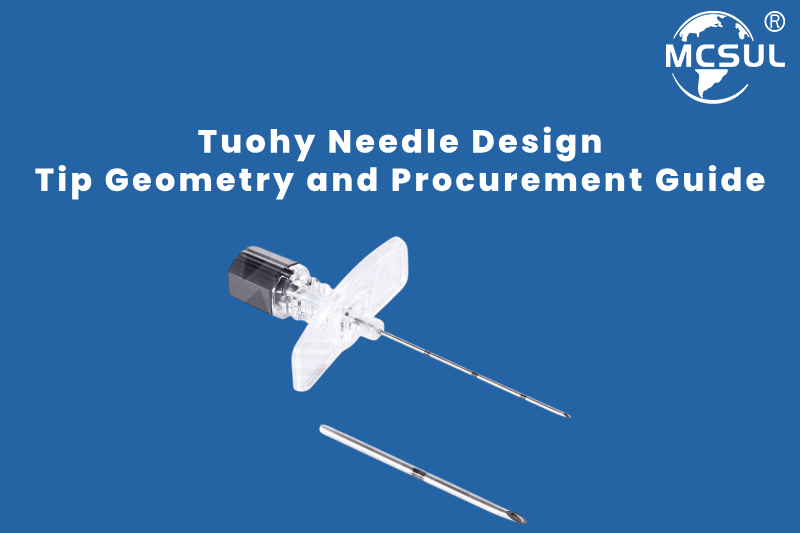
Quick Overview : A Tuohy needle has a curved, blunt tip called a Huber point. The curve pushes tissue apart instead of cutting it. This lowers the risk of dural puncture during epidural anesthesia. Most Tuohy needles use a 16G or 18G gauge with an 8 to 10 cm shaft. Every Tuohy needle must meet FDA 21 CFR 868.5150, ISO 7864, ISO 9626, and ISO 13485. Many hospitals are also moving to ISO 80369-6 NRFit connectors to stop wrong-route drug errors between epidural and IV lines.
The Tuohy needle is the mainstay of epidural anaesthesia. It resembles a basic steel tube. However, the tip form took decades to perfect. It also entails significant clinical implications. A faulty tip might indicate a failed initial attempt. It might also indicate a torn dura or a terrible headache.
This guide views the Tuohy needle from two perspectives. First, the engineering: why does the tip curve, what gauge to use, and how does it compare to other epidural needle designs. Second, consider the paperwork: what requirements a manufacturer must achieve before you place an order.
What Is a Tuohy Needle and Why Is It the Standard for Epidural Anesthesia?
A Tuohy needle is a hollow steel needle with a curved, blunt tip. Doctors use it to find the epidural space and guide a thin catheter into place.
The needle does not deliver the anesthetic by itself in most cases. Instead, it works as a guide. Once it reaches the epidural space, the doctor threads a soft catheter through it. The needle is then removed. The catheter stays behind for continuous pain relief.
This design dates back to the 1940s. Dentist Ralph Huber patented a curved, non-coring needle tip for dental injections in 1946. Anesthesiologist Edward Tuohy adopted that same curved tip. He added a stylet, a thin rod that fills the needle during insertion. The combination became the modern Tuohy epidural needle. It remains the most common epidural needle in clinical use today.
What Makes Tuohy Needle Tip Geometry Different From a Standard Hypodermic Needle?
A Tuohy needle’s tip curves slightly and ends in a blunt, rounded edge. A standard hypodermic needle has a sharp, straight bevel that cuts in a straight line.
This curved tip is called a Huber point. It sits at roughly a 20-degree angle to the shaft. There is no sharp point at the very tip. Instead, the opening sits on the side of the needle, just behind the curve. This side opening is the key design choice. It lets the catheter exit at an angle, so it threads sideways into the epidural space instead of straight ahead.
A stylet sits inside the needle during insertion. It blocks tissue from entering the hollow tube and forming a plug. Without the stylet, a small core of tissue could block the needle or get pushed into the epidural space.
These two features together, the curved Huber point and the stylet, are what separate a Tuohy needle from a generic puncture needle. You can see this geometry up close on KDL’s anesthesia needle product line, which covers spinal, epidural, and combined designs side by side.
How Does the Curved Tip Reduce the Risk of Accidental Dural Puncture?
The curved Huber point pushes tissue fibers apart. It does not cut them. This lowers the chance of tearing the dura. The dura is the tough membrane around the spinal cord. It holds the cerebrospinal fluid, or CSF, that cushions the cord.
A sharp, straight bevel cuts a clean path. That sounds precise. But it can nick the dura before the doctor feels any change. A blunt, curved tip works differently. It pushes against the ligamentum flavum. This is a tough ligament just outside the epidural space. The needle gives a clear “give” once it passes through. This feel helps the doctor stop at the right depth.
Even with this design, dural puncture still happens by accident now and then. Doctors call this an accidental dural puncture, or ADP for short. Published ADP rates for Tuohy needles in obstetric epidurals have held steady at 0.5% to 1.5% since the 1970s. About half of these cases lead to a headache. Bevel direction matters too. Some studies find fewer headaches when the doctor turns the bevel 90 degrees right after reaching the epidural space. This happens just before the catheter goes in. None of this replaces good technique. But it shows why tip shape alone cannot remove all risk. Build quality and skill both matter.
Tuohy vs. Hustead vs. Crawford: How Do Epidural Needle Tip Designs Compare?
The Tuohy needle is not the only epidural needle design. Three other tip styles, Hustead, Crawford, and Weiss, solve the same problem in slightly different ways.
| Needle Type | Tip Design | Key Feature | Best-Fit Use Case |
|---|---|---|---|
| Tuohy | Curved Huber point, side opening | Stylet guides catheter upward; most common type | Continuous lumbar epidural |
| Hustead | No back bevel, very short heel-to-tip gap | Slightly less curve than Tuohy; blunter heel | Continuous epidural, similar to Tuohy |
| Crawford | Short bevel, straight tip, no sharp edges | No curve; simpler shape | Steep-angle approach, combined spinal-epidural |
| Weiss | Blunt tip with winged hub | Wings improve grip during advance | Continuous epidural needing extra control |
The Tuohy design remains the default for most hospitals. It has a long track record and wide availability. Hustead and Weiss needles serve a similar purpose with small ergonomic differences. Crawford needles trade the protective curve for a simpler, straighter path. Some clinicians prefer this for specific approach angles.
What Gauge and Length Should You Choose for a Tuohy Needle?
Most Tuohy needles for adult epidurals use a 16G or 18G gauge with a shaft length of 8 to 10 cm. Depth markings appear every 1 cm to help track insertion progress.
Gauge affects two things. It changes how easily the needle passes through tissue. It also changes how large a catheter can fit through the lumen, the hollow center of the needle. An 18G needle is thinner and may feel less invasive. A 16G needle gives a larger lumen for easier catheter threading. The trade-off is a slightly larger hole if dural puncture does occur.
A standard 8 to 10 cm shaft works for most adult patients. A 15 cm version exists for patients with a higher body mass index, where the epidural space sits farther from the skin. Color-coded hubs, like the gauge system KDL uses across its anesthesia needle line, let staff confirm gauge at a glance before insertion.
| Gauge | Outer Diameter | Color Code | Typical Length |
|---|---|---|---|
| 20 G | 0.9 mm | Yellow | 3½” |
| 19 G | 1.1 mm | Cream | 3½” |
| 18 G | 1.2 mm | Pink | 3½” |
| 16 G | 1.6 mm | White | 3½” |
What Standards and Certifications Should Tuohy Needle Buyers Verify?
A Tuohy needle, like any anesthesia conduction needle, must meet named, checkable rules before it reaches a patient. A vague quality claim on a sales sheet is not enough.
Check for these:
- FDA 21 CFR 868.5150 — the U.S. rule for anesthesia conduction needles. It lists Tuohy and other epidural needles as Class II devices under product code BSP.
- ISO 13485 — the main quality rule for medical device makers.
- ISO 7864:2016 — the rule for sterile, single-use needles. It covers sharpness, bond strength, and cleanliness.
- ISO 9626:2016 — the rule for the steel tubing inside the needle. It covers strength and rust resistance.
- CE marking — required to sell in the EU.. Tuohy needles are usually Class IIa devices there, for short-term use inside the body.
A factory that can only show a basic business license, with none of the above, is a clear warning sign. Ask any supplier to show current certificates before you commit to a trial order.
Why Does the Luer vs. NRFit Connector Choice Matter for Epidural Needle Procurement?
The hub connector on a Tuohy needle is becoming its own compliance question. A growing number of health systems now ask for ISO 80369-6 NRFit connectors instead of standard Luer fittings.
The problem ISO 80369-6 fixes is simple but serious. A standard Luer connector can fit an IV line, a feeding tube, or an epidural catheter. They all use the same shape. This has caused real, fatal drug errors. Medicine meant for an IV line has gone into the epidural space by mistake. The reverse has also happened. ISO 80369-6 came out in 2016. It sets a connector that is about 20% smaller than a Luer fitting. It cannot plug into an IV or feeding line by design. Most people call this connector NRFit.
There is no single global deadline for this switch. Some countries, including Japan and parts of the UK, have moved further along than others. For procurement teams, this means asking suppliers directly: can this Tuohy needle ship with an NRFit hub, a standard Luer hub, or both? A manufacturer that already supports both formats gives your hospital room to transition at its own pace, without a forced re-tender later.
How Should Procurement Teams Evaluate a Tuohy Needle Manufacturer?
Treat the manufacturer as carefully as the needle’s tip geometry. A well-made tip from a poorly controlled factory is still a risk.
- Check OEM/ODM flexibility. A supplier with OEM and ODM skills can often adjust gauge, hub style, or labeling without the cost of new tooling.
- Ask for a recent batch test report. This proves what actually shipped, not just what the spec sheet promises.
- Confirm cleanroom production. Needles should be made and packed in a controlled, monitored space.
- Request samples before a bulk order. Real handling and tactile feel do not always match a spec sheet.
- Compare tip designs side by side. A strong supplier offers Tuohy, Hustead, or Weiss-style options. Your clinical team can then match the needle to the case. We cover a similar choice in our guide to pencil point and Quincke spinal needles.
For a full walkthrough of certificates and supplier red flags, see our guide on evaluating spinal anesthesia needle manufacturers. Most of the same checks apply to Tuohy needle sourcing too.
Which Tuohy Needle Manufacturers Lead the Market?
A handful of manufacturers supply most of the world’s Tuohy needles. Each one leads in a different way.
| Manufacturer | Key Strength | Certifications |
|---|---|---|
| KDLNC (Nanchang Kindly Meditech) | Global Manufacturer and Supplier with OEM/ODM flexibility across Tuohy, combined spinal-epidural, and color-coded gauge lines | ISO 13485, CE |
| B. Braun | Full NRFit-ready epidural sets (needle, catheter, filter, LOR syringe) under the Perican/Perifix line | ISO 13485, CE |
| BD | Modified Tuohy point needles with calibrated depth markings; strong distribution in North America | ISO 13485, CE, FDA |
| Pajunk | Tuohy II line made in Germany since 1965, with echogenic tip options | ISO 13485, CE |
| Smiths Medical | Broad anesthesia and infusion device portfolio | ISO 13485, CE, FDA |
KDLNC builds a full range of Tuohy and epidural needles. OEM work is available for distributors and hospital groups. This covers custom gauge, hub style, or labeling. B. Braun and Pajunk have decades of focus on regional anesthesia. Both moved early on NRFit-ready sets. BD and Smiths Medical bring large product lines. They also have a wide footprint across North America and Europe.
Certificates and test data should come first in any comparison. Lead time, price, and openness to custom orders come next. The right fit often comes down to your order size and connector needs.
What Mistakes Do Buyers and Clinicians Make When Sourcing Tuohy Needles?
Most sourcing mistakes come from a focus on price or habit instead of the full picture.
- Skipping the batch test report. A spec sheet does not prove what shipped in this specific lot.
- Ignoring connector type. Ordering standard Luer hubs without checking your facility’s NRFit transition plan can force a costly re-order later.
- Treating all curved-tip needles as identical. Tuohy, Hustead, and Weiss needles share a goal but not an identical feel or fit.
- Skipping sample testing. A photo or a spec number cannot replace handling a real sample.
- Relying on a single supplier. A supply gap during a stock-out can delay procedures.
Key Takeaways
- A Tuohy needle uses a curved Huber point tip to separate tissue rather than cut it. This lowers the risk of accidental dural puncture during epidural placement.
- Most adult Tuohy needles use a 16G or 18G gauge with an 8 to 10 cm shaft. A 15 cm version exists for higher BMI patients.
- Hustead, Crawford, and Weiss needles offer related but distinct tip designs, each suited to slightly different clinical needs.
- Every Tuohy needle should meet FDA 21 CFR 868.5150 (Class II, product code BSP), ISO 13485, ISO 7864:2016, and ISO 9626:2016.
- CE-marked Tuohy needles are typically Class IIa devices for short-term invasive use in the EU.
- ISO 80369-6 NRFit connectors are replacing standard Luer hubs in many health systems. This change aims to prevent wrong-route medication errors.
- Evaluate the manufacturer as closely as the needle itself. Batch test reports, cleanroom production, and OEM/ODM flexibility all matter.
- Major Tuohy needle makers include KDLNC, B. Braun, BD, Pajunk, and Smiths Medical. Each holds ISO 13485 and CE at minimum, with some adding FDA registration.
Final Thoughts
A Tuohy needle looks simple. A curved steel tube with a stylet does not seem like complex engineering. But that curve is the whole reason this design has outlasted nearly every other option. It sits at roughly 20 degrees and has been refined since the 1940s. Give procurement the same care as the engineering. Start with the named standards. Check that the connector type fits your facility’s plan. Then test a real sample before any bulk order ships.