 +86-791-8686-1216


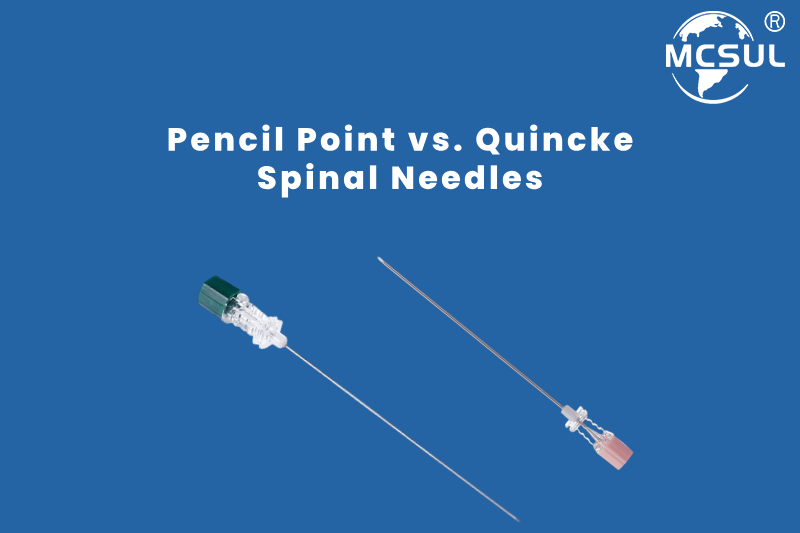
Quick Overview:A pencil point needle (Whitacre or Sprotte design) has a rounded, closed tip. It pushes dural fibers apart. A Quincke needle has a sharp cutting bevel. It cuts through the dural fibers instead. Pencil point needles cut headache risk after the procedure by roughly half. Quincke needles insert with less resistance and cost less per unit. Both pencil point and Quincke spinal needle must meet ISO 7864, ISO 9626, and FDA 21 CFR 868.5150.
Choosing between a pencil point and Quincke spinal needle is not a small detail. It changes patient comfort. It changes complication rates. Additionally, it can even change how often a procedure has to be repeated. This guide breaks down the real, evidence-based differences between the two tip designs. It covers the clinical safety data behind each needle.
What Is the Difference Between a Pencil Point and Quincke Spinal Needle?
A pencil point spinal needle has a rounded, closed tip with a side hole. A Quincke spinal needle has a sharp, cutting bevel right at the tip.
The pencil point design is also called Whitacre or Sprotte, depending on the maker. It pushes dural fibers apart instead of cutting them. The Quincke design slices straight through the dura with its beveled edge. This one design choice is the root cause of nearly every clinical difference below.
You can compare KDL’s pencil-point spinal needle and Quincke-tip spinal needle side by side. Seeing the tip shapes up close helps before you order samples.
How Does Needle Tip Design Affect Post-Dural Puncture Headache Risk?
Pencil point needles reduce the chance of a post-dural puncture headache by almost half. This is compared to Quincke needles based on pooled clinical trial results. A post-dural puncture headache (PDPH) is produced by spinal fluid seeping from the puncture site.
A meta-analysis in the journal Anesthesiology pooled 57 randomized trials. It covered more than 16,000 patients in total. It found pencil point needles cut PDPH risk by about 59%, compared with cutting needles like the Quincke. A separate meta-analysis of 25 trials found a matching pattern. Pencil point needles also led to fewer severe headaches. They also resulted in fewer epidural blood patch treatments, which are a popular therapy for severe PDPH.
This gap matters most in cases where a headache complaint is a major concern. Obstetric anaesthesia and outpatient operations are the most obvious examples.
Pencil Point vs. Quincke Spinal Needle: Comparison Table
| Feature | Pencil Point (Whitacre/Sprotte) | Quincke |
|---|---|---|
| Tip design | Rounded, closed tip with side hole | Cutting bevel, open tip |
| Dural interaction | Separates fibers | Cuts fibers |
| Relative PDPH risk | Lower | Higher |
| Insertion feel | Slightly more resistance, clear “click” at dura | Smoother, more familiar feel |
| Best-fit use cases | Obstetric, outpatient, ambulatory surgery | Diagnostic LP, cost-sensitive bulk orders |
| Relative unit cost | Slightly higher | Lower |
| Common gauge range | 24G–27G | 22G–27G |
Which Needle Type Has a Higher Procedural Success Rate?
A very fine Quincke needle can match a pencil point needle on headache risk. However, it has a higher failure rate on the first pass.
A network meta-analysis compared 11 needle types. It covered 61 trials and almost 15,000 patients in total. A 26-gauge pencil point needle ranked best overall. It had both low PDPH risk and high procedure success. A 29-gauge Quincke needle came close on headache risk alone. But it failed more often, which led to repeat punctures. Each repeat puncture raises the odds of a headache on its own. In most settings, a reliable first pass beats a slightly thinner needle.
What Is an Introducer Needle, and Why Does It Matter Here?
An introducer needle is a short, wider needle that guides the thin spinal needle through the skin and into place. It stops the fine needle from bending or buckling on the first pass.
Most spinal needle kits include a matching introducer. It is sized to fit the spinal needle’s gauge. Try to source the introducer and the spinal needle from one anesthesia needle line. This keeps the hub fit and angle consistent. It lowers the chance of a failed first attempt, no matter which tip design you use.
What Gauge Should You Choose for Pencil Point vs. Quincke Needles?
Needle gauge reduces PDPH risk significantly for Quincke needles but scarcely alters the needle in pencil point designs.
A meta-regression analysis revealed a definite relationship with cutting needles such as the Quincke. A finer gauge indicated a decreased PDPH risk. The similar relationship did not apply to pencil point needles. For those, the tip form determines the output, not the gauge. This modifies the size technique based on the tip type:
- Quincke needles: go as fine as the clinical job permits, since gauge directly influences headache risk.
- Pencil point needles: choose a gauge primarily for handling and insertion sensation, since the tip design already mitigates headache risk.
- Regardless of the kind or gauge prioritise a clean initial pass over the thinnest feasible needle.
What Standards and Certifications Should Spinal Needle Buyers Verify?
A spinal needle, of either tip design, must meet named, checkable standards. This is true before it ever reaches a patient. A sales claim of “high quality” is not enough on its own.
Look for:
- ISO 13485 — the core quality rule for medical device makers.
- ISO 7864:2016 — rules and test methods for sterile, single-use needles. It covers sharpness, bonding strength, and cleanliness.
- ISO 9626:2016 — rules for the steel tubing used to make the needle. It covers strength and resistance to rust.
- FDA 21 CFR 868.5150 — the U.S. rule for anesthesia conduction needles. This includes spinal needles, listed as Class II devices under product code BSP.
- CE marking – needed to sell in the EU. Spinal needles are usually Class IIa devices under EU rules, for short-term use inside the body.
Ask any supplier to show current certificates before you place a trial order. A factory with only a basic business license is a clear warning sign.
Which Clinical Scenarios Call for Pencil Point vs. Quincke Needles?
The right tip design is determined by the patient group and operation type, not by what happens to be on the shelf.
Obstetrical and outpatient anaesthesia. Pencil point needles are the best match here. Lower PDPH risk is especially important for individuals who will be up and moving shortly after the surgery.
Diagnostic lumbar puncture, as well as cost-sensitive bulk orders. When affordability and familiarity are important factors, a fine-gauge Quincke needle is frequently the better option.
Procedures that combine spinal and epidural components. In most circumstances, a spinal needle is used in conjunction with an epidural needle from the same package. That is true regardless of whatever spinal tip design is used, as long as the hub fit remains constant.
How Should Procurement Teams Evaluate Spinal Needle Suppliers?
Buyers should treat tip design as one factor among several, not the only one.
- Stock both tip types. A strong supplier offers pencil point and Quincke options, so your clinical team can match the needle to the case.
- Check OEM/ODM flexibility. Suppliers with OEM and ODM skills can often change gauge, packaging, or labels for you. This usually comes without the cost of full custom tooling.
- Request a recent batch test report. A supplier that cannot give you one is a red flag. It does not matter how strong the sales pitch sounds.
- Test samples before a bulk order. Specs on paper do not always match real handling and feel.
For a full manufacturer checklist, covering certificates, production quality, and supply terms, see our guide to evaluating spinal anesthesia needle manufacturers.
What Mistakes Do Buyers and Clinicians Make When Choosing Spinal Needle Tip Design?
Most mistakes here come from habit, not from a lack of data.
- Picking a tip design out of habit, not need. Clinical setting should drive the choice, not what was stocked last year.
- Weighing PDPH risk alone. Procedural success and repeat-puncture rates matter just as much as headache risk.
- Stocking only one tip type. This forces every case into the same needle, even when it is not the best fit.
- Skipping the batch test report. A spec sheet does not prove what shipped in this specific batch.
- Mixing introducer needles across suppliers. Hub and gauge mismatches raise the risk of a failed first pass.
Key Takeaways
- Pencil point needles (Whitacre/Sprotte) separate dural fibers; Quincke needles cut through them with a beveled edge.
- Pooled trial data shows pencil point needles cut PDPH risk by roughly half compared with Quincke needles.
- Needle gauge strongly affects PDPH risk for Quincke needles, but only weakly affects pencil point needles.
- A 26-gauge pencil point needle ranks well on both headache risk and procedure success in network meta-analysis data.
- Every spinal needle should meet ISO 13485, ISO 7864:2016, ISO 9626:2016 and FDA 21 CFR 868.5150 (Class II, product code BSP).
- CE-marked spinal needles are typically Class IIa devices for short-term invasive use.
- Match tip design to the clinical setting: pencil point for obstetric and outpatient cases, Quincke for diagnostic LP and cost-sensitive bulk orders.
- Source the introducer needle from the same manufacturer as the spinal needle to avoid hub mismatches.
Final Thoughts
Pencil point and Quincke spinal needles are not interchangeable by default. They are tools for various tasks. The clinical data clearly favours pencil point needles for headache-sensitive individuals. Quincke needles continue to be used in applications where cost and familiarity are more important. Regardless, tip design is only important if the manufacturer can demonstrate sterility, tube strength, and batch uniformity using genuine, checkable criteria. Start with the certifications. Confirm the clinical fit. Then, before you place a bulk purchase, test a sample.