 +86-791-8686-1216


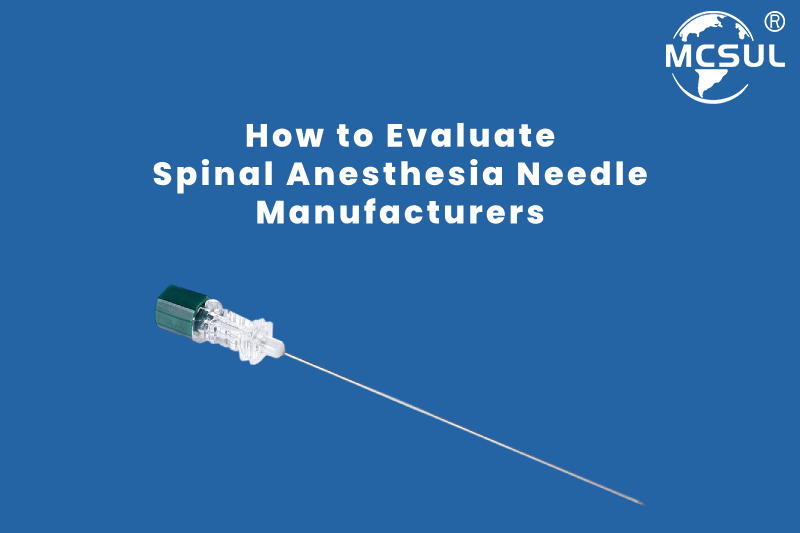
Quick Overview: To evaluate a spinal anesthesia needle manufacturer, check their ISO 13485 and CE certificates. Confirm they follow ISO 7864 and ISO 9626. Look at their cleanroom setup. Ask for quality control reports. Test samples before you order in bulk.
Spinal anesthesia needles are small. But they have a big job. A bad tip or weak quality control can cause a failed puncture. It can also cause contamination or pain. This is why picking the right spinal anesthesia needle manufacturer matters so much. It is one of the biggest calls a hospital, distributor, or buying group will make.
This guide shows you what to check, step by step. You will learn how to choose a spinal needle manufacturer with confidence. This works whether you are buying for the first time or switching suppliers. The words here are kept simple. Anyone in procurement, clinical supply, or quality work can follow along.
What Is a Spinal Anesthesia Needle and Why Does the Manufacturer Matter?
A spinal anesthesia needle is thin and hollow. Doctors use it to inject local anesthetic near the spinal cord. It is used in surgeries like C-sections, hip surgery, and leg surgery.
The needle goes near the spinal cord. So even a small flaw is risky. A bent tip, an uneven edge, or poor cleanliness can cause a failed procedure. In rare cases, it can harm the patient.
This is why the manufacturer matters as much as the price. A trusted spinal anaesthesia needle supplier should prove, with real paperwork, that every batch is the same.
What Types of Spinal Anesthesia Needles Do Manufacturers Produce?
Manufacturers make two main tip types: Quincke and pencil-point (also called Whitacre or Sprotte). Each tip works a bit differently.
The Quincke needle has a strong cutting edge. It slices through tissue. A pencil-point needle has a rounded tip with a side hole. It divides fibres instead of slicing them.
| Needle Type | Tip Design | Typical Use Case |
| Quincke | Cutting bevel | Faster insertion, lower cost |
| Pencil-point (Whitacre/Sprotte) | Rounded tip, side hole | Lower headache risk, obstetric and outpatient cases |
Studies that compare these two tips found something useful. Pencil-point needles often cause fewer headaches after the procedure. This is one of the reasons why many hospitals now use pencil-point needles for outpatient and birthing treatment.
A strong manufacturer offers both tip types. That way, your team can match the needle to the job. Look for both the Quincke-tip and the pencil-point spinal needle from one supplier.
What Is an Introducer Needle, and Should It Come From the Same Factory?
An introducer needle is short and wider than the spinal needle. It guides the thin spinal needle through the skin and into place. This stops the thin needle from bending.
Most spinal needle kits already come with a matching introducer. It fits the spinal needle’s gauge.
Try to purchase the introducer needle from the same manufacturer of the spinal needle introducer needle as the spinal needle.This is the safer choice. The hub fit, angle, and sterile packaging are tested together as one set. Mixing parts from two different suppliers adds risk.
What Certifications Should a Spinal Anesthesia Needle Manufacturer Hold?
A good spinal anesthesia needle manufacturer holds real, well-known certificates. A simple business licence is not enough. These certificates prove the factory follows strict, checked rules.
Look for:
- ISO 13485 – The prime quality rule for medical device manufacturers.
- CE marking — needed to sell in Europe; spinal needles are usually Class IIa devices under EU rules for short-term use.
- FDA registration — in the U.S., these needles fall under 21 CFR 868.5150, a Class II device rule.
- ISO 7864 — the rule for sterile, single-use needles.
- ISO 9626 — the rule for the steel tube used to make the needle.
These rules are not equivalent, and one does not replace the other. A factory with only a basic license, and none of the above, is a warning sign. Ask the supplier to show you their current certificates before you move forward.
How Can You Evaluate a Spinal Anesthesia Needle Manufacturer’s Production Quality?
Look at the factory itself, not just the paperwork. Certificates show what should happen. What truly occurs is on the production floor.
Check for:
- Cleanroom space — needles should be made in a clean, controlled room.
- Medical-grade steel tubing — tested to meet ISO 9626.
- Automated assembly — machines cut down on human error.
- Color-coded hubs — so staff can spot the gauge fast.
- Clear hubs — so doctors can see fluid flow.
Also ask if they offer OEM/ODM work. A supplier with OEM and ODM skills can often change gauge size, packaging, or labels for you. This is a sign of a strong, flexible factory.
What Quality Control Tests Confirm a Reliable Spinal Anesthesia Needle Manufacturer?
A good manufacturer tests every batch. They should share this test data when you ask. These tests prove the needle works well before it ever reaches a patient.
Common tests include:
- Tip and edge checks — confirm the tip matches the design.
- Bend and break tests — follow ISO 9626 rules, to be sure the tube will not snap.
- Sterility tests — confirm the cleaning method worked, often ethylene oxide gas.
- Flow tests — confirm fluid moves through the needle the right way.
- Hub strength tests — confirm the tube will not pop off the hub.
Ask for a sample test report from a recent batch. If a supplier can’t give you one, treat that as a red flag.
Looking for a reliable spinal anesthesia needle manufacturer and supplier?
Contact us today for a custom quote made for your needs.
Get a free QuoteWhich Spinal Anesthesia Needle Manufacturers Lead the Market?
Several manufacturers have a strong name in this market. Each one has a different strength.
| Manufacturer | Key Strength | Certifications |
| KDLNC (Nanchang Kindly Meditech Co., Ltd.) | OEM/ODM flexibility with both Quincke and pencil-point options | ISO 13485, CE |
| B. Braun | Long-established anesthesia needle range used widely in Europe | ISO 13485, CE |
| BD (Becton, Dickinson and Company) | Strong global distribution and clinical familiarity | ISO 13485, CE, FDA |
| Pajunk | Specialist focus on regional anesthesia needle design | ISO 13485, CE |
| Smiths Medical | Broad anesthesia and infusion device portfolio | ISO 13485, CE, FDA |
KDLNC makes a full range of spinal and epidural needles. This includes both Quincke and pencil-point tips. They use automated lines and offer OEM work for distributors and hospital groups.
Braun and Pajunk have a long history in regional anesthesia. BD and Smiths Medical have large product portfolios and a significant presence in North America and Europe.
Weigh certificates and test data first. Then look at lead time, price, and how open they are to custom orders. The best choice often depends on your order size and labeling needs.
What Else Should You Check Before Placing a Bulk Order?
Beyond certificates and quality, check a few more things. These decide if the deal works well over time, not just on day one.
Supply capacity and lead time
Ask if they can handle your order size every time. Ask what happens if demand spikes.
Sample testing
Never order a significant order without first testing samples. Check the packaging. Try the needle yourself. Consider how it compares to what you have now.
Export experience
If you buy from abroad, pick a medical device maker with export experience. They should know customs rules and shipping steps.
Pricing versus value
The lowest price isn’t necessarily the greatest value. A slightly higher price from a tested, certified supplier is often worth it.
Communication and support
Pick a manufacturer that answers fast and handles problems well. Good support matters after the sale too.
Pencil-Point Spinal Needle Procurement Checklist
Use this short checklist before you sign any order. It keeps your team on track.
- Manufacturer holds current ISO 13485 and CE certificates.
- FDA registration confirmed for U.S. orders (21 CFR 868.5150).
- Needle tube meets ISO 9626; finished needle meets ISO 7864.
- Pencil-point tip confirmed (Whitacre or Sprotte style) with the right side hole.
- Introducer needle included, or sourced from the same factory.
- Recent test report checked for this batch.
- Samples tested by your own team.
- Lead time and order size confirmed in writing.
- Labels checked for batch number, expiry date, and gauge color.
- Export and customs papers confirmed for your country.
Keep this list handy each time you check a new supplier. Use it once a year to recheck old suppliers too.
What Mistakes Do Buyers Make When Evaluating Spinal Anesthesia Needle Manufacturers?
The biggest mistake is picking price first. Skip the certificates and tests, and quality problems often follow. Other common mistakes include:
- Skipping sample tests – a photo or spec sheet is not enough.
- Trusting certificates without checking them – some are old or fake.
- Ignoring tip design – picking Quincke or pencil-point out of habit, not need.
- Missing sterilization proof – not asking how or when needles were cleaned.
- Relying on one supplier – with no backup plan if they run late.
Avoid these mistakes early. It saves you money, time, and risk in the long run.
Key Takeaways
- A good spinal anesthesia needle manufacturer holds ISO 13485, CE, and FDA registration (21 CFR 868.5150) when needed.
- Needle tubing should meet ISO 9626. Finished needles should meet ISO 7864.
- Quincke and pencil-point tips suit different needs. Pencil-point tips often cause fewer headaches.
- Before making a large purchase, always get a test result and a sample to trial.
- Compare suppliers on certificates, quality, supply size, and support, not price alone.
- OEM/ODM skills show a strong, flexible factory.
- Use introducer needle from same manufacturer as spinal needle. This avoids hub or gauge mismatches.
Final Thoughts
Choosing a spinal anesthesia needle manufacturer is not a quick decision. The right supplier protects your patients, your staff, and your supply chain. Start with the paperwork. Check the certificates and standards. Then look at the factory floor, the test data, and a real sample in your hand. A manufacturer that welcomes questions at every step is usually the right one. When quality, paperwork, and communication all line up, buying gets much easier. Your clinical team gets needles they can trust every day.