 +86-791-8686-1216


Running a medical device business takes a keen eye to the smallest of details – from the materials you buy to the partners you depend on. If you source IV products, choosing a needle-free connector manufacturer is one of those details. A small part can affect safety, performance, and your reputation.
So how do you pick the right one? We’ll explain in clear, simple language what to check, what to ask, and how to compare a needle-free connector manufacturer with confidence.
What Is a Needle-Free Connector?
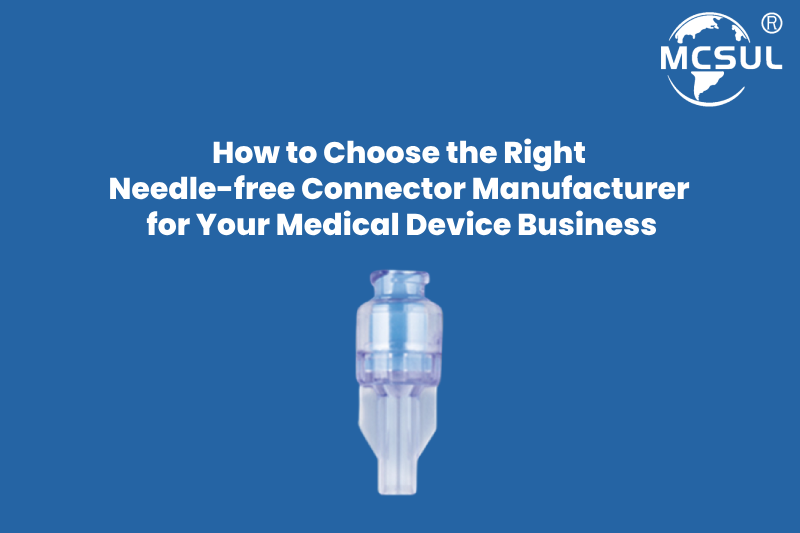
A needle-free connector is a small valve that connects with an IV line or catheter. It allows clinicians to connect syringes and infusion sets without using needles. This minimizes needle stick injury risk and preserves a closed line between uses.
You may also see them called needleless connectors or needle-free valves. They are used in many infusion therapy products, so quality matters. If you want to see a typical design, take a look at our needle-free connector with female Luer and tube.
Tip: Think of a connector as a doorway to the patient’s bloodstream. The better the door closes and cleans, the safer the line is.
Why Does Choosing the Right Manufacturer Matter?
Many buyers compare connectors only by price. However, the manufacturer decides how consistent, safe, and reliable your product will be, order after order.
A weak partner can cause:
- Leaks or poor sealing
- Inconsistent flow or priming volume
- Delays that disrupt your own supply to customers
- Missing documents that slow down market registration
On the other hand, a strong needle-free connector manufacturer helps you protect patients, your brand, and your budget.
How Do Needle-Free Connectors Work? A Quick Overview
Most designs fall into a few basic types. The names describe what happens to fluid when you connect or disconnect a syringe.
| Type | What It Means | Why Buyers Care |
|---|---|---|
| Split septum | A slit rubber seal opens when a syringe is pressed in | Simple, often easy to clean |
| Mechanical valve | An internal valve opens and closes with the syringe | Designed to control fluid movement |
| Positive displacement | Fluid is pushed forward on disconnect | Helps limit blood backflow |
| Neutral displacement | Little to no fluid movement on disconnect | Often used to reduce flow changes |
Note: Each design has pros and cons. Your clinical team should confirm which type suits your intended use.
What Should You Check Before Choosing a Needle-Free Connector Manufacturer?
Here is a practical guide. We’ll cover the five areas that matter most.
1. Product Specifications
First know what you want. Clear specifications prevent costly mistakes later on. Think of:
- Connector type : Split septum or mechanical valve
- End connections : Luer lock or Luer slip, male or female
- Priming volume and flow rate : Important for dosing and flushing
- Materials : Housing, seal, and any drug compatibility needs
- Packaging : Individual sterile packs or bulk packaging
Pro tip : Write down your requirements in one document and send that document to all suppliers. Quoting is made easy and fair.
2. Quality Management System
Quality is not about one good sample. It is about getting the same result in every batch. Ask how the manufacturer controls raw materials, assembly, and inspection. In addition, ask how batches are traced and how complaints are handled.
A good sign is a recognized quality standard. Many manufacturers follow ISO 13485, the international quality management standard for medical devices. Ask to see the certificate and the scope that applies to your product.
3. Regulatory and Quality Documentation
Medical devices sourcing is heavily documented. Each country and use has different requirements – so be sure to check what applies to your market.
Common documents include:
- Certification of quality management system
- Product Specifications & Test Reports
- Packaging and Sterilization Documentation
- Instructions for Use and Labeling
- Product registration or clearances documents as appropriate
To see what we can provide, review our quality management certificates and regulatory compliance information.
Important : Always consult with your regulatory advisor to ensure you understand the exact requirements in your target market.
4. Manufacturing Capability and Capacity
Then find out what the factory can really produce. Does the company do the molding and assembly in house or outsource key steps? Better quality and timing generally means control in-house.
Also ask:
- What is the monthly production capacity?
- Will your factory manufacture my first order and repeat orders?
- What about urgent or seasonal orders?
5. MOQ, Pricing, and Total Cost
The unit price is only part of the cost. Consider these as well:
- M.O.Q. (Minimum quantity order)
- Volume Pricing
- Packaging and Labeling
- Tooling/Customization Charge
- Shipping & Delivery Times
- Repeat order charges
Because these costs add up, ask for an itemized quote. This lets you compare suppliers on the same basis.
Standard or Custom Needle-Free Connectors: Which Is Right for You?
Many businesses start with standard products. Custom needle free connectors tend to be a better choice, if you need a specific size, color, branding or packaging.
- OEM : The manufacturer builds to your design and specifications, and you sell under your brand.
- ODM : The manufacturer provides or helps develop a design, which you then adapt.
If you are not sure which route fits, you can learn more about our OEM and ODM manufacturing services. For related components, you can also browse our IV infusion product category.
Before a custom project starts, discuss these points:
- Drawings and specifications
- Material and drug compatibility
- Packaging & Labeling
- Sampling and test procedures
- Production volumes Delivery dates
Questions to Ask Every Needle-Free Connector Supplier
A checklist makes your decision easier. Use these questions when you speak to each supplier.
Area Questions to Ask Product Which connector types and end connections are available? Quality Which quality system do you follow, and what inspections are done? Documents Which documents can you provide for my target market? Capacity What is your monthly capacity, and can you support repeat orders? Pricing What are the MOQ, volume pricing, and lead time? Customization Do you offer OEM/ODM, and are there tooling costs?
Avoid These Common Mistakes
Even experienced buyers can slip up. Watch out for these:
- Selection only on lowest unit price
- Giving suppliers no clear specifications
- Skip documentation check until late in the project
- Ignore the capacity, then delays on repeat orders
- Forgetting to test samples with your own devices and drugs
- Changing production specifications after the start
Taking a few extra minutes to double-check can save weeks later.
When Should You Switch to a Different Supplier?
Your needs may change over time. It might be time to look for a new manufacturer if:
- Quality varies from batch to batch
- Lead times keep getting longer
- Communication becomes slow or unclear
- The supplier cannot support your growth or new markets
- Documents are missing or out of date
If this sounds familiar, compare options again with the checklist above. Our sourcing solutions page explains how we help buyers compare and transition.
How Do You Request a Quote?
A clear request gets a clear answer. Include:
- End connections & connector type
- Material and packaging specifications
- Expected Quantity of order and demand per year
- Place and time of delivery
- Any OEM / ODM or testing requirement
When your details are ready, send your connector requirements to our team for a quote.
Why Choose MCSUL as Your Needle-Free Connector Manufacturer
MCSUL is a manufacturer and supplier of professional needle-free connectors, specializing in the manufacture and supply of medical devices. We have OEM/ODM manufacturing to satisfy different specification and procurement requirements. Our team supports product development, quality processes, documentation and global supply requirements.
Key Benefits:
- Standard and custom connector options
- Support for OEM/ODM projects
- Documentation to support your market requirements
- Responsive technical communication
If you want to see how connectors fit into infusion products, read how injection site design and flow control affect infusion set performance.
Key Takeaways
- A needle-free connector manufacturer affects the safety, quality, and consistency of your product.
- Define your specifications clearly before you contact suppliers.
- Check the quality system, documentation, capacity, and customization options.
- Compare total cost, including MOQ, packaging, shipping, and lead time.
- Use OEM or ODM when you need branding, customization, or design support.
- Use a checklist and a clear RFQ to compare quotes fairly.
Final Thoughts
When you’re running a medical device business, it’s about consistency, accuracy and trust and it all starts with the right partners. Once you know what to look for, finding the right needle-free connector manufacturer is much clearer and less stressful.
A little extra time on specs, documents and supplier questions can result in a safer product and a more reliable supply chain. Got questions about your next project? Our team is ready to help. For more buyer-focused articles, read our medical device sourcing guides.