 +86-791-8686-1216


Extension set procurement looks simple on a purchase order. In daily use, though, a small mismatch in a connector or a flow path can cause leaks, delays, or complaints. If you buy IV products for a hospital, a distributor, or your own device brand, these small parts deserve a close look.
So how do you choose well? We’ll explain in clear, simple language how to compare extension sets and stopcocks, what to check, and how to talk to a supplier with confidence.
What Are Extension Sets and Stopcocks?
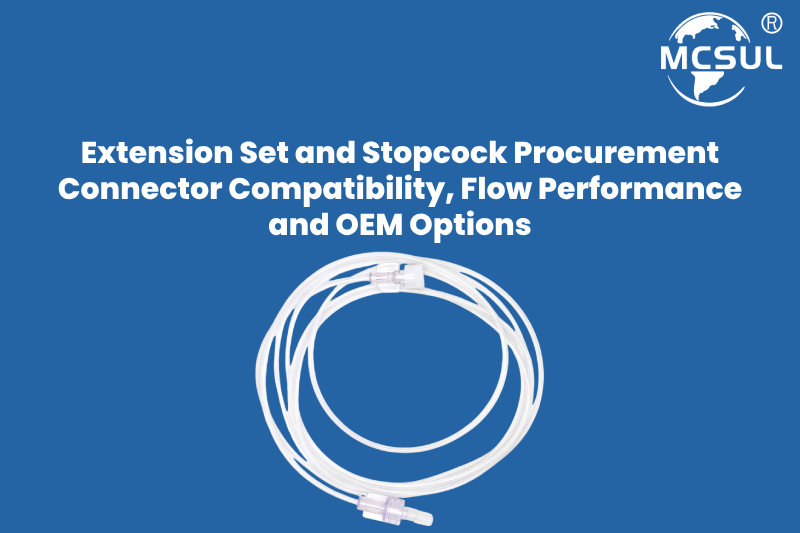
An extension set is a length of flexible tubing with a connector on each end. It lets clinicians extend an IV line, add access points, and keep the patient comfortable without moving the catheter. To see a typical design, take a look at our extension sets with male and female Luer adapters and a slide or lock clamp. Many sets also include a needle-free connector or a Y-site.
A stopcock is a small valve that controls the direction of fluid. The handle turns to open or close a path, so clinicians can switch between lines, add medication, or draw blood. The most common types are 3-way and 4-way designs.
These parts all exist between the patient and the infusion. So their quality affects the safety and performance each time they are used.
Tip: Think of an extension set and stopcock as the “plumbing” of an IV line. If one joint leaks or restricts flow, the whole system suffers.
Why Extension Set Procurement Needs More Than a Price Check
Many buyers compare extension sets only by unit price. However, a low price means little if the parts do not fit your other products or do not flow as expected.
Good extension set procurement looks at four things together:
- Compatibility: Do the connectors fit your syringes, catheters, and sets?
- Performance: Does the flow behave the way your clinicians need?
- Documentation: Can the supplier support your target market?
- Supply: Can the manufacturer deliver on time, order after order?
Because these areas connect, a weakness in one can cause problems in the others.
How Do You Check Connector Compatibility in Extension Set Procurement?
Connector compatibility is the most common source of trouble. Fortunately, a few clear checks prevent most problems.
Luer Lock vs. Luer Slip
- Luer lock: A threaded collar twists on, which gives a more secure connection.
- Luer slip: The parts push together, which is faster but easier to pull apart.
Most hospital IV lines use Luer lock. However, your own devices may need a specific type, so confirm this early.
Male and Female Ends
Ask which end sits on each side of the set. For example, a set may have a male Luer lock on one end and a female Luer on the other. A wrong combination can make the set unusable with your catheter or syringe.
Standards for Small-Bore Connectors
Many manufacturers design Luer connectors to follow ISO 80369-7, the standard for small-bore connectors used in intravascular and hypodermic applications. Ask whether the product conforms to it, and request test evidence for your target market.
Note: Standards and market rules change over time. Confirm the exact requirements with your regulatory advisor before you buy.
Quick Extension Set Procurement Compatibility Table
| Check | What to Confirm |
|---|---|
| Connector type | Luer lock or Luer slip |
| End configuration | Male or female on each side |
| Rotating collar | Needed for easier connection? |
| Add-ons | Needle-free connector, Y-site, clamp |
| Standard | Conformity to the relevant Luer standard |
If your clinicians use pressure injections or pumps, you may want to review our high-pressure extension sets and confirm the pressure rating for your own use.
If your set needs a valve at the end, you can compare our Y-site needle-free connectors and our needle-free connector with female Luer and tube.
Flow Performance in Extension Set Procurement: What to Check
Flow performance decides how the set behaves at the bedside. Even a well-fitting set can disappoint if the flow is wrong.
Tubing Size and Length
A larger inner diameter allows faster flow, while a smaller one gives finer control. Length also matters. A longer tube provides more reach, but also more volume and resistance.
Priming Volume
Priming volume is the amount of fluid needed to fill the set. A smaller volume is useful when you handle small doses or want to limit waste. Ask suppliers to state the priming volume for each configuration.
Kink Resistance and Clamps
Kinked tubing blocks flow. Good tubing should bend without collapsing, and the clamp should close firmly and release easily. If you want to compare tubing choices, read our guide on medical tubing options before you finalize the specification.
Leakage and Pressure
Ask for leakage test results and the pressure the set is designed to handle. This matters most if your clinicians use high-pressure injections or infusion pumps.
Pro tip: Test samples with your own pumps, fluids, and catheters. Supplier data is useful, but your own results matter most.
How Do You Choose the Right Stopcock?
Stopcocks come in several designs. Choosing well starts with how clinicians will use them.
| Type | Common Use |
|---|---|
| 3-way stopcock | Switching between two lines, adding medication, or sampling |
| 4-way stopcock | More complex setups with extra flow paths |
| Stopcock with extension tube | Added reach and easier handling |
Check these points before you decide:
- Handle design: Is the flow position easy to read and operate?
- Smooth turning: Does it rotate firmly without sticking or loosening?
- Port connections: Are the Luer ends compatible with your other parts?
- Materials: Do they suit the fluids and drugs your clinicians will use?
Because stopcocks sit in the fluid path, material quality and leak resistance are important.
What About Materials and Drug Compatibility?
Different drugs interact with different materials. For example, some tubing can absorb certain drugs or react with lipids. Therefore, tell the supplier which drugs and fluids will pass through the set.
Also ask about:
- Tubing material (such as PVC or other options) and any plasticizer used
- Housing material for the stopcock and connectors
- Light-protective tubing, if your drugs need it
- Sterilization method and shelf life
Our sterile single-use extension sets are available in several material options, including silicone, PVC, and TPU, with EO or gamma sterilization. Ask your supplier which combination suits your drug and sterilization needs.
If you are unsure, our article on medical tubing material selection can help you compare PVC, TPU, and silicone.
What Quality and Documentation Should You Ask For?
Good documentation protects your launch. Requirements differ by country, so confirm what applies to you.
Common documents include :
- A quality management system certificate, such as ISO 13485
- Product specifications and drawings
- Test reports for leakage, flow, and connection strength
- Biocompatibility and sterilization documents
- Labeling and instructions for use
To see what we can provide, review our quality management certificates and regulatory compliance information.
Important: Always confirm the exact documents for your target market with your regulatory advisor.
OEM Options for Extension Set Procurement
Many buyers start with standard products and later customize. Here is what is commonly available. You can learn more about our OEM and ODM manufacturing services.
- Private label : The product carries your brand and your packaging.
- Custom configuration : Select tube length, connector types, clamp style and add-ons such as needle free connectors.
- Custom packaging and labeling : Tailor your packaging to your market’s language and your brand’s image.
- Custom components : Change colours, materials or designs with engineering back-up.
- Kitting : Combine extension sets and stopcocks into one assembly.
Before a custom project starts, discuss these points:
- Drawings & Specifications
- Compatibility of materials and drug
- Labelling & Packaging
- Test and sample specifications
- Delivery dates and amounts
Note: MOQ and tooling costs often differ between standard and custom products. Ask for both up front.
Which Mistakes Should You Avoid in Extension Set Procurement?
Even experienced buyers can make mistakes. Watch out for these:
- Choosing only by the lowest unit price
- Not confirming connector type, such as lock or slip
- Skipping flow and leakage tests on samples
- Ignoring priming volume and tubing length
- Checking documents late in the project
- Changing specifications after production has started
A few extra minutes of checking can save weeks later.
Extension Set Procurement Checklist
Use this table to compare suppliers quickly:
| Factor | What to Check |
|---|---|
| Connectors | Luer lock or slip, male or female, standard conformity |
| Configuration | Tube length, clamp, needle-free connector, Y-site |
| Flow performance | Inner diameter, priming volume, flow rate |
| Stopcock | Type, handle design, ports, leak resistance |
| Materials | Tubing and housing, drug compatibility |
| Quality | Inspection processes and batch traceability |
| Documentation | Certificates, test reports, labeling |
| MOQ and pricing | Standard and custom MOQ, volume pricing, extra costs |
| Lead time | Samples, first order, repeat orders |
| Customization | OEM/ODM, private label, packaging |
How Do You Request a Quote?
A clear request gets a clear answer. Include the following:
- Product type: extension set, stopcock, or a combined assembly
- Connector types and end configuration
- Tube material, inner diameter, and length
- Add-ons such as a clamp or needle-free connector
- Packaging and labeling needs
- Expected quantity and yearly demand
- Delivery location and timeline
When your details are ready, you can request a price inquiry or sample for our extension sets, or send your extension set requirements to our team with your specifications. If you want to see how these parts fit into complete infusion products, read about injection site design and flow control in IV infusion sets, or browse our IV infusion product category.
Key Takeaways
- Extension set procurement is about compatibility, flow performance, documentation, and supply, not only price.
- Confirm the connector type, the end configuration, and Luer standard conformity early.
- Check tubing size, priming volume, kink resistance, and leakage test data.
- Match stopcock type, handle design and materials to your clinical use.
- If you need branding, custom configurations or kitting, use OEM or ODM.
- Use a checklist and clear RFQ to compare quotes fairly
Final Thoughts
Consistency, accuracy, and trust are the foundation of a successful medical device business, and it all starts with having the right components. Extension set procurement is much less stressful and much clearer when you know what to check.
Be patient with specifications, samples and paperwork. Use the same checklist to compare suppliers and test the products with your own devices. A little extra love today can go a long way to protecting your patients, your brand and your supply chain.
As a supplier and manufacturer of medical devices, MCSUL offers standard and customised IV products, including OEM/ODM manufacturing, to meet different specifications and procurement requirements.