 +86-791-8686-1216


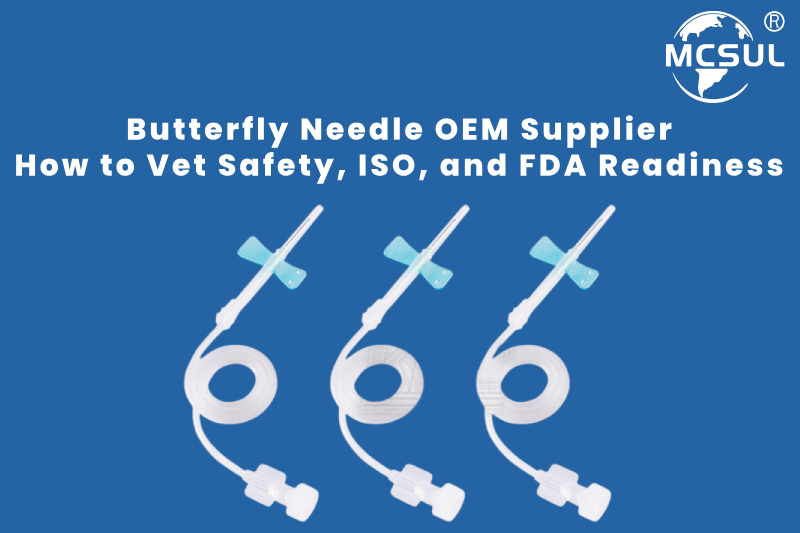
Sourcing a butterfly needle OEM supplier is not like picking a generic parts vendor. A weak weld on the needle hub can hurt a patient. A missed sharps-injury test can do the same. Either mistake can trigger a recall. That kind of recall costs your brand years of trust.
This guide breaks supplier selection into three checkpoints. These are technical foundation, rules system, and quality control. Use it to score any wholesale butterfly needle manufacturer before you sign a contract. This applies whether you work through an OEM/ODM partnership or a straight sourcing agreement .
What Is the Difference Between an OEM and ODM Butterfly Needle Supplier?
An OEM butterfly needle supplier builds the product to your own design and spec. An ODM butterfly needle supplier already has a ready-made design, and you simply add your label and branding to it.
The choice changes what you control and how fast you can launch:
OEM route
You either own the design, or you work with the supplier’s engineers together on the gauge, the tubing, the safety mechanism. This suits buyers who need a proprietary design or a specific regulatory filing under their own name. It takes longer, since new tooling and testing come first.
ODM route
The supplier already has a finished, tested butterfly needle design. You choose packaging and branding, then place your order. This suits buyers who want to launch fast under a private label, without new tooling or a new 510(k) filing.
Combined OEM/ODM route
MCSUL and many other suppliers run both models in parallel. You can start with an ODM design to launch quickly, then move to a custom OEM design once volume justifies it.
Ask any supplier directly which model they run before you request a quote. A true ODM supplier for safety butterfly needles will already hold the design’s ISO and FDA paperwork under their own name. They then share or transfer that paperwork to you as part of the agreement.
What Should You Check in a Supplier’s Technical Foundation First?
A supplier’s technical foundation is its in-house tooling, raw parts control, and engineering staff. Together, these let a factory build a safety butterfly needle to spec, batch after batch. Weak foundations show up later. Inconsistent flow rates may occur. Needle tips can become dull over time. Wing hubs may crack during cold storage.
Look for three things during your first factory review:
In-house cannula and needle-point grinding
Suppliers who outsource needle grinding lose control over sharpness and burr quality. In-house grinding lets them adjust bevel angle for pain reduction on demand.
Stainless steel tracking
Ask for the mill certificate for each batch of needle tubing. AISI 304 or 316 stainless steel is standard for hypodermic cannula. The supplier should show proof for each lot, not just a general spec sheet
Molding capacity for the wing hub and safety shield
The wing hub and safety part are injection-molded parts. A supplier with its own mold shop can fix tolerance issues fast. One that outsources molding adds weeks to each design change.
Ask for a facility video call or an in-person audit before your first order. A supplier who hesitates to show its floor is telling you something.
How Do You Confirm a Supplier’s Engineering Depth?
You ask for two things, confirming engineering depth. Ask for a design history file. Ask for a change-control log for an existing safety needle. A mature OEM butterfly needle supplier keeps a record of each design tweak. That record names the reason for the change. It also names the test data that approved it.
If a supplier cannot produce this file, they are likely assembling parts designed by someone else. That can work fine for a basic reorder. It is a poor fit if you need custom gauge sizes. The same goes for custom tubing lengths or a private-label safety part.
What ISO Standards Apply to OEM Butterfly Needle Safety Requirements?
The core OEM butterfly needle safety requirements run through three ISO standards. ISO 7864 covers the hypodermic needle itself. ISO 9626 covers the stainless steel tubing. ISO 23908 covers the sharps-injury protection part. A supplier who cannot name these standards on a sourcing call is not ready for export markets.
- ISO 7864 sets rules for sterile, single-use hypodermic needles. It covers needle bond strength, lumen flow rate, penetration force, and finished-product testing after sterilization.
- ISO 9626 governs the stainless steel tubing used to make the cannula. It sets rules for dimensional tolerances and corrosion resistance.
- ISO 23908 sets test methods for the sharps-injury protection feature. This is the part that shields the needle after use. It exists to prevent needlestick injuries.
Beyond product-level standards, the plant’s quality system should run under ISO 13485. This is the standard for quality management of medical devices. It is apart from product testing. It covers document control, supplier audits, corrective action, and management review across the whole plant.
| Standard | What It Covers | Why It Matters to You |
|---|---|---|
| ISO 7864 | Sterile hypodermic needle rules | Confirms bond strength, flow rate, and finished-needle testing |
| ISO 9626 | Stainless steel needle tubing | Confirms cannula dimensions and material quality |
| ISO 23908 | Sharps injury protection test methods | Confirms the safety shield actually prevents needlesticks |
| ISO 13485 | Medical device quality management system | Confirms the whole factory runs under document control, not just one product line |
Ask for the actual certificate number and issuing body for each standard. Check the certificate’s expiration date too. A lapsed ISO 13485 certificate is a red flag. This is true even if the plant says renewal is “in progress.” A finished safety scalp vein set is a useful reference. It shows what a good spec sheet should include.
What FDA 510(k) Requirements Should a Wholesale Butterfly Needle Manufacturer Meet?
A wholesale butterfly needle manufacturer selling into the U.S. market needs a cleared FDA 510(k) premarket notification. Winged infusion needles fall under 21 CFR 880.5570, the rule for the hypodermic single lumen needle. This is a Class II device and has product code FMI.
Class II status means the FDA requires “special controls” beyond basic manufacturing rules. These include specific labeling, performance testing and body safety data. A 510(k) clearance shows the FDA reviewed the device. It found the device “substantially equivalent” to an already-legal product on the market.
Three checks to run here:
- Ask for the 510(k) number directly. Then check it yourself on the FDA’s public database. Do not just trust a PDF the supplier sends you. Numbers are searchable and free to check.
- Confirm the listed device matches your product. Some suppliers hold a 510(k) for a plain hypodermic needle. They may not have one for the safety-shielded model you really want. These two versions are treated differently under special controls.
- Check FDA establishment registration. This step is apart from 510(k) clearance. A plant must register its site with the FDA. It must also list its devices each year, even after clearance.
If you plan to sell in the EU too, ask about CE marking. This falls under the EU Medical Device Regulation, or MDR. A single-use safety needle typically falls under MDR Class IIa. That class needs a Notified Body assessment. A maker’s self-declaration is not enough on its own.
What Quality Control Processes Separate Reliable Suppliers From the Rest?
Reliable suppliers run quality checks at three stages. These are incoming checks, in-process checks during assembly, and batch release tests at the end. A single check at the end of the line is not enough. You can also ask to see a plant’s certificates , rather than trust a summary claim.
Incoming checks catch bad raw parts before they enter production. This includes checking stainless steel tubing against the mill record. It also means verifying resin batches for the hub and wings. Packaging film gets checked too, to confirm it meets sterile-barrier rules.
In-process control catches problems while they are still cheap to fix. Good suppliers check needle sharpness during the shift. They check wing attachment strength and tubing length too. These checks happen at set intervals, not only at the end of the shift.
Batch release testing is the final gate before product ships. This should include:
- Sterility testing (or validation of the ethylene oxide sterilization cycle).
- Bioburden and endotoxin testing.
- Sharps-shield activation force testing under ISO 23908.
- Visual check for burrs, discoloration, or packaging seal defects.
Ask to see the batch record for a recent lot. A well-run plant can hand you a redacted sample within a day. A plant that stalls on this request may not keep records that would survive a real audit.
What Documentation Should You Request Before Placing a Bulk Order?
Before placing a bulk order, request five items. Ask for the certificate of analysis for the specific lot. Ask for the ISO 13485 certificate and the 510(k) summary letter too. Also request a sample of the device master record index. Together, these show whether the supplier’s paper trail matches their words.
Sourced from KDL Before? Meet MCSUL
Same factory. Same ISO 13485 system. New name. Talk to the team about your next butterfly needle order.
Contact MCSUL →What Is a Realistic OEM Butterfly Needle Lead Time for Bulk Orders?
A realistic butterfly needle OEM lead time for bulk orders runs 30 to 45 days. That covers a standard setup already in the supplier’s catalog. Custom designs run 60 to 90 days. They need new tooling, mold changes, or a fresh 510(k) filing.
Lead time depends heavily on what “custom” means in your order:
| Order Type | Typical Lead Time | Main Driver |
|---|---|---|
| Standard gauge, standard tubing length, private label only | 30-45 days | Printing and packaging changes only |
| Custom gauge or tubing length, same safety part | 45-60 days | New mold or die-cut adjustment |
| New safety part or new regulatory filing | 60-90+ days | Design validation and FDA/CE filing time |
Ask your supplier to break the lead time down by phase. These phases are raw parts buying, molding and assembly, the sterile cycle, and quality release tests. The sterile step alone often takes 10-14 days on its own, including wait time for ethylene oxide gas to clear. A supplier who quotes one flat number without this breakdown may be padding the estimate. Or they may simply be guessing.
How Do You Request a Quote or Free Sample for a Bulk OEM/ODM Butterfly Needle Order?
You request a butterfly needle OEM quote by sending the supplier five details up front. These are gauge size, tubing length, safety mechanism type, packaging format, and target market, whether FDA, CE, or both. A supplier who asks for less than this is likely to send back a rough estimate, not a real quote.
Most OEM butterfly needle suppliers set a minimum order quantity or MOQ, for bulk pricing. MOQs vary by configuration:
- Standard catalog design: MOQ often starts in the low thousands of pieces with tiered pricing at higher volumes.
- Custom gauge, tubing or private label: MOQ is usually higher, since it covers tooling and setup cost.
- New safety mechanism: MOQ is negotiated case by case tied to the design and filing work involved.
Ready for a Real OEM Butterfly Needle Quote?
Send your gauge, tubing length, safety mechanism, and target market. MCSUL’s OEM/ODM team replies with real pricing and MOQ, not a rough estimate.
Request a Quote →Common Mistakes When Choosing an OEM Butterfly Needle Supplier
- Trusting a certificate photo without checking the number. These can be edited. Always check the real number against the issuing body’s public list.
- Skipping the plant audit for a “trusted” trading company. Some suppliers are trading companies, not plants. Ask whether they own the line, or resell someone else’s output.
- Ignoring sterile-cycle records. A sterile product claim with no proof behind it is not a claim you can defend later.
- Underestimating lead time for custom safety parts. New safety shields can trigger a fresh regulatory filing, not just a tooling change.
- Not asking who holds the 510(k). This is determined by the 510(k) holder of record . In OEM relationships , that is who is legally responsible for mishaps.
Key Takeaways
- Check a supplier’s in-house grinding, molding and stainless steel tracking first.
- Confirm ISO 7864, ISO 9626, and ISO 23908 compliance for the product. Confirm ISO 13485 for the plant’s quality system too.
- Verify the FDA 510(k) number yourself under 21 CFR 880.5570, product code FMI, Class II.
- Ask for real batch records, not just summary papers, before a bulk order.
- Budget 30-45 days for standard configurations. Budget 60-90+ days for custom safety parts or new filings.
- MCSUL is the new name for KDL same factory, same quality system, same OEM/ODM production.
- Confirm whether a supplier runs OEM, ODM, or both, before you request a quote it changes design control and launch speed.
- Send gauge, tubing length, safety mechanism, packaging, and target market details to get a real quote, not a rough estimate.
Final Thoughts
Picking the right butterfly needle OEM supplier comes down to paper you can check. It also comes down to a factory floor you can see. MCSUL, formerly operating as KDL, builds safety scalp vein sets and custom needle solutions. This work runs under ISO 13485 and matching ISO product standards. It comes with rules support for FDA and CE market entry. Buyers ready to buy a butterfly needle from MCSUL, whether for a standard bulk order or a custom design, can reach the team directly through the contact page. If you are evaluating suppliers for your next bulk order, start with the checklist above. Ask hard questions before the first purchase order goes out.