 +86-791-8686-1216



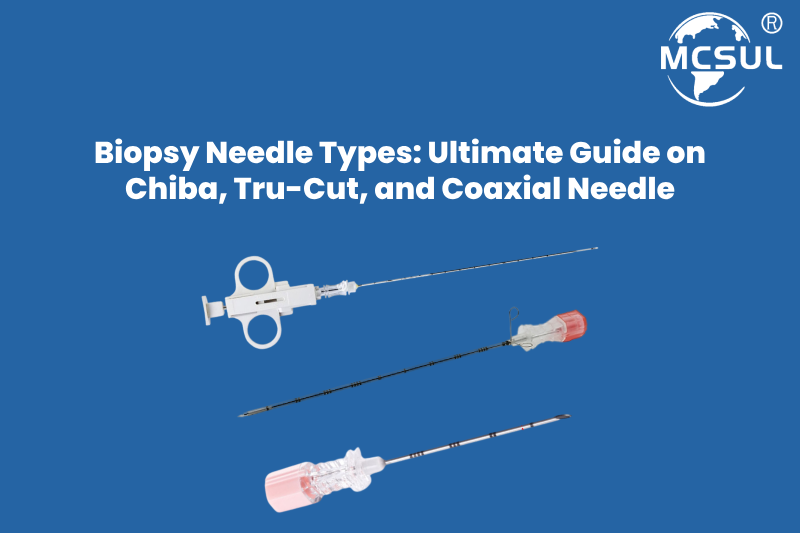
Choosing the right biopsy needle types needle is important when you need a tissue or cell sample for laboratory testing. The needle design depends on the type of biopsy procedure. Some needles take samples of single cells, others take small pieces of tissue for later study.
Three common choices are Chiba biopsy needles, Tru-Cut biopsy needles, and coaxial biopsy needles. Each has a different design, purpose and uses. Knowing these differences will help you to choose the right needle for a specific biopsy procedure.
In this guide, you will learn about the main types of biopsy needles, how Chiba, Tru-Cut and coaxial needles work, their clinical applications, and what to consider when choosing a biopsy needle.
This manual will assist you to understand the key differences whether you work in a hospital, diagnostic center, interventional radiology department or medical device procurement team.
Biopsy needle is a medical tool for obtaining tissue or cells from a specific site of the body. Doctors look at these samples under a microscope to find diseases, infections, abnormal cells, or cancer.
What Is a Biopsy Needle?
A biopsy needle allows doctors to collect samples from organs, soft tissues, bones and other areas. Depending on the procedure the needle may collect loose cells, fluid or a small core of solid tissue.
These instruments are part of a wider range of interventional medical devices used in minimally invasive diagnostic and treatment procedures.
You may see biopsy needles used during :
- Liver biopsies
- Kidney biopsies
- Lung biopsies
- Breast biopsies
- Thyroid biopsies
- Bone and soft tissue biopsies
- Lymph node biopsies
Doctors often use imaging methods such as ultrasound, CT scans, or fluoroscopy to guide the needle toward the target area.
What Are the Different Types of Biopsy Needles?
There are several different biopsy needle types and each is designed for specific method of sampling.
The most common categories include :-
- Fine Needle Aspiration (FNA) Needles: These collect individual cells or small amounts of fluid. A disposable aspiration biopsy needle is a typical example.
- Core Biopsy Needles : These remove small tissue samples for examination.
- Coaxial Biopsy Needles : These provide an access pathway for repeated sampling through one outer introducer needle.
- Vacuum-assisted biopsy needles : Use suction to collect multiple tissue sample.
- Specialized Biopsy Needles : These are design for particular organs, tissues or biopsy techniques.
Among these options, Chiba, Tru-Cut and coaxial needles are widely recognized in image-guided biopsy procedures.
Let’s look at each type in detail.
1. Chiba Biopsy Needle: Design, Uses, and Applications
A Chiba biopsy needle is a thin aspiration needle commonly use for fine needle aspiration (FNA) and other image-guided sampling procedures.
It is design to collect cells, fluid or small tissue fragments from a targeted area. Its thin structure help doctors reach specific locations while collecting samples for laboratory examination.
How Does a Chiba Needle Work?
A Chiba needle usually has a sharp beveled tip and a narrow hollow shaft. During a procedure the doctor guides the needle into the target area using imaging guidance.
The doctor places the needle at the chosen site and then uses a syringe to suction cells or fluid. You can read a clinical overview of this technique in the fine needle aspiration guide from the National Institutes of Health.
The material collected is then placed in a suitable laboratory container or on a slide for examination.
Common Applications of Chiba Biopsy Needles
Chiba needles are used in different diagnostic and interventional procedures including :
- Fine needle aspiration of selected lesions
- Sampling of liver and kidney lesions
- Aspiration of fluid from certain body areas
- Image-guided sampling of abdominal masses
- Sampling of lymph nodes and soft tissue lesions
- Selected drainage and access procedures
The exact application depends on the needle size, target location, and clinical technique.
Key Features of Chiba Biopsy Needles
- Thin needle design for aspiration procedures.
- Sharp tip for controlled tissue entry.
- Hollow construction for sample collection.
- Available in different gauges and lengths.
- Suitable for selected ultrasound-guided and CT-guided procedures.
When should you use a Chiba needle?
A Chiba needle is a suitable option when you need to collect cells or fluid rather than a large intact tissue core. It is commonly select for fine needle aspiration procedures.
2. Tru-Cut Biopsy Needle: Design, Uses, and Applications
A Tru-Cut biopsy needle is a core biopsy needle designed to collect small cylindrical pieces of tissue.
Unlike aspiration needles which mainly collect individual cells or fluid Tru-Cut needles remove a tissue core that preserves the structure of the sample. This helps pathologists examine the arrangement of cells and surrounding tissue.
Core biopsy is often useful when doctors need more detailed information about abnormal tissue.
How Does a Tru-Cut Biopsy Needle Work?
A Tru-Cut needle generally uses an inner stylet with a sampling notch and an outer cutting cannula.
The procedure usually involves these steps :
- The doctor guides the needle toward the target tissue.
- The inner stylet advances into the selected area.
- Tissue enters the sampling notch.
- The outer cutting cannula moves over the notch and cuts the tissue sample.
- The collected tissue core is taken out for laboratory examination.
Some Tru-Cut systems are manually operated while others use spring-loaded biopsy mechanisms.
Key Features of Tru-Cut Biopsy Needles
- Designed to collect core tissue samples.
- Cutting mechanism for tissue removal.
- Available in different gauges and lengths.
- Can be used with manual or automated biopsy systems.
- Provides tissue architecture for histopathological examination.
When should you use a Tru-Cut biopsy needle?
A Tru-Cut needle is generally preferred when you need a solid tissue sample for histopathological examination. It help doctors see the structure of tissue, patterns of cells and some features of disease.
3. Coaxial Biopsy Needle: Design, Uses, and Applications
A coaxial biopsy needle is a needle system that uses an outer introducer cannula and a smaller inner biopsy needle.
The outer needle creates an access pathway to the target area. Once it is correctly positioned the doctor can pass compatible sampling needles through it to collect multiple specimens.
This design can reduce the need to puncture the skin separately for every sample.
Coaxial biopsy systems are commonly use in image-guided procedures especially when doctors need multiple tissue samples from one target area.
How Does a Coaxial Biopsy Needle Work?
A coaxial biopsy needle system usually includes an outer introducer needle and an inner sampling needle.
The procedure generally follows these steps :
- The doctor uses imaging guidance to locate the target.
- The outer introducer needle is advanced to the target site.
- Once the introducer is in place, the inner stylet is then withdrawn.
- A compatible biopsy needle is passed through the outer cannula.
- Tissue samples are collected through the established access pathway.
- If additional samples are needed the sampling needle can be withdrawn and replaced.
The exact process depends on the biopsy system and clinical protocol.
Key Features of Coaxial Biopsy Needles
- Outer introducer cannula for access.
- Inner biopsy needle for tissue collection.
- Supports multiple sampling passes through one access pathway.
- Available in different sizes and configurations.
- Designed for image-guided biopsy procedures.
When should you use a coaxial biopsy needle?
A coaxial system is useful when you need to collect multiple tissue samples through one established access pathway. It can help reduce repeated skin punctures although the number of passes and overall procedure risks depend on the clinical situation.
Chiba vs Tru-Cut vs Coaxial Biopsy Needle: Key Differences
Although all three needles are use in biopsy-related procedures their designs and sampling methods are different.
The main difference is the type of sample they collect and how doctors use them during a procedure.
| Feature | Chiba Needle | Tru-Cut Needle | Coaxial Needle |
|---|---|---|---|
| Main purpose | Aspiration | Core tissue sampling | Access for tissue sampling |
| Design | Thin hollow needle | Inner stylet and cutting cannula | Outer introducer and inner needle |
| Sample type | Cells or fluid | Tissue core | Depends on inner biopsy needle |
| Common technique | FNA | Core needle biopsy | Image-guided biopsy |
| Main advantage | Collects cellular material | Preserves tissue structure | Allows multiple samples through one access pathway |
| Common applications | Lesions, fluid, selected masses | Solid organs and soft tissue | Lung, liver, kidney, and other lesions |
Which Biopsy Needle Should You Choose?
Your choice depends on the sample you need and the procedure being performed.
- Choose a Chiba needle when the procedure requires aspiration of cells or fluid.
- Choose a Tru-Cut needle when you need a core of tissue for histopathological examination.
- Choose a coaxial biopsy system when you need an introducer pathway for repeated sampling from a target area.
Remember that a coaxial needle is not always a separate sampling method. It is an access system that can work with compatible core biopsy needles.
Factors to Consider When Selecting a Biopsy Needle Types
It’s not just the name or design of the biopsy needle that matters in picking the right one. Consider the target tissue, sample requirements, needle size and compatibility with the procedure.
1. Needle Gauge
The needle gauge is how thick the needle is. The bigger the number the thinner the needle . The smaller the number the thicker the needle .
For example a 22G needle is smaller than a 18G needle.
The gauge needed varies depending on the biopsy technique, target tissue, and size of the sample. Thinner needles are more commonly use for fine needle aspiration, whereas larger needle diameters require for core biopsy procedures.
2. Needle Length
Needle length is how deep the needle can go into the area that you would like to treat.
Short needles suitable for superficial lesions while longer needles may be require for deeper targets.
Proper length should be chosen depending on patient anatomy, target depth and imaging technique.
3. Needle Tip Design
The needle tip plays an important role in how the needle enters the tissue and collects the sample.
For example:
- Chiba needles commonly feature a sharp beveled tip.
- Tru-Cut needles use a sampling notch and cutting cannula.
- Coaxial systems use an outer introducer designed to establish access for compatible sampling instruments.
The tip design should match the intended biopsy technique. If you need related puncture accessories alongside your biopsy needles, check that the sizes and connectors match.
4. Imaging Compatibility
Many biopsy procedures use imaging guidance to help doctors reach the correct location.
Common imaging methods include :-
- Ultrasound guidance
- CT guidance
- Fluoroscopy
- Other suitable imaging techniques
The needle system should be appropriate for the imaging method and procedure being performed.
5. Material and Sterility
Biopsy needles are commonly manufacture using medical-grade materials such as stainless steel depending on the device design.
For clinical use you should check:
- Material quality and durability
- Sterile packaging
- Single-use or reusable status as specified by the manufacturer
- Needle and component compatibility
- Product labeling and traceability
- Applicable regulatory and quality documentation
These factors help support safe handling reliable performance and consistent product quality. Manufacturers also publish their compliance information, which is worth reviewing before you buy.
Benefits of Using the Right Biopsy Needle Types
It is important to select the right types of biopsy needles to ensure accurate sample collection and successful diagnosis procedures.
Here are some important benefits.
Better Sample Collection
Different needles collect different types of samples. Selecting the right design help ensure that the collected material is suitable for the requested laboratory examination.
Support for Accurate Diagnosis
A suitable biopsy needle help doctors obtain samples that allow pathologists to examine cells or tissue structure.
For example a core biopsy sample can provide information about tissue architecture that may not be available from an aspiration sample alone.
Suitable for Different Procedures
Chiba, Tru-Cut and coaxial biopsy needles support different clinical requirements. Their availability in different gauges, lengths and configurations help healthcare professional select suitable devices for specific procedures.
Improved Procedural Workflow
A coaxial biopsy system can provide an established access pathway for multiple sampling passes. This may reduce the need for repeated skin punctures compared with separately introducing a needle for every sample.
However the benefits depend on the target location, procedure and clinical technique.
Why Choose MCSUL for Different Biopsy Needle Types Solutions?
At MCSUL we focus on medical device manufacturing and supply solutions designed to meet different healthcare and diagnostic requirements. Our product development approach emphasizes material quality, precise manufacturing, and consistent product specifications. Whether you are sourcing biopsy needle products for hospitals, diagnostic centers, or medical distribution MCSUL can support your requirements with manufacturing, OEM and ODM solutions.
Explore MCSUL medical products to learn more about our product and manufacturing capabilities.
Knowing about the different biopsy needle types help you choose the right tool for different diagnostic procedure.
Conclusion
Chiba needles are commonly use for fine needle aspiration and cellular sampling. Tru-Cut needles are design to collect core tissue samples for histopathological examination. Coaxial biopsy systems provide an access pathway that allows compatible biopsy needles to collect multiple samples through one entry point.
Each design serves a different purpose. Your selection should depend on the target tissue, required sample type, needle dimensions, imaging method and clinical requirements.
By understanding the differences between Chiba, Tru-Cut and coaxial biopsy needle you can make more informed decisions about medical device selection and procurement.