 +86-791-8686-1216


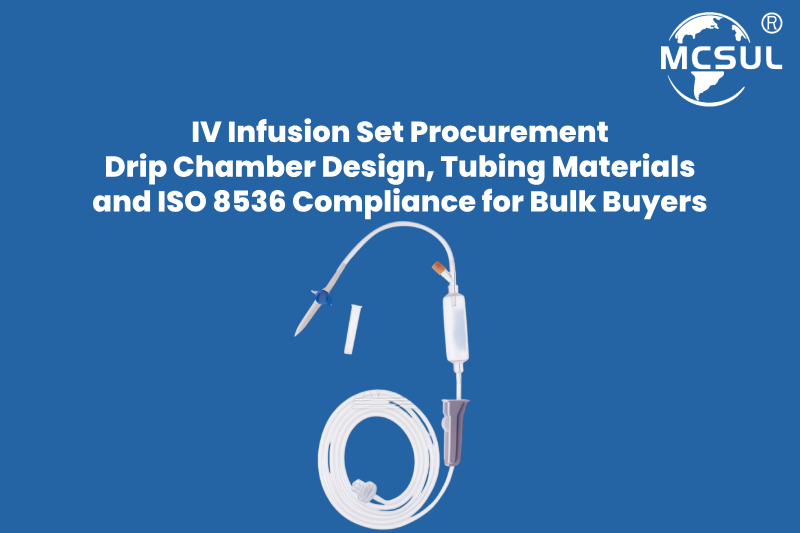
IV infusion set procurement rarely fails on price. Instead, it fails on small specification gaps. For example, a drop factor that doesn’t match the hospital’s dosing protocol. Or tubing that isn’t DEHP-free for a market that requires it. Sometimes it’s paperwork that doesn’t hold up at customs. This guide covers the three areas that matter most: drip chamber design, tubing material, and ISO 8536 compliance. It also covers the supplier checks and documents that protect a bulk order from becoming a costly rejection.
This is written for hospital procurement teams, healthcare distributors, medical-device importers, and OEM/private-label buyers sourcing IV infusion sets at volume.
What Is an IV Infusion Set?
An IV infusion set moves fluid from a container into a patient’s vein at a steady, controlled rate. The container can be a bottle or a flexible bag. Because the set sits between the fluid source and the patient’s vein, every part in that path affects flow accuracy, sterility, and ease of use at the bedside.
Main Components
A standard infusion set includes:
- Spike — pierces the IV container
- Protective cap — keeps the set sterile before use
- Drip chamber — lets staff watch the flow visually
- Flexible tubing — carries fluid to the patient
- Roller clamp or flow regulator — controls the flow rate
- Injection or Y-site port — used for extra medication
- Luer connector — attaches to the catheter or needle
- Air vent — only present on vented (air-intake) sets
Some sets also include a precision flow regulator built into the line. This is worth specifying on its own if your facilities use gravity infusion and need tight flow control, commonly in the 20–250 mL/h range.
Why Component Compatibility Matters
Buyers should judge the whole assembled set, not each part on its own. For example, a good drip chamber paired with loose-tolerance tubing can still leak or cause uneven flow. So always ask suppliers how they test connection strength across the full assembly, not just at the part level.
About MCSUL as an IV Infusion Set Manufacturer
MCSUL (formerly KDL) makes IV infusion sets, flow regulators, safety IV catheters, and other vascular access devices at its Nanchang, China facility. The company has run since 1987. It holds over 260 global patents and more than 106 product registration certificates across international markets. As a result, MCSUL now supplies distributors and hospitals in over 50 countries and holds close to 20% of the domestic Chinese market for puncture medical devices. All infusion sets are made under ISO 13485 quality management and sterilized with EO (ethylene oxide) gas. Batch-level traceability records are available on request.
Key Factors in IV Infusion Set Procurement
Intended Clinical Application
General fluid delivery, medication delivery, and gravity infusion each need slightly different set configurations. So before you finalize an order, confirm exactly which use case your buyer specification covers.
Configuration and Specifications to Lock Down
- Tube length and diameter
- Drop factor
- Connector type (Luer slip vs. Luer lock)
- Chamber dimensions
- Clamp or regulator type
- Port setup (single Y-site or multiple ports)
- Sterilization method
- Packaging format (bulk, blister, or individual pouch)
Regulatory and Market Requirements
Requirements differ by destination market. A set that clears customs in one country may not meet another country’s material or labeling rules. So confirm the rules for your specific market before you place a purchase order. Don’t assume a supplier’s default configuration works everywhere.
Total Cost in IV Infusion Set Procurement vs. Unit Price
Unit price is only one line item. You also need to factor in shipping, packaging, testing and certification costs, defect rates, lead times, minimum order quantities, and supplier reliability. In the end, a cheap unit price that causes a failed customs inspection or a recall costs far more than any savings.
Drip Chamber Design: What Bulk Buyers Should Evaluate
Purpose
The drip chamber lets clinicians confirm flow by eye. They count drops to estimate the rate, and they can spot interruptions early. So chamber design has a direct effect on how usable the set is at the bedside.
Size, Geometry, and Drop Factor
Chamber size affects fluid visibility, priming ease, and how drops form. Drop factor, meaning drops per mL, is not the same across every set. So buyers must state the exact drop factor they need, rather than assume every chamber produces the same rate. This number feeds straight into flow-rate math at the point of care. That means a mismatch here is a real safety issue, not just a small detail.
Transparency and Air Management
Clear chamber material matters because it helps staff spot flow interruptions or unusual air movement. Watch for haze, discoloration, or distortion in your samples, since these often signal poor resin quality. Chamber and tubing design also affect how easily the line primes. Still, the chamber alone should not be treated as a full air-removal device.
Common Drip Chamber Quality Problems
When you check samples, look for: poor transparency, uneven drop formation, cracks, leaks, deformation under normal handling, hard priming, and inconsistent chamber size within the same batch. MCSUL’s plastic-spike infusion sets come in vented and non-vented versions, with single-wing, double-wing, or wingless needle options. It’s worth checking these directly against your own spec sheet.
Tubing Materials: PVC, DEHP-Free PVC, and TPE
Why Material Matters
Tubing material affects flexibility, kink resistance, strength, fluid compatibility, and clarity. It also affects how easily the tubing can be processed during assembly, which in turn affects regulatory approval in different markets.
PVC
PVC remains the most common tubing material. That’s because it’s flexible, easy to manufacture, and generally low cost. The key variable to check is plasticizer formulation, so ask your supplier for documentation on it.
DEHP and DEHP-Free PVC
DEHP is a plasticizer once used widely to keep PVC flexible. However, more markets, institutions, and clinical settings now require or prefer DEHP-free formulations, especially in pediatric and neonatal care. So if your spec calls for DEHP-free tubing, get that confirmed in writing, backed by real material documentation, not just a verbal promise.
TPE Tubing
Thermoplastic elastomers, or TPE, offer an alternative to PVC with their own flexibility and processing profile. Cost and compatibility vary by formulation. So this material should be checked case by case for your application, rather than assumed to be a simple swap for PVC.
Comparing Tubing Materials
| Factor | PVC | DEHP-Free PVC | TPE |
|---|---|---|---|
| Flexibility | Evaluate by formulation | Evaluate by formulation | Generally flexible |
| Cost | Often economical | May be higher | Varies |
| Plasticizer considerations | Important | Reduced/alternative chemistry | Different chemistry entirely |
| Transparency | Available | Available | Formulation-dependent |
| Documentation required | Yes | Yes | Yes |
Choosing the Right Material
Base your choice on intended use, drug compatibility, market regulation, storage conditions, and cost target. Then back every claim with supplier documentation.
Understanding ISO 8536 for IV Infusion Sets
What the Standard Covers
ISO 8536 is a series of standards for infusion equipment, not one single rule. So buyers should find the exact part that applies to their product, instead of just saying “ISO 8536 compliant.” Also confirm which edition of the standard the supplier is using. For example, ISO 8536-16:2025 is the current edition covering infusion sets used with volumetric infusion controllers, and it’s worth checking against whichever part matches your product configuration.
Which Part Applies to Your Product
Different parts of the series cover different types of infusion equipment. So ask your supplier to name the exact part and edition that applies to the configuration you’re buying. Both product setup and intended use affect which part applies.
Performance and Construction Requirements
Depending on the standard involved, checks may cover size, flow performance, leak resistance, part integrity, connection strength, drop characteristics, and packaging or sterility requirements.
Sterility and Sterilization
Confirm whether the set is sterile or non-sterile, how it’s sterilized (commonly EO gas for this product type), how that process is validated, and how packaging protects sterility across the full shelf life.
Compliance vs. Certification
This distinction matters more than most buyers realize. A standard, a test report, a product certificate, and a quality-management certificate like ISO 13485 are four different things. So a company-level ISO certificate does not prove that every single product meets every requirement. Instead, ask for product-specific test evidence, not just the company’s general quality certificate.
Ready to evaluate a sample from MCSUL before your next bulk order?
Request a sample today and check it against your spec sheet before you commit to volume.
Request a SampleDocumentation to Request From the Manufacturer for IV Infusion Set Procurement
- Product specification sheet — product code, configuration, dimensions, materials, drop factor, connector type, sterilization method, packaging details
- Test reports — applicable ISO 8536 test documentation, material documentation, sterilization validation records
- Quality management documentation — certifications, manufacturing-site information, inspection procedures, traceability systems
- Regulatory documentation — destination-market registration, declarations of conformity, import/export paperwork
- Batch and lot traceability — lot numbers, manufacturing dates, expiry information, recall traceability
How to Evaluate an IV Infusion Set Manufacturer
Sound IV infusion set procurement means looking past the quote. Check manufacturing capability, such as automation, cleanroom facilities, and sterilization capacity. Check quality processes, from incoming inspection through to final batch release. Also check product consistency across large runs, OEM or private-label support, and how quickly the supplier responds to documentation and sample requests.
For related sourcing decisions, buyers who need vein access devices alongside infusion sets often review MCSUL’s safety scalp vein sets and safety IV catheters. Both are made under the same batch-traceability and documentation standards described above.
Common Mistakes to Avoid in IV Infusion Set Procurement
- Choosing on price alone — a low unit price can hide gaps in quality or documentation that cost more later
- Accepting generic “ISO certified” claims — always ask which ISO 8536 part applies and request the report behind it
- Ignoring tubing material — spell it out in the purchase order instead of leaving it implied
- Skipping sample approval — never move straight from quotation to mass production
- Not defining acceptance criteria — set clear specs and rejection limits before you order
- Overlooking packaging and shelf life — confirm storage and transport conditions protect sterility
- Not checking destination-market rules — requirements vary by country, so verify before you ship
Conclusion
Reliable IV infusion set procurement comes down to balance: performance, material choice, compliance, quality control, documentation, and cost, never unit price alone. Getting it right the first time also avoids the far higher cost of a rejected shipment or a rushed mid-batch supplier switch. So evaluate drip chamber design and tubing material against your specific clinical use. Confirm the exact ISO 8536 part that applies, rather than assume it. And back every claim with product-specific documents. Finally, approve a sample before you commit to volume, and choose a manufacturer for consistency and dependable long-term supply.