 +86-791-8686-1216


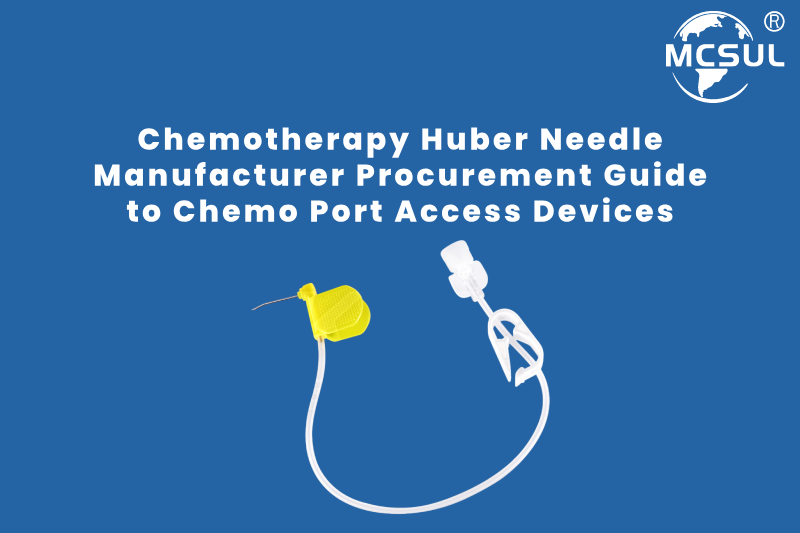
Hospital procurement teams rarely get fun projects. But sourcing chemo port safety access devices is one that matters a lot. A bad needle batch does more than waste a purchase order — it can core a port septum, delay a chemo session, or hurt a nurse on the floor. This guide breaks down how to check Huber needles and extension sets from a chemotherapy huber needle manufacturer, and shows how to qualify a supplier before you sign a bulk order. It also covers which standards to ask for along the way.
Most of this work sits outside clinical staff. It sits with procurement, sourcing, and quality teams. That means the checklist below reads more like a supplier audit than a nursing guide, even though every choice you make lands back on the nursing floor.
What Are Chemo Port Safety Access Devices and Why Do They Matter for Procurement?
Chemo Port Safety Access Devices are the needles, extension sets and connectors used to access an implanted port under the skin of a patient. They matter for procurement because the wrong device can damage the port, not just the needle.
Ports stay implanted for months or years. Oncology and long-term IV patients need repeat access through the same small septum. Each needle that touches that septum either protects it or wears it down. That’s why the Huber needle is the required tool for this job, not a standard hypodermic needle.
This changes how you should evaluate a purchase. You are not just comparing price per unit. You are comparing how well each design protects a costly implanted device over hundreds of uses.
What Makes a Huber Needle Non-Coring, and Why Does Design Proof Matter?
A non-coring huber needle has a curved, angled tip. This tip pushes septum fibers aside instead of cutting through them. It stops the needle from punching out a small plug of silicone, called a core.
A core is a real risk. It can lodge in the port. It can even get flushed into the patient’s bloodstream. Standard hypodermic needles have a straight, sharp bevel built to cut. That’s fine for a muscle shot. It’s not safe for a port septum.
Ask the supplier for test data against ASTM F3212-16(2023). This is the Standard Test Method for Coring Testing of Huber Needles. The test pushes a sample needle into a silicone disk. Then it checks for any removed material. A pass means the design does not core under simulated use. If a supplier can’t show you this report, they haven’t proven the one claim your whole order depends on.
Who Qualifies as a Reliable Huber Needle Manufacturer?
A reliable huber needle manufacturer keeps a record of design, sterilization and safety test for each batch. Not just for the first sample they send you. Reliability shows up in paperwork as much as in the product.
Consider these four proof points as you shortlist a vendor:
- Design test data. Coring test results (ASTM F3212), needle sharpness checks, and drag-force test data.
- Sterilization records. Proof of ethylene oxide (EO) or gamma sterilization, with batch tracking.
- Safety testing. Data that follows the ISO 10993 series. This covers skin irritation, allergic response, and toxicity.
- Quality system proof. A current ISO 13485 certificate for the actual factory, not just the parent company.
A manufacturer who shares all four without being asked is usually further along than one who only sends a photo and a price list.
What Should a Chemo Port Extension Set Include for Kink Resistance?
A chemo port extension set should keep its shape when bent. If the tube kinks, flow stops mid-infusion. This can trigger a pump alarm. This matters even more in chemo settings, since a stopped drug flow carries real clinical risk.
When you check a huber needle extension set for kink resistance, look at these design points:
- Tubing material and wall thickness. PVC and non-PVC tubing act differently under a bend. Ask for flex-cycle test results.
- Reinforced bend points. Some sets add a stiffer collar near the needle hub. This is where kinking happens most.
- Clamp and Y-site placement. A clamp placed too close to a bend point adds stress at the weakest spot.
- Priming volume. A smaller lumen flows slower but may resist kinking better. This is a real trade-off, not just a number on a spec sheet.
Ask any shortlisted supplier for bend-radius or occlusion-pressure test data. A number you can compare across vendors is worth more than a marketing claim.
What Certifications Should You Require From a Huber Needle Supplier?
A qualified huber needle supplier should hold ISO 13485 certification. They should also give you CE technical files under EU MDR 2017/745. And they should refer to named standards such as ISO 7864 and ISO 8536.These are not extras for a B2B medical order. They are the paper trail your facility needs for an audit.
Here’s what each one actually proves:
- ISO 13485. Shows the manufacturer runs a certified quality system built for medical devices. This covers design control and batch tracing.
- CE marking under EU MDR 2017/745. Huber needles and extension sets are usually treated as Class IIa devices. This means a Notified Body must review the file.
- ISO 7864:2016. Sets requirements and test methods for sterile, single-use hypodermic needles. This is the base standard behind needle tube quality.
- ISO 8536-4. Sets requirements for single-use infusion sets. This covers the tubing, clamp, and connector parts of an extension set.
- ISO 80369-7:2016. Governs small connectors for IV and hypodermic use. This is why Luer fittings seal and lock the way your staff expects.
- FDA 21 CFR 880.5570. The U.S. rule number for non-coring (Huber) needles. It’s listed under product code PTI as a Class II device needing 510(k) clearance.
Get Sample-Batch Pricing Before Your Next Bulk Order
Request specs, certification files, and quote details for MSCUL Huber needles and extension sets.
Explore Huber Needle Range →If you buy for both EU and U.S. sites, ask which of these certificates cover which product code. Some vendors hold ISO 13485 company-wide but only a few products carry current clearance.
What Port Access Best Practices Should the Device Support for Nurses?
Your device choice should make correct huber needle port access best practices easier for nurses to follow, not harder. A good needle-and-set combo cuts down on steps a nurse could get wrong under time pressure.
Common best practices your device should support:
- A right-angle entry. A well-marked, 90-degree needle hub helps confirm correct entry into the port.
- Confirmed placement. A clear flashback point lets the nurse check for blood return before flushing the line.
- Needlestick protection. A passive safety shield lowers injury risk during withdrawal. This is when most Huber needlestick injuries happen.
- Stable fixation. A solid wing base keeps the needle from shifting once it’s taped in place.
If your current device needs extra manual steps, like a shield the nurse has to trigger by hand, expect more variation across shifts. That variation is a procurement problem before it becomes a training problem.
Comparison: Huber Needle Configurations for Procurement Evaluation
| Feature | Basic Non-Coring Huber Needle | Safety Huber Needle with Connector | Power-Injectable Safety Set |
|---|---|---|---|
| Non-coring tip | Yes | Yes | Yes |
| Needle-free connector | No | Yes | Yes |
| Passive needlestick shield | No | Usually | Usually |
| Kink-resistant extension tubing | Rarely included | Yes | Yes |
| Rated for CT contrast injection | No | No | Yes |
| Typical use case | Short, single-dose access | Routine chemo sessions | High-pressure power port access |
| Relative unit cost | Lowest | Mid | Highest |
Use this table as a first filter. Then ask for full spec sheets and test reports for anything that fits your patient volume.
Common Mistakes Buyers Make When Sourcing Huber Needles
- Buying on gauge size alone. Gauge matters, but it says nothing about coring performance or connector fit.
- Skipping the coring test request. Many buyers accept “non-coring” as a label. They don’t ask for ASTM F3212 data.
- Ignoring extension set fatigue testing. A needle can pass every check while the attached tube kinks under normal patient movement.
- Missing SKU-level gaps. A company-wide ISO 13485 certificate does not mean every product line has current CE or FDA clearance.
- Treating OEM/ODM orders like standard resale. Private-label and OEM/ODM orders need their own file review. Packaging changes can affect regulatory status.
- Locking in a single supplier too early. Multi-region hospital systems often need more than one qualified vendor. This protects against a single recall or a shipping delay leaving units with no backup source.
How Should Procurement Teams Qualify a Chemotherapy Huber Needle Manufacturer?
Qualifying a chemotherapy huber needle manufacturer means checking paperwork first. Then confirm it with a sample order before you place a full-scale purchase. Jumping straight to a large PO based on a catalog page is where most avoidable risk sits.
A practical qualification sequence:
- Ask for the ISO 13485 certificate. Ask for the CE technical file summary. U.S. buyers should also ask for the FDA 510(k) number or product code.
- Request ASTM F3212 coring test results. Ask for ISO 10993 safety test summaries for the exact SKU, not just the product family.
- Order a small test batch. Try it under your own facility’s conditions, not just the spec sheet.
- Confirm OEM/ODM support if you need custom packaging. Ask who owns the technical file in that deal.
- Check sourcing support if you’re combining several SKUs, like needles, safety huber needles, and extension sets, under one supplier.
This takes longer than a single email. But it catches gaps a nice product page won’t show you.
How Long Does Supplier Qualification Usually Take?
Supplier qualification for a new huber needle manufacturer usually takes four to eight weeks from first sample to final approval. This is not a delay to avoid This is the window in which most expensive mistakes are caught, before a bulk order goes out.
A rough timeline looks like this:
- Week 1-2: Document request and review. This covers ISO 13485, CE files, and coring test data.
- Week 2-4: Sample batch arrives. Your quality team runs in-house checks, including a visual coring check and a flow test on the extension set.
- Week 4-6: Clinical trial on a small unit, if your facility allows it, with direct nurse feedback on handling and fixation.
- Week 6-8: Final sign-off, pricing lock, and first bulk purchase order.
Rushing this timeline to hit a quarterly budget deadline is a common but costly shortcut. A few weeks extra up front is much cheaper than switching suppliers mid-year after a batch fails in the field.
Key Takeaways
- Chemo port safety access devices protect a costly implanted port. Procurement should weigh port safety, not just unit price.
- A true non-coring huber needle design should have ASTM F3212-16(2023) coring test data behind it, not just a label claim.
- A chemo port extension set needs proven kink resistance. A folded line can stop a chemo infusion mid-session.
- Request records for ISO 13485, CE under EU MDR, ISO 7864, ISO 8536-4, ISO 80369-7 and FDA 21 CFR 880.5570 by SKU.
- Devices should make port access best practices easier for nurses to follow, especially around needlestick safety and placement checks.
- Qualify any chemotherapy huber needle manufacturer with a sample order and SKU-level paperwork before a bulk buy.
Final Thoughts
Sourcing Huber needles and extension sets looks like a small budget line. But it carries a big clinical impact. Take the extra week to ask for coring test data, kink-resistance results, and SKU-level certificates from your chemotherapy huber needle manufacturer. It costs far less than one damaged port. It costs even less than one preventable needlestick injury on your nursing floor.