 +86-791-8686-1216


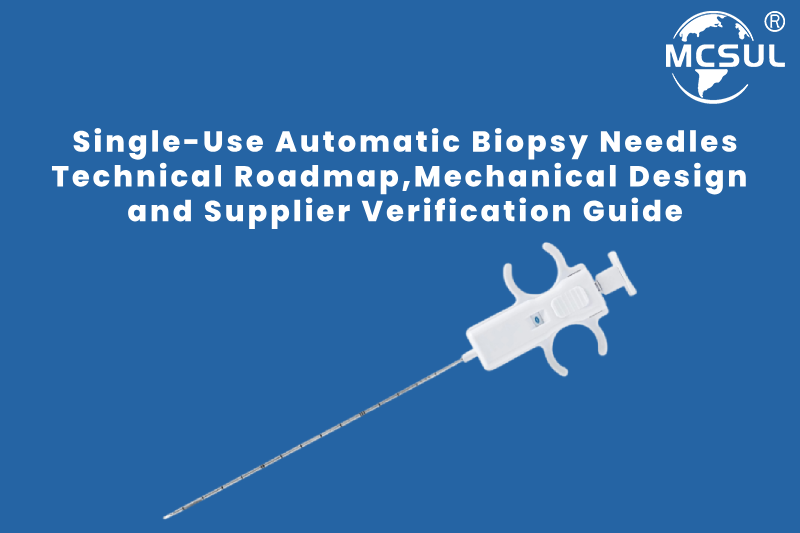
If you buy medical devices for a living, you already know that a biopsy needle is not a place to cut corners. A single-use automatic biopsy needle looks simple from the outside. But inside that plastic housing is a spring-loaded system that has to fire the same way, every single time, to get a clean tissue sample without hurting the patient. When you’re sourcing these devices whether for a hospital, a distributor, or a private label brand you need more than a nice price. You need evidence that the needle truly works.
This guide talks you through what “quality” actually means for a single-use automated biopsy needle, the mechanical design characteristics that matter most, and how to confirm that a manufacturer or OEM/ODM partner can actually deliver what they promise. By the end, you’ll know exactly what to test, what to ask for, and what a reliable single-use automatic biopsy needle should be able to prove on paper.
What Is a Single-Use Automatic Biopsy Needle?
A single-use automatic biopsy needle, sometimes called a disposable core biopsy needle, is a spring-fired device used to collect tissue samples for diagnosis. Unlike manual biopsy needles, the automatic type fires the needle forward using a triggered spring mechanism. This gives a fast, consistent stroke that captures a cleaner tissue core with less tearing.
Because these devices touch human tissue and are used once, quality control is not optional. A weak spring, a dull tip, or a bent shaft can mean a failed sample, a second procedure, or worse, an injury to the patient. That’s why hospitals, distributors, and private label buyers spend so much time checking a supplier’s manufacturing process before placing a bulk order.
Automatic Biopsy Needle Mechanism Explained
If you’ve never seen one fired, the automatic biopsy needle mechanism is easier to picture than it sounds. Here’s the basic sequence:
- The user cocks the device, which loads tension into an internal spring.
- The needle tip is positioned at the biopsy site.
- The trigger is pressed, releasing the spring in a fraction of a second.
- The inner stylet (the part with the sample notch) fires forward first, followed almost instantly by the outer cutting cannula.
- The cannula slides over the notch, shearing off a tissue core and trapping it inside.
This whole cycle happens in well under a second, which is why spring consistency and trigger force matter so much. If the spring is weak or the tolerances are off, the notch might not fully close over the tissue, and the sample comes out short or torn.
If you’re weighing device types, it also helps to see how a semi-automatic biopsy needle works, since the firing sequence and control differ from the fully automatic version covered here.
Why Performance Quality Assessment Matters When Sourcing a Single-Use Automatic Biopsy Needle
If you’re searching for a “biopsy needle manufacturer,” a “disposable biopsy needle supplier,” or an “OEM biopsy needle factory,” you’re probably trying to answer one core question: can this company make a device that performs the same way, batch after batch?
Performance quality assessment answers that question with data instead of guesswork. It gives you:
- Proof the needle meets clinical performance standards
- A way to compare suppliers on more than just price
- Documentation you can show regulators, hospital purchasing boards, or your own quality team
- Lower risk of product recalls or failed procedures down the line
Skipping this step is how buyers end up with a warehouse full of needles that bend on first use or don’t fire with enough force to get a good sample. If private labeling or custom specs are part of the plan, it’s worth reviewing a supplier’s OEM/ODM manufacturing options before you get into the mechanical details below.
The Technical Roadmap: How Quality Gets Built In single-use automatic biopsy needle
Good manufacturers don’t test quality in at the end. They build it in from the start. Here’s the general roadmap a trustworthy single-use automatic biopsy needle manufacturer should follow. For a wider view of sourcing best practices, our needles and syringes sourcing guide covers many of the same principles.
Design Verification
Before mass production starts, the design has to be verified against clinical and mechanical requirements. This includes choosing needle gauge, spring tension, sample notch size, and the materials that will touch the patient. A supplier offering true OEM or ODM services should be able to walk you through this stage, not just hand you a finished catalog item.
Raw Material Inspection
Every batch of stainless steel, plastic housing, or spring wire should be checked before it enters production. This is where a lot of cheap suppliers cut corners, using unverified steel grades that don’t match the certificate of analysis.
In-Process Testing
During manufacturing, the factory should be checking dimensions, spring force, and needle straightness at multiple points, not just at the end of the line. Ask any potential supplier how often they sample during production. If they can’t answer clearly, that’s a red flag.
Finished-Goods Testing
Before packaging and sterilization, finished needles go through a final round of mechanical and functional testing. This is the last checkpoint before the product becomes “sellable.”
Sterilization Validation
Since these are single-use, sterile devices, sterilization validation (usually ethylene oxide or gamma) has to be documented and repeatable. A supplier should have validation reports on file, not just a claim that “it’s sterile.”
Post-Market Surveillance
Reliable manufacturers keep tracking complaints and field performance after the product ships. If a supplier has zero process for collecting feedback from hospitals, they’re flying blind on real-world performance.
Core Mechanical Design Parameters You Should Ask About single-use automatic biopsy needle
When you’re comparing single-use automatic biopsy needle suppliers, don’t just ask “is it good quality.” Ask about specific numbers. Here are the mechanical parameters that actually separate a well-made needle from a risky one.
Needle Gauge and Diameter Tolerance (Including 14G Options)
Gauge size (usually ranging from 14G to 20G for core biopsy needles) needs to be accurate and consistent. Even small variations in outer or inner diameter can affect how the needle passes through tissue and how much sample it collects.
A single-use automatic biopsy needle 14G is one of the most requested sizes, since it tends to strike a good balance between sample size and tissue trauma. If you’re sourcing 14G specifically, ask the supplier for their diameter tolerance range and whether they batch-test every lot or only spot-check a sample.
Penetration Force and Firing Force
This measures how much force it takes for the needle to enter tissue, and how much force the spring delivers when triggered. Too little force and the needle won’t get a clean core sample. Too much, and it risks tissue damage. Reputable manufacturers test this with calibrated force gauges and can share the acceptable range.
Firing Distance, Stroke Length, and Penetration Depth Standardization
The “throw” how far the needle travels when fired needs to be consistent across every unit. Inconsistent stroke length is one of the most common complaints clinicians have about low-quality disposable biopsy needles.
This is where biopsy needle penetration depth standardization comes in. Standardization means every needle in a batch, and every batch across time, fires to the same depth within a tight tolerance. Without it, a clinician can’t predict how far the needle will travel past the skin surface, which makes it harder to place samples accurately and safely near sensitive structures. Ask suppliers what tolerance they hold penetration depth to, and whether that number is backed by test data or just an assumption.
Sample Notch Design
The notch is the opening where tissue collects. Its length and depth directly affect sample size and quality. A supplier that understands notch geometry (and can adjust it for OEM custom orders) is usually more experienced than one selling a generic, one-size-fits-all design. A bone marrow biopsy needle, for example, typically uses a longer notch to pull a larger core sample than a soft-tissue device would need.
Spring and Firing Mechanism Reliability
Since the whole device depends on a spring mechanism, cycle testing matters. Manufacturers should be running repeated-fire tests to confirm the spring performs the same way from the first unit in a batch to the last.
Tip Sharpness and Bevel Geometry
A dull or poorly angled tip means more resistance, more patient discomfort, and a higher chance of a failed sample. Don’t just eyeball sharpness, measure it.
Shaft Straightness and Rigidity
A bent or overly flexible shaft can throw off needle placement accuracy. Straightness testing under a microscope or with dedicated inspection equipment should be part of every manufacturer’s routine QC.
Material Biocompatibility
The stainless steel grade and any coatings used need to be biocompatible and traceable. Ask for material certificates, not just a verbal assurance.
How Performance Testing Actually Works
If you want to sound credible when talking to a supplier and get real answers instead of a sales pitch it helps to know how a single-use automatic biopsy needle is actually tested before it ships.
Force and Velocity Testing
Penetration force and firing velocity are tested using instrumented rigs that measure force over time as the needle fires into a test medium, often a gel that mimics human tissue.
Sample Yield Testing
This checks whether the needle reliably captures a usable tissue core, tested against a set number of trials with a target success rate.
Fatigue and Repeat-Fire Testing
For devices with reusable handles paired with disposable needles, the firing mechanism gets cycled many times to confirm it holds up.
Packaging and Sterility Testing
Seal strength testing and accelerated aging studies confirm the sterile barrier will hold up through shipping and shelf storage, not just on day one.
Dimensional Inspection
Tools like coordinate measuring machines (CMM) and microscopy confirm gauge size, notch dimensions, and shaft straightness are within spec.
Common Failure Modes to Watch For in a Single-Use Automatic Biopsy Needle
Knowing what can go wrong helps you ask sharper questions during supplier vetting. Even a well-designed single-use automatic biopsy needle can fail if manufacturing controls slip, so it helps to know what to watch for. The most common issues buyers report include:
- Needle bending during firing or storage
- Misfires or incomplete firing strokes
- Sample notch collecting too little tissue
- Tip dulling faster than expected
- Packaging seals failing before the expiration date
If a supplier can’t explain how they prevent these specific problems, that’s worth noting before you sign a purchase order. Many of these risks are exactly why single-use designs replaced reusable ones in the first place we go into more detail in our piece on the benefits of disposable biopsy needles.
Supplier Verification Guide: Vetting a Single-Use Automatic Biopsy Needle Manufacturer
This is the part most buyers actually search for, so let’s get specific. Whether you’re looking for a biopsy needle OEM partner, an ODM manufacturer, or a straightforward bulk supplier, here’s what to verify. Our sourcing solutions is also a useful starting point if you’re shortlisting vendors for the first time.
Certifications and Registrations
At minimum, ask for:
- ISO 13485 certification (medical device quality management)
- CE marking (for the EU market) or FDA registration and 510(k) clearance (for the US market)
- Country-specific medical device licenses if you’re sourcing for a different region
Don’t just accept a PDF. Where possible, verify certificate numbers against the issuing body’s public database. The same due diligence applies across needle categories our core criteria for evaluating needle manufacturers lays out a checklist that transfers well to biopsy devices too.
Document Checklist
Ask the supplier to share:
- Device Master Record (DMR)
- Design History File (DHF), especially if you want OEM/ODM customization
- Test results for the mechanical parameters mentioned above.
- Certificate of Analysis (COA) for raw materials
- Sterilization validation reports
A manufacturer confident in their process will hand these over without hesitation. Hesitation or vague answers is a warning sign. For an example of what proper regulatory documentation looks like in practice, see how a KDL disposable biopsy needle was approved for marketing.
Sample Evaluation Before Bulk Ordering
Never place a large order without testing samples first. Run your own basic checks: firing consistency, packaging integrity, and visual inspection under magnification. If you have lab access, test penetration force and sample yield yourself.
How to Evaluate Biopsy Needle Trigger Force Consistency
Trigger force is one of the easiest specs to test yourself, and one of the most telling. Here’s a quick way for evaluating it before you commit to a big order:
- Pull at least 10 to 15 units from the same batch, not just one or two.
- Use a calibrated force gauge to measure the force needed to fire each unit.
- Record every reading and compare it against the supplier’s stated trigger force range.
- Flag any unit that falls outside that range, even by a small margin.
- Repeat the test with units from a different production date to check batch-to-batch consistency, not just within-batch consistency.
If the readings are all over the place, that usually points to inconsistent spring quality or loose assembly tolerances, both of which are hard to fix later and easy to catch now.
Factory Audit
Whenever possible, do an on-site or virtual factory audit. Our manufacturer procurement guide walks through a similar audit checklist you can adapt for biopsy needle production lines. Look at:
- Cleanroom conditions for assembly
- In-process quality checkpoints
- Equipment calibration records
- Staff training documentation
Red Flags When Vetting a New Supplier
Be cautious if a supplier:
- Can’t provide test data, only marketing claims
- Has no traceable batch or lot numbering system
- Offers a price far below the market average with no clear explanation
- Refuses factory visits or virtual audits
- Has no written procedure for managing consumer concerns
Ongoing Supplier Monitoring
Verification doesn’t stop after the first order. Set up incoming inspection for every shipment and track batch-to-batch consistency over time. A supplier that performed well on the first order should keep performing well on the fiftieth.
Quick Reference: What to Check and Why
Use this table as a fast checklist any time you’re evaluating a single-use automatic biopsy needle before placing an order.
| Parameter | What to Ask For | Why It Matters |
|---|---|---|
| Needle gauge/diameter | Tolerance range, inspection method | Affects accuracy and comfort |
| Firing force | Test data, acceptable range | Determines sample quality |
| Stroke length | Consistency across batches | Prevents misplaced samples |
| Sample notch | Design specs, yield data | Directly affects diagnostic usefulness |
| Sterilization | Validation report | Ensures patient safety |
| Certifications | ISO 13485, CE/FDA proof | Confirms regulatory compliance |
Final Thoughts
Sourcing single-use automatic biopsy needles is not just a procurement task, it’s a patient safety decision. The manufacturers and suppliers worth working with are the ones who can back up their claims with real test data, clear documentation, and a manufacturing process built around consistency, not luck.
Before you commit to a bulk order or an OEM/ODM partnership, ask for the numbers. Ask for the certificates. Ask for samples. A supplier that welcomes those questions is usually the one worth doing business with and that’s the standard every single-use automatic biopsy needle on your shortlist should be held to.
If you’re ready to compare options, you can browse our sterile biopsy needles for single use, or read our guide on how to choose the right biopsy needles for your practice for a practice-side perspective on the same buying decision.