 +86-791-8686-1216


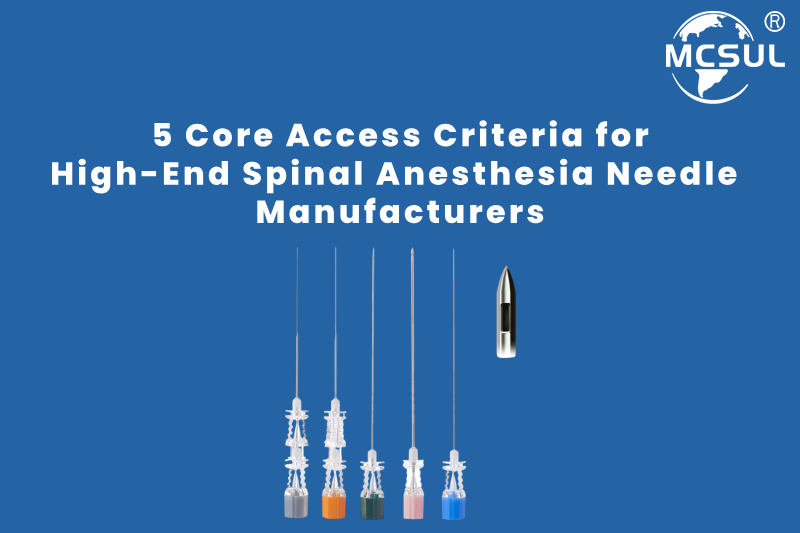
Procurement teams sourcing spinal anesthesia needles face a hard truth. Not every spinal needle manufacturers can handle a high-end order. The Sprotte design makes this gap very clear. A Sprotte-style spinal needle has a rounded ogival tip, a large lateral eye, and a precision-fit stylet. Every one of those features demands tighter manufacturing tolerances than a standard Quincke bevel needle. If a Spinal Needle Manufacturer cannot meet those tolerances, clinical outcomes will suffer.
This guide gives procurement teams five objective criteria to use when evaluating any spinal needle manufacturers. It uses the Sprotte pencil-point design as a case study throughout. That design represents the most demanding end of the category. For a broader overview of needle and syringe procurement, see our guide to sourcing high-quality needles and syringes.
What Is a Sprotte Spinal Needle Manufacturer and Why Does FDA Registration Matter?
A sprotte spinal needle manufacturer is a factory that can produce the ogival-tip, pencil-point needle design Dr. Günter Sprotte introduced in 1979. It must also hold current FDA clearance to sell that needle in the United States. FDA clearance matters because spinal needles fall under 21 CFR 868.5150 Anesthesia Conduction Needle, product code BSP. That regulation requires a 510(k) premarket notification before any new needle enters the U.S. market. A 510(k) submission proves the needle is substantially equivalent to an already-cleared device. Without that approval, the product cannot be legally sold in the U.S.
The FDA clearance check is simple. Buyers can search the 510(k) database at accessdata.fda.gov. They need the supplier’s establishment registration number and product code BSP. If nothing appears, that supplier is not a valid source for U.S.-bound stock.
Criterion 1: Does the Supplier Hold a Verified FDA 510(k) for Pencil-Point Spinal Needles?
A verified FDA-approved pencil-point spinal needle Manufacturer holds a cleared 510(k) for the specific needle type they are selling. This is the most important document in any spinal needle evaluation. It is the proof that FDA reviewed the design, confirmed sterility data, and accepted the product.
The Sprotte design has a long FDA clearance history. PAJUNK GmbH, the original commercial partner for the Sprotte needle, has held cleared 510(k)s going back to the early 1990s. All are filed under 21 CFR 868.5150, product code BSP. Any other supplier claiming to make a Sprotte-style needle for the U.S. market needs its own independent 510(k). A reference to someone else’s clearance does not count.
Before placing any order, ask to see the supplier’s certificates and quality documentation. Then ask for three specific items:
- Their specific 510(k) K-number.
- The predicate device listed in their submission.
- The cleared intended use statement.
The intended use must match your order. Clearance for an epidural needle does not cover a spinal needle. This distinction matters.
Criterion 2: Is the Spinal Needle Manufacturer Certified to ISO 13485 and Compliant with ISO 7864 and ISO 9626?
The best spinal needle manufacturers hold ISO 13485:2016 certification and produce needles that conform to ISO 7864 and ISO 9626. ISO 13485:2016 is the quality management standard for medical device manufacturers. It covers design controls, process checks, complaint handling, and post-market reviews. ISO 7864 sets the dimensional and performance rules for sterile hypodermic needles for single use. ISO 9626 covers the stainless steel materials used to make needle tubing.
For a Sprotte-style needle, ISO 9626 compliance is especially important. The ogival tip and large lateral eye need ultra-thin walled tubing that holds tight size tolerances. The steel must not deform or break during tip-forming. A factory that uses substandard steel cannot reliably produce a Sprotte tip that is both strong and atraumatic. Atraumatic means the tip spreads tissue rather than cuts it. That quality is the whole point of the pencil-point spinal needle design.
Ask any supplier for:
- A current ISO 13485 certificate with scope covering spinal needles.
- Conformance statements for ISO 7864 and ISO 9626 in their product technical file.
A factory with only a basic business license and no ISO 13485 certification is a clear warning sign. Do not proceed.
Criterion 3: Does the Tip Geometry Meet Clinical-Grade Atraumatic Standards?
Clinical grade atraumatic tip geometry causes the needle to spread the dural fibres instead of cutting them. This is the basic mechanical explanation for why pencil-point needles reduce postdural puncture headache (PDPH). PDPH is a well known complication of spinal anaesthesia. This is when the dura is cut and CSF leaks out. Atraumatic needles greatly reduce this risk.
Clinical studies provide good evidence. A meta-analysis of 57 randomized controlled trials covering 16,416 patients, published in Regional Anesthesia & Pain Medicine, found that pencil-point needles reduced PDPH incidence by 59% compared to cutting-bevel needles a result that held across both obstetric and non-obstetric procedures.
The atraumatic profile of the Sprotte needle is due to three specific design features. The ogival (bullet) tip tends to spread rather than cut the dura. The lateral eye is located just behind the tip to enable a quick return of CSF. The stylet is precision fitted so that the lateral eye is closed exactly, and no tissue is cored as the needle advances. You can directly compare these features in our Pencil Point and Quincke Safety & Procurement Guide.
If evaluating a manufacturer, ask to see:
- Reports of tip geometry from microscope or SEM inspection
- Tip surface test data to prove burr free finish
- stylet to eye fit tolerances specs
If a supplier cannot provide these documents, he cannot guarantee consistent atraumatic performance between batches.
Criterion 4: How Does a Sprotte Needle vs Pencan Needle Differ, and Can Your Supplier Produce Both?
A sprotte needle vs pencan needle comparison comes down to three engineering differences: tip shape, lateral eye size, and the distance from the tip to the eye. Both are FDA-cleared pencil-point designs. But they are not the same, and a manufacturer that cannot explain the differences is likely operating without controlled design documentation.
Here is how the two compare:
| Feature | Sprotte Needle | Pencan Needle |
| Tip Shape | Ogival (elongated bullet) | Rounded pencil-point |
| Lateral Eye Size | Larger opening | Smaller (0.65 mm) opening |
| Tip-to-Eye Distance | Longer | Shorter (1.7 mm to back of eye) |
| CSF Flashback Speed | Fast (large eye) | Fast (short tip-to-eye) |
| Dura Click Feedback | Present | Emphasized in design |
| PDPH Risk | Low | Low |
| Best Patient Group | General and pediatric spinal | Obstetric and outpatient spinal |
The Pencan design was built to reduce the risk of the lateral eye straddling the dura. Early studies on the original Sprotte needle raised this concern. The Sprotte design was then refined in 1993. The lateral eye was repositioned and shortened. A top-tier manufacturer knows this history. Ask them to explain it. If they cannot, look elsewhere.
A high-end manufacturer must be able to produce both designs accurately. The tooling is different for each. The Sprotte tip needs a separate ogive-forming die. The Pencan tip requires a different closing geometry. A supplier using one shared mold for all pencil-point styles is making a generic product, not a true Sprotte or Pencan needle.
KDL offers a Combined Anesthesia Needle in Sprotte type alongside the Quincke tip combined anesthesia needle two distinct tooled designs, not variants of the same mold.
Criterion 5: What Are the Supplier’s Sterility and Traceability Standards?
The high end spinal needle manufacturers sterilise with ethylene oxide (EO) gas or gamma radiation. The most common is EO gas, for spinal needles. It needs to be validated against ISO 11135:2014 for EO sterilisation of health care products. The sterility should be maintained throughout the validated shelf life of usually two to five years.
Traceability means that each lot can be traced from the raw material to the end user. Full lot traceability is required for spinal needles going into an operating room. It is required by FDA 21 CFR Part 820 (Quality System Regulation) and ISO 13485:2016. A batch record associated with a SAL of 10-6 is not linked to a supplier shipping a product below the minimum standard. SAL 10-6 means not more than 1 in a million units may be non-sterile. That’s the world standard for implantable and high risk devices.
Ask the supplier for:
- Their EO sterilisation validation report on cycle parameters
- Here’s an example certificate of conformance for a recent batch
- Their batch recall process
If any of these are missing or vague, the supplier is not operating at a clinical grade level. Teams evaluating OEM or ODM partnerships should include these documents in their standard supplier qualification checklist.
Sprotte vs Pencan vs Quincke: A Three-Way Clinical Comparison
Procurement teams often need to present a multi-needle comparison to clinical teams. For background on how these designs differ mechanically, our post on the anatomy of the Quincke tip spinal needle is a useful reference. Here is a clear summary of all three designs:
| Criteria | Sprotte | Pencan | Quincke |
| Tip Type | Pencil-point (ogival) | Pencil-point (rounded) | Cutting bevel |
| PDPH Risk | Low | Low | Higher |
| Insertion Resistance | Moderate | Moderate | Low |
| CSF Flow Rate | High (large lateral eye) | High | High |
| Best Patient Group | General, pediatric | Obstetric, outpatient | Cost-sensitive cases |
| FDA Classification | 21 CFR 868.5150 (BSP) | 21 CFR 868.5150 (BSP) | 21 CFR 868.5150 (BSP) |
| Typical Gauge Range | 24G–27G | 22G–27G | 20G–29G |
All three types fall under the same FDA classification code. The difference is in clinical outcome data and the manufacturing precision each design demands. For a size-by-size clinical breakdown, see our comparative analysis of spinal needle sizes.
Common Procurement Mistakes to Avoid
These are the errors that come up most often in spinal needle sourcing.
Assuming all pencil-point needles are the same. They are not. A generic “atraumatic” label does not mean the needle meets the ogival geometry standards of a true Sprotte design. Check the technical file. Our guide on choosing the right anesthetic needle covers what to look for.
Accepting CE marking as a substitute for FDA clearance. CE marking covers the EU market only. It is not FDA clearance. A supplier needs both documents to serve global markets.
Not asking for the 510(k) K-number. Many suppliers say “FDA registered” to describe their facility listing. That is not a product clearance. Ask for the actual K-number for the specific needle.
Skipping tip inspection. Tip geometry defects do not always show up in routine incoming checks. Request SEM or microscopy data for at least one production batch per year.
Choosing on price alone. A spinal needle goes into the subarachnoid space. The cost of treating one PDPH case far exceeds the savings from cheaper needles. For guidance on safely administering anesthetic injections, the design quality of the needle matters at every step.
Key Takeaways
- All spinal anesthesia needles sold in the U.S. are subject to clearance via a 510(k) submission per 21 CFR 868.5150, product code BSP. Check the K-number before you buy it.
- The minimum quality baseline for a creditable spinal needle manufacturer includes: ISO 13485:2016 certification, conformance to ISO 7864 and ISO 9626.
- The Sprotte is a large lateral eye, ogival tip design. Such features require individual controlled tooling. A factory that shares a generic mold cannot make a real Sprotte needle.
- Sprotte versus Pencan differences are real engineering differences, not branding differences. Tip to eye distance, eye diameter & tip shape – all are variable. Your supplier needs to explain these in technical detail.
- Sterility validated to SAL 10-6 per ISO 11135:2014. If there is no validation report for sterilization, it is not clinical grade.
- Lot traceability is a requirement in FDA 21 CFR Part 820 and ISO 13485:2016. When ordering ask for a batch recall procedure.
Final Thoughts
Finding the right spinal needle Manufacturer is a clinical decision, not just a cost decision. The Sprotte design is a useful test because it shows exactly where supplier capability breaks down. If a factory cannot document its tip geometry, its FDA 510(k) clearance, or its sterilization validation, it is not ready to supply high-end spinal needles.
Buyers who check these five criteria FDA clearance, ISO certification, tip geometry standards, design knowledge of Sprotte vs Pencan, and sterility traceability will find credible partners fast. They will also avoid the errors that come from sourcing on price alone.
KDL produces disposable spinal anesthesia needles in pencil-point and Quincke tip designs, sterilized by ethylene oxide and packaged with transparent hubs for clear CSF observation. Our full anesthesia needle range covers spinal, epidural, and combined configurations including the Combined Anesthesia Needle in Sprotte type and epidural needles for diverse clinical needs.