 +86-791-8686-1216


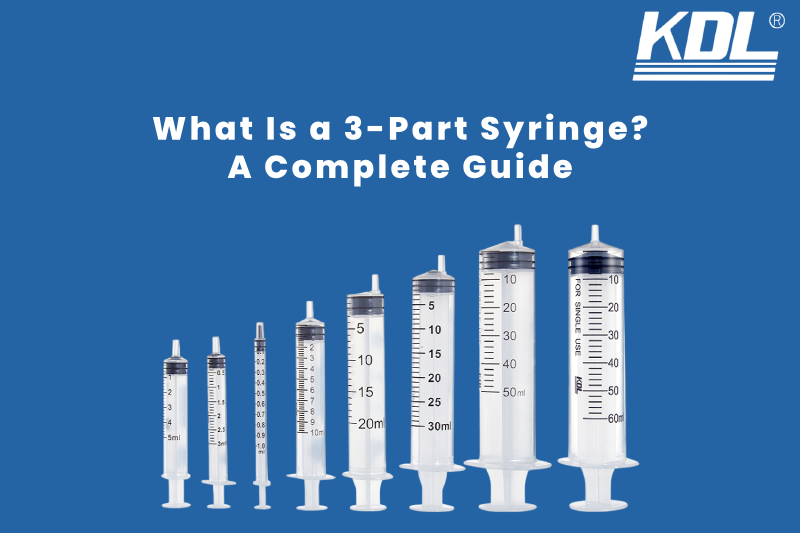
If you’ve ever visited a clinic, pharmacy, or hospital, you’ve likely seen a syringe. It looks simple a small tube with a needle but it’s actually a carefully designed medical tool. One of the most common types use today is the 3-part syringe (also called a three-piece syringe).
Healthcare workers like it since it’s safe, accurate, and super easy to use. From giving vaccines to drawing blood samples, this syringe is used every single day around the world.
In this complete guide, you’ll learn:
- What a 3-part syringe is
- Its parts and how it works
- Types and sizes available
- Uses in medical
- Advantages over 2-part syringes
- How to choose the right one
We’ll keep the language simple so anyone can understand it.
What is a 3-Part syringe?
A 3-part syringe is a disposable medical syringe made of three separate components:
- A Barrel
- Pull Plunger
- Rubber gasket (also known as a piston or stopper)
What makes them different is that rubber piece. It seals the barrel tightly, letting liquid medicine move easily and be measured correctly.
Because of its design, the three piece syringe is the most popular disposable syringe in hospitals today.
Why It’s Called “3-Part”
Many people think the needle counts as a part but technically, it doesn’t.
The “three parts” refer only to the internal working mechanism:
- Plastic tube (barrel)
- Moving rod (plunger)
- Rubber seal (gasket)
The needle is an attachment. Some syringes come with it, some don’t.
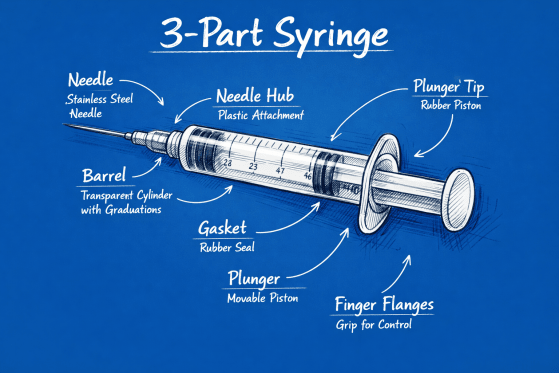
Components of a 3-part syringe
Clear comprehension of each component is imperative.
1. Barrel
The hollow plastic tube that holds the liquid medicine is known as the barrel.
Features:
- Produced from polypropylene plastic of medical grade.
- Easy visibility with Transparent
- Marked with measurement lines (ml units)
- Disposable and Sterile
These markings are employed by physicians to determine the precise dosage.
2. Plunger
The plunger is the rod you push and pull.
Its job:
- Pull back → draws fluid into syringe
- Push forward → injects medicine into body
A good plunger moves smoothly but stays tight.
3. Rubber Gasket (Piston)
This is the most important part.
The rubber gasket sits at the tip of the plunger and seals the barrel. Without it, liquid would leak or air would enter.
Benefits of the rubber seal:
- Smooth injection
- Accurate dosage
- Less hand pressure needed
- No medicine wastage
This is why healthcare workers prefer a 3-part luer lock syringe over a 2-part syringe.
4. Needle Hub (Attachment Area)
This is where the needle connects.
Two common types exist:
Luer Slip Syringe
Needle pushes on directly.
Luer Lock Syringe
Needle twists and locks in place.
Most hospitals prefer 3-part luer lock disposable syringes because they prevent leakage.
How a 3-Part Syringe Works
The working principle is simple — air pressure.
- Pull plunger → vacuum forms → liquid enters
- Push plunger → pressure increases → liquid exits
The rubber gasket makes this airtight. That’s why the injection feels smoother compared to cheaper syringes.
Common Sizes of 3-Part Syringe
Different treatments need different volumes. So syringes come in multiple sizes.
| Size | Typical Use |
|---|---|
| 1 ml | Insulin & pediatric injections |
| 2 ml | Small drug doses |
| 3 ml | Most common medical injections |
| 5 ml | IV medicines |
| 10 ml | Blood sampling |
| 20 ml | Irrigation or flushing |
| 50/60 ml | Feeding tubes & catheter flushing |
The 3 ml disposable syringe is the most widely used worldwide.
Types of 3-Part Syringe
By Tip Type
Luer Lock Syringe
- Screw-on needle
- No leakage
- Used in hospitals
Luer Slip Syringe
- Push-fit needle
- Faster to attach
- Used in clinics
Catheter Tip Syringe
- For feeding tubes
- No needle
By Sterility
Sterile syringe
- Single use
- Packed individually
- Used in injections
Non-sterile syringe
- Lab use only
- Not for medical injection
Uses of a 3-Part Syringe
The uses go far beyond injections.
Medical Uses
1. Vaccination
COVID, flu, tetanus, hepatitis — most vaccines use a 3-piece syringe.
2. Medication Injection
Used for:
- IV injections
- IM injections
- Subcutaneous injections
3. Blood Collection
Doctors draw blood samples using larger sizes.
4. IV Line Flushing
Saline is pushed through IV lines.
5. Feeding Tubes
Catheter tip syringes deliver liquid nutrition.
Advantages of a 3-Part Syringe
Here’s why they replaced older syringe designs.
1. Better Accuracy
- The rubber piston prevents leakage.
- Doctors can measure exact dosage.
This is critical for insulin and pediatric medicine.
2. Smooth Injection
- Less force needed.
- Patients feel less pain.
3. Reduced Drug Wastage
No medicine stuck in barrel gaps.
4. Safer Handling
Works well with luer lock needles — prevents accidental spills.
5. Perfect for Thick Liquids
- Antibiotics and vaccines typically have a thicker consistency.
- The rubber seal is great at handling pressure!
6. More Hygienic
- Most are EO gas sterilized disposable syringes.
- Single use = prevents infection spread.
Are 3-Part Syringe Safe?
Yes when used correctly.
Modern disposable syringes follow strict medical standards :
- Sterile packaging
- Latex-free rubber
- Pyrogen-free materials
- Non-toxic plastic
But safety depends on usage.
Important Safety Rules
- Never reuse a syringe
- Always use new needle
- Dispose in sharps container
- Do not recap needle
Reusing syringes spreads infections like HIV and hepatitis.
How Sterilization Works
Most disposable syringes are sterilized using Ethylene Oxide (EO) gas.
Why EO sterilization?
- Kills bacteria and viruses
- Safe for plastic
- Keeps syringe transparent
- Long shelf life
Shelf life is usually 3–5 years if sealed.
How to Choose the Right 3-Part Syringe
Picking the correct syringe matters for comfort and accuracy.
Step 1 : Select Size
Match medicine volume:
- Small dose → 1 ml or 2 ml
- Normal injection → 3 ml
- Large dose → 5 ml or 10 ml
Step 2 : Choose Tip Type
- Vaccination → Luer lock
- Quick clinic use → Luer slip
- Feeding tube → Catheter tip
Step 3 : Check Needle Gauge
Thin needle = less pain
| Gauge | Use |
|---|---|
| 31G | Insulin |
| 26G | Pediatric |
| 24G | Vaccine |
| 22G | IV drug |
Step 4 : Verify Sterility
Look for :
- Individually packed
- EO sterilized mark
- Expiry date
Key Takeaways
- A 3-part syringe has barrel, plunger, and rubber gasket
- It provides accurate and smooth injections
- Used in hospitals, clinics, labs, and veterinary care
- Safer and more reliable than 2-part syringes
- Always use once and dispose properly
Final Thoughts
The 3 part syringe might not seem like a very important medical tool, but it is very important in modern healthcare. Vaccination, life saving drugs, and daily treatments rely on its accuracy.
Everything changed when the rubber piston was added. It made the patient more comfortable, cut down on mistakes, and made procedures safer for both the patient and the healthcare worker.
Now you know what a syringe is… it’s not just a piece of plastic with a needle in it. It’s a well-thought-out device that will send medicine right where it’s needed.
And getting it right can mean the world.