 +86-791-8686-1216


A biopsy is a medical test in which doctors take a small piece of tissue from the body to look for disease. This test is used to find out things like cancer, infections or abnormal growths early. One modern tool in this process is the MRI Biopsy Needle.
MRI Biopsy Needle is design to work with MRI (Magnetic Resonance Imaging) scans. It helps doctors take very accurate tissue samples from hard-to-reach areas inside the body. The improved clarity of soft tissue images by MRI increases the accuracy and safety of this method.
In this article you will learn what is this tool, how it works and why doctors use it. We will also discuss the procedure step by step, its benefits, possible risks and recovery process. The language is simple so that everybody can easily understand.
What is MRI Biopsy Needle
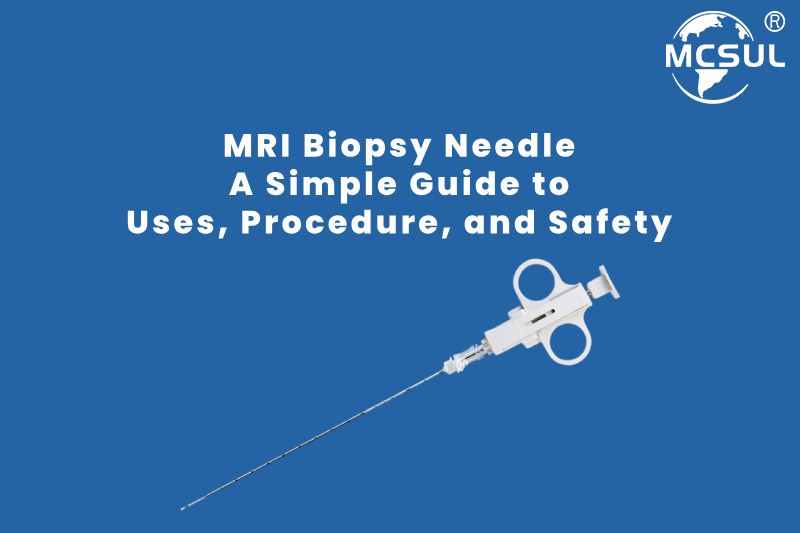
The MRI Biopsy Needle is a unique type of medical device that takes tissue samples from within the body using MRI imaging guidance. Doctors use it when they need very precise targeting, especially in soft tissues such as brain, breast, prostate or liver.
MRI helps doctors see detailed images of internal organs. They move the needle to the exact place where the sample is needed. This will help in reducing errors and improving diagnostic accuracy.
The tool is slim, long and made from materials that don’t interfere with MRI machines. Designed for safety and precision.
Key purposes of MRI Biopsy Needle system
The MRI Biopsy Needle system serves in situations where normal imaging methods like X-ray or ultrasound are not clear enough.
Some major uses are:
- Soft Tissue Tumour Detection
- Looking for abnormal findings on MRI
- Diagnosing cancer in the early stages
- Guiding doctors to hard to reach areas of tissue
- Improved accuracy of biopsy results
Doctors use this method when they need detailed images and precise targeting.
Step by step Imaging support
The MRI machine is producing images throughout the procedure. The doctor uses these images to guide the needle, one step at a time.
This process guarantees:
- Proper needle placement
- Least pain to the patient
- High quality tissue samples
Types and components of biopsy needles
There are different types of biopsy needles depending on the procedure. Each type serves a specific purpose.
Typical biopsy needle types
- Fine needle aspiration (FNA) needles: Small tissue or fluid sampling
- Core biopsy needles: Used to use a larger tissue sample
- Vacuum-assisted needles: Collect tissue using suction
- MRI-compatible needles: Specifically designed for MRI guided procedures
Manufacturers construct MRI-compatible needles with non-metallic or non-magnetic materials for MRI-guided biopsies.
Major components of MRI Biopsy needles
The MRI Biopsy Needle system includes the following parts:
- Outside needle tube
- Internal cutting device
- Sample collection chamber
- MRI-safe materials (e.g. titanium or special polymers)
- Precision guide sheath
Each part works together to ensure safe and accurate tissue collection.
Step by step biopsy procedure with MRI guidance
They painstakingly perform the MRI-guided biopsy procedure step by step. Doctors and medical staff are very careful and cautious to maintain safety and accuracy.
Step 1: Patient Prep
Pre procedure:
The patient is asked to lie down quietly
Remove metal items
Sometimes light sedation is administered
The area to be treated is cleaned and sterilised
Step 2: MRI scanning
They position the patient inside the MRI scanner. The scanner then obtains initial images to identify the precise area for the biopsy.
Step 3: Planning the needle
Doctors look at the MRI images and decide:
- The portal
- Needle depth
- The safest way to the goal
Step 4: Needle insertion
The MRI scanner delicately guides the insertion of the MRI Biopsy Needle into the body.
Step 5: Collect tissues
After the needle has reached the target:
A small amount of tissue is removed
Sample is preserved for lab testing
Step 6: Finish & Dress
The needle is then pulled out and a small plaster is applied.
Major benefits of this procedure:
- High accuracy
- Not much pain
- Fewer complications
- Correct diagnosis
Pros and cons of MRI-guided biopsy with MRI Biopsy Needle
An MRI-guided biopsy with an MRI Biopsy Needle offers many benefits, but like any medical procedure it does carry some risks.
Advantages of MRI-guided biopsy
This method is widely used since it has several advantages:
- The detection of disease is highly accurate
- Enhanced imaging of soft tissues
- Minimal trauma of healthy tissue
- Good for hard to reach organs
- Early detection of serious disease
- Better treatment planning
This is the method doctors rely on when precision is very important.
Possible side effects and risks
It is safe, but there are some dangers:
- Mild Discomfort or Soreness
- Low risk of bleeding
- Insertion site infection
- Temporary swelling or discolouration
- Uncommon allergic reaction to sedation
Doctors take safety steps to lower these risks.
How risks are managed
Medical teams are bound by strict rules of safety:
- Clean environment
- Advanced controls for images
- Medical personnel experienced
- Close patient monitoring
MRI Biopsy Needle in modern medical diagnosis
The MRI Biopsy Needle is an essential tool in modern healthcare. It helps doctors to diagnose a disease earlier and more correctly than the old methods.
Common areas of use
- Detection of breast cancer
- Analysis of brain lesions
- Prostate evaluation
- Sampling of liver tissue
- studies of deep organs
Why do doctors prefer MRI guidance?
- It shows soft tissue well
- It offers detailed images
- It reduces the guesswork
- Enhances safety for patients
Technology improvements
And with modern improvements, MRI-guided biopsies have become even better:
- Faster imaging systems
- Better needle control
- Materials safer for use in MRI
- More patient comfort
Recovery and follow-up care with an MRI Biopsy Needle
Patients usually recover quickly after a biopsy with an MRI Biopsy Needles. But it has to be properly taken care of.
Immediate after-care measures
Post-procedure:
- Patients are observed briefly
- The biopsy site is covered with a bandage
- You should rest a few hours
What patients can do in their own homes
Patients must be:
- Keep the area dry and clean
- No heavy lifting for 24-48 hours.
- Take medications as needed as prescribed
- Look for signs of infection
When to contact a doctor
Patients are recommended to visit a doctor if they notice:
- Intense Pain
- Bleeding too much
- Chills and fever
- Swelling that gets worse over time
- Recovery time frame
Most people get better in a few days. Normally you can resume your normal activities soon.
Conclusion
The MRI Biopsy Needle is a helpful medical device that help doctors to collect accurate tissue samples from within the body. This method often reduces errors and detects diseases in an early stage. It also complements MRI imaging to improve accuracy and safety during biopsy procedures. It is especially useful for checking delicate tissues and hard to get areas.It is quite safe, with only a few minor hazards, because of current medical technology and rigorous protocols. Usually patients recover quickly and with moderate pain.
So, this needle basically enables MRI-guided biopsy, a crucial procedure in present-day diagnosis. It allows clinicians to make better decisions and to treat earlier, which can have a huge impact on patient outcomes.