 +86-791-8686-1216


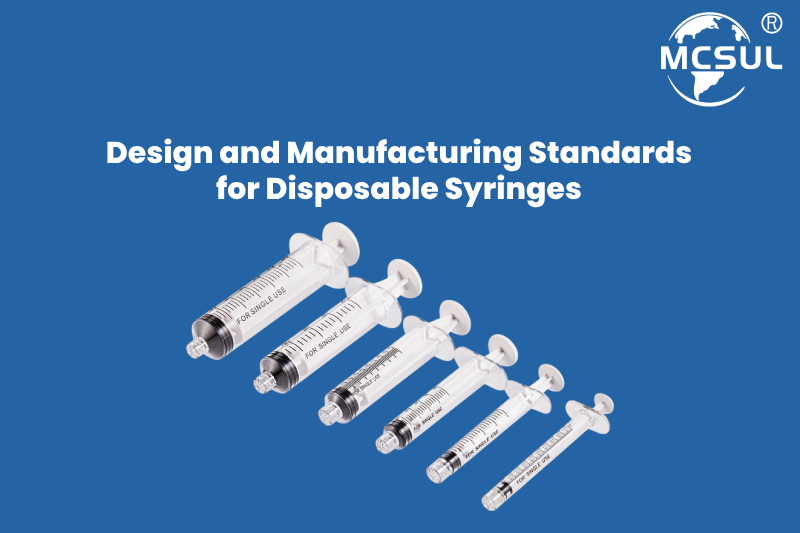
Disposable syringes are among the most widely used medical devices in the world. Yet the margin for error in their production is close to zero. A single defect a leaking barrel, a stiff plunger, or a misaligned needle hub — can compromise dosage accuracy, patient safety, and clinical trust. That’s why disposable syringe manufacturing standards govern every stage of production. They apply from the moment raw polymer pellets enter a facility to the moment a sterile, packaged syringe leaves it.
This guide breaks down the full journey behind disposable syringe manufacturing standards. It covers material selection, design compliance, in-process quality checks, and final testing. Together, these form the complete framework buyers, engineers, and regulatory teams look for when evaluating disposable syringe quality.
Why Disposable Syringe Manufacturing Standards Matter
Syringes fall under strict regulatory oversight because they are direct-contact, often invasive medical devices. Any deviation from disposable syringe manufacturing standards can cause dosing errors, contamination risks, or device failure in use. So for hospitals, distributors, and procurement teams, knowing these standards isn’t optional. They form the foundation for supplier evaluation and long-term partnership decisions.
A well-controlled disposable syringe manufacturing process typically follows five stages. These are material sourcing, design and tooling, molding and assembly, quality inspection, and sterilization/packaging. Each stage carries its own compliance checkpoints. Skipping any one of them increases risk downstream.
Step 1: Raw Materials and Disposable Syringe Manufacturing Standards
The material of the syringe determines the quality of the product. Manufacturers usually rely on:
- Medical grade polypropylene (PP) for syringe barrels, chosen for clarity, chemical resistance, and dimensional stability
- Polycarbonate in select applications that need greater transparency or stiffness
- Synthetic rubber or thermoplastic elastomer plunger stoppers, valued for low friction and low extractables
- Surgical grade stainless steel needles, tested for sharpness consistency and corrosion resistance
Every material must carry USP Class VI biocompatibility certification, ISO 10993 biological evaluation, or another applicable certification before manufacturers approve it for use. Reputable manufacturers also keep incoming material inspection logs. They check each batch against certificates of analysis (CoA) before production begins. This is also where medical device manufacturing standards first come into play. Traceability starts at the raw material stage, not at final packaging.
Step 2: Design Standards for Disposable Syringe Manufacturing
Design is where function meets regulation. The global benchmark here is ISO 7886, the standard that governs sterile hypodermic syringes for single use. It covers dimensional tolerances, dead space limits, and dosage accuracy requirements — all core parts of disposable syringe manufacturing standards.
Design elements buyers and engineers need to watch closely include:
Barrel clarity and graduation accuracy
ISO 7886 requires the barrel of the syringe to be transparent enough for users to read the graduation markings clearly. It must also let them detect air bubbles or particulate matter. Poor syringe barrel clarity isn’t just a cosmetic issue; it directly affects dosing safety. As a result, clarity testing is a mandatory checkpoint, and manufacturers commonly specify high-clarity polycarbonate syringes for exactly this reason.
Luer lock vs. slip tip configuration
One of the most common procurement questions is choosing between disposable syringe Luer lock vs. slip tip designs. Luer lock polycarbonate syringes use a threaded connection that screws onto a needle or IV line. This reduces the chance of accidental disconnection. Buyers therefore prefer them for high pressure injections, infusion setups, or procedures where a tight seal matters. By contrast, pull-ring plunger slip tip syringes use a friction-fit connection that allows for faster attachment and removal. Teams generally reserve them for routine, lower-risk applications. Manufacturers that produce both variants need to validate each one against its own fit, torque, and leakage tolerances.
Dead space minimization
Low dead-space design reduces medication waste and residual fluid retention. This is an increasingly important spec for vaccine and biologic drug delivery.
Ergonomic barrel and plunger design
Consistent glide force ensures smooth, controlled administration without dosing shocks.
Step 3: Controls of Manufacturing Processes
Once material and design decisions are final, the manufacturing process moves into production. This stage usually involves:
- Injection molding under controlled temperature, pressure, and cycle-time conditions, which prevents flash, short shots, or warping
- Assembly in a clean room environment, typically ISO Class 7 or Class 8, to minimize particle and microbial contamination
- Automated barrel-plunger insertion, needle bonding, and hub attachment, which reduces contamination risk from human contact
- Siliconized barrels and plungers for a consistent, low-friction glide force
In addition, manufacturers offer syringe OEM custom plunger design services. Here, they tailor plunger geometry, stopper material, and glide-force targets to a specific client’s clinical or device-integration needs, rather than pulling from a standard catalog. Color-plunger syringes are one example of this kind of OEM configuration for a specific client.
Step 4: Quality Control Under Disposable Syringe Manufacturing Standards
This is where disposable syringe quality control becomes measurable rather than theoretical. QC checkpoints normally include:
Dimensional accuracy test
Technicians use calibrated measuring instruments to check barrel diameter, plunger fit, and needle length against ISO tolerances. Buyers audit this checkpoint often, since dimensional accuracy directly impacts dose accuracy.
Seal integrity and leakage testing
Teams typically run syringe leakage tests using pressure-decay or dye-penetration methods. These detect leaks of liquid or air at the plunger seal and the needle hub connection.
Slip force testing
This measures the force required to move the plunger, which has to fall within a certain range. Too much resistance means the dose isn’t consistent. Too little means the device may discharge accidentally.
Visual and automated inspection
Inspectors check for flash, discoloration, particulate contamination, and graduation mark accuracy. High-volume lines often use automated vision systems for this step.
These checkpoints form the backbone of syringe inspection standards. Manufacturers typically document them per batch for full traceability, a requirement under ISO 13485 and FDA 21 CFR Part 820.
Step 5: Packaging & Sterilization
Sterility is a must for single-use devices. Common sterilization methods include:
- Ethylene oxide (EtO): widely used because it’s compatible with plastic and rubber components
- Gamma irradiation: offers fast processing and high penetration for bulk sterilization
- E-beam sterilization: a faster alternative to gamma, suited to high-throughput lines
Sterile syringe packaging must maintain a validated barrier against microbial ingress from sterilization until the point of use. To confirm that, teams run seal integrity tests, such as dye penetration, bubble emission, or vacuum decay. These tests ensure the package hasn’t been compromised.
Manufacturers also assign each batch a lot number. That way, they can trace it fully through manufacturing, sterilization, and distribution.
Common Defects and Root-Cause Prevention
Even mature manufacturing lines encounter recurring defect patterns. The most common include:
- Flash or short shots from inconsistent injection molding parameters
- Plunger stiction caused by uneven silicone application
- Needle misalignment from assembly tolerance drift
- Barrel haze or clouding, often linked to resin contamination or improper cooling cycles
To prevent these issues, manufacturers rely on statistical process control (SPC) on the production line. They also perform routine mold maintenance and periodic tooling requalification. These practices separate consistent medical syringe manufacturing operations from ones prone to batch variability.
Procurement Considerations: Combo Kits and Bulk Supply
Beyond standalone syringes, many healthcare buyers procure syringe and needle combo kits. Here, manufacturers pre-assemble and pre-sterilize syringes with a matched needle gauge for specific clinical use cases. This reduces prep time and packaging waste in high-volume settings like vaccination drives or hospital wards.
Buyers should also confirm that vendors validate the needle and syringe as a single sterile unit. Vendors shouldn’t simply package them together after sterilization. Pre-fixed configurations, such as a syringe with a fixed needle, are a typical example of this validated, ready-to-use solution.
For hospitals, distributors, and government procurement programs, sourcing from a medical disposable syringe bulk supplier also requires verifying consistent batch-to-batch quality at scale, not just at pilot volumes. That means checking manufacturer capacity certifications, documented QC pass rates, and cold-chain or storage handling capabilities for large orders.
What to Look for in a Disposable Syringe Manufacturer
When evaluating a disposable syringe manufacturer or supplier, procurement and QA teams typically assess whether the company follows recognized disposable syringe manufacturing standards, plus:
- ISO 13485 certification for medical device quality management
- FDA registration and/or CE marking, depending on the target market
- Documented compliance with ISO 7886 for design and performance
- In-house testing capability (dimensional, leakage, force-to-glide, sterility)
- Batch traceability systems from raw material to finished, packaged product
- Ability to support syringe OEM custom plunger design or combo-kit assembly for specific client needs
A sterile syringe manufacturer that can demonstrate all of the above isn’t just meeting minimum compliance. It’s building the kind of consistency that reduces recall risk and builds long-term supplier trust.
Disposable Syringes Built on a Quality-First Approach
MCSUL (formerly known as KDL) makes 2-part, 3-part, fixed-needle, and insulin syringes. These sit inside its wider drug delivery device range. Every line runs through ISO 13485:2016-certified production. EO sterilization and CE documents are available on request.
MCSUL also supports OEM/ODM projects, which suits buyers who want a custom volume, label, or package. Product specs, certificates, and batch records are available for procurement or regulatory review.
Looking for a syringe manufacturing partner?
Contact MCSUL to talk about specs, packaging, documents, and production needs.
Discuss Your Requirements →Conclusion: Disposable Syringe Manufacturing Standards Built to Last
Disposable syringe quality isn’t determined by a single inspection at the end of the line. Instead, it’s built layer by layer. It starts with certified raw materials. Then it’s reinforced through ISO 7886-compliant design. Cleanroom manufacturing keeps it controlled. Finally, rigorous dimensional, leakage, and sterility testing confirm it. For buyers and engineers, understanding this full chain of disposable syringe manufacturing standards matters. It’s the clearest way to separate a reliable medical device syringe manufacturer from one cutting corners.
At MCSUL, this end-to-end quality framework is built into every production batch. That means everything from ISO-certified raw material sourcing to validated sterile packaging. Are you evaluating a manufacturing partner? We support standard syringes, custom plunger OEM work, and bulk combo-kit procurement. Browse our full range of disposable syringes, or reach out for our QC documentation and certifications on request.