 +86-791-8686-1216



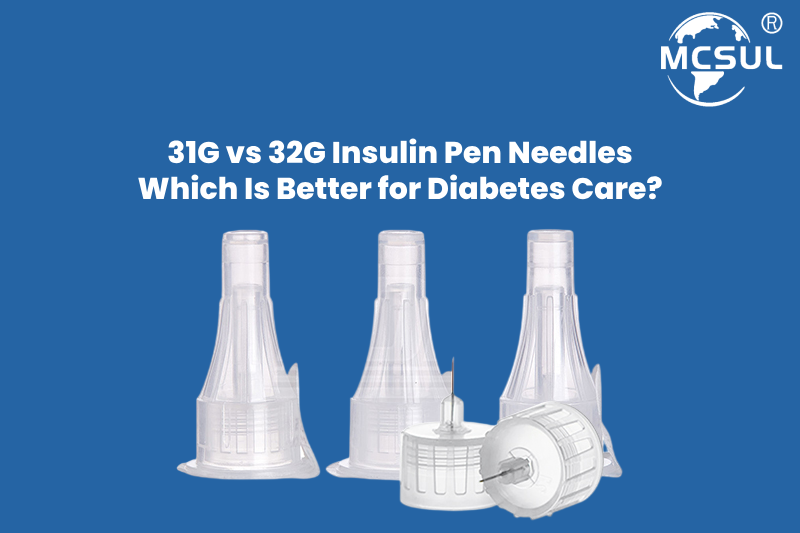
If you use an insulin pen to manage diabetes, you know that small details can make a big difference in your daily routine. Your insulin pen needle is one of them. The right needle can help you feel more comfortable and make your injections easier to manage. When you compare 31G vs 32G insulin pen needles, the main difference is thickness. A 32G needle is thinner than a 31G needle. This smaller diameter may help reduce the force needed to enter your skin.
But does a thinner needle always mean a better injection?
Not necessarily. Needle length, internal design, sharpness, insulin flow, and your injection technique also matter. In this guide, you will learn the difference between 31G and 32G pen needles, compare their benefits, and understand what to consider when choosing an insulin pen needle for diabetes care.
What Are 31G and 32G Insulin Pen Needles?
Insulin pen needles are small, disposable needles that attach to insulin pens. They help deliver insulin into the fatty tissue beneath your skin.
Pen needles come in different gauges and lengths. Gauge tells you how thick the needle is. Length tells you how far the needle extends into your skin.
What Does 31G Mean in Insulin Pen Needles?
A 31G insulin pen needle has a gauge of 31. It is slightly thicker than a 32G needle.
A typical 31G insulin pen needle has an outer diameter of around 0.25 mm. It is available in different lengths, such as 4 mm, 5 mm, 6 mm, and 8 mm, depending on the product.
You may find 31G pen needles useful if you prefer a familiar needle size or want to compare different needle designs for daily insulin delivery.
What Does 32G Mean in Insulin Pen Needles?
A 32G insulin pen needle has a gauge of 32. It is thinner than a 31G needle.
A typical 32G insulin pen needle has an outer diameter of around 0.23 mm. Many products are available in shorter lengths, including 4 mm and 6 mm options.
If you prefer a thinner needle, a 32G insulin pen needle may be worth discussing with your healthcare professional.
How Does Insulin Pen Needle Gauge Work?
The gauge system works in reverse:
- A lower gauge number means a thicker needle.
- A higher gauge number means a thinner needle.
For example, a 30G needle is thicker than a 31G needle, and a 31G needle is thicker than a 32G needle.
This difference is small, but it can affect how the needle enters your skin and how insulin flows through it. The exact experience depends on the needle’s construction.
31G vs 32G Insulin Pen Needles: Key Differences
When you compare insulin pen needles 31G vs 32G, you should look beyond the gauge number.
Both sizes are used for insulin delivery. However, they differ in outer diameter and may differ in injection comfort and flow performance.
31G vs 32G Insulin Pen Needle Comparison
| Feature | 31G Insulin Pen Needle | 32G Insulin Pen Needle |
|---|---|---|
| Outer diameter | About 0.25 mm | About 0.23 mm |
| Thickness | Slightly thicker | Slightly thinner |
| Skin penetration | May need more force in similar designs | May need less force in similar designs |
| Comfort | Comfortable for many users | May offer added comfort |
| Insulin flow | Depends on internal design | Depends on internal design |
| Needle length | Varies by product | Varies by product |
| Durability | Depends on construction | Depends on construction |
| Common use | Daily insulin injections | Daily insulin injections |
Note: These are general comparisons. Needle performance can vary based on wall thickness, tip design, coating, and manufacturing quality.
Which Insulin Pen Needle Is Thinner?
A 32G insulin pen needle is thinner than a 31G insulin pen needle.
The typical outer diameter of a 32G needle is about 0.23 mm, while a 31G needle measures around 0.25 mm.
This means a 32G needle has a smaller outer diameter. However, the outside of the needle does not tell you everything about its insulin flow.
The inside diameter, also called the lumen, matters too.
Does a Higher Gauge Mean Less Pain?
A higher gauge means a thinner needle. A thinner needle may require less force to enter the skin, which can help make an injection more comfortable.
However, you should not assume that every 32G needle is less painful than every 31G needle.
The needle tip, coating, length, and injection technique all play a role. A well-designed 31G needle may feel more comfortable than a poorly designed 32G needle.
The American Diabetes Association explains that a higher gauge means a thinner needle and less pain. Its Diabetes Forecast guide on pen needles also notes that thicker needles can give a larger dose more quickly.
31G vs 32G Insulin Pen Needles: Which Is More Comfortable?
Comfort is one of the main reasons people compare 31G vs 32G pen needles.
If you inject insulin every day, even a small improvement in comfort may make your routine easier.
Skin Penetration and Injection Pain
A thinner needle has a smaller outer diameter. In similar needle designs, this may reduce the force needed to pass through your skin.
For this reason, some people may prefer 32G insulin pen needles.
However, your experience may differ. Skin sensitivity, injection site, needle sharpness, and your technique can all affect how an injection feels.
If you often feel pain during insulin injections, ask your healthcare professional to review your technique and needle choice.
Needle Sharpness and Silicone Coating
Gauge is only one part of needle comfort.
A sharp needle tip can help the needle enter your skin smoothly. Some pen needles also use a silicone coating to reduce friction during insertion.
These features may help improve your injection experience.
When comparing 31G and 32G insulin pen needles, look for product information about:
- Needle tip design
- Surface coating
- Wall thickness
- Needle length
- Product quality and consistency
These features may matter as much as the gauge number.
Which Needle Is Better for People Afraid of Injections?
If you feel nervous about injections, a thinner needle may be a useful option to discuss with your healthcare professional.
A 32G needle has a smaller outer diameter than a 31G needle. This may help some people feel more comfortable during injection.
Still, changing needle gauge alone may not remove injection anxiety.
You can also ask for support with injection technique, site rotation, and ways to make your daily insulin routine easier.
31G vs 32G Insulin Pen Needles: Insulin Flow and Delivery
Needle thickness can affect insulin delivery, but the relationship is not as simple as it may seem.
A thinner needle does not always mean slower insulin flow.
Does Needle Thickness Affect Insulin Flow?
Insulin flows through the inside of the needle, not around its outer surface.
The inside diameter of the needle affects how easily insulin can pass through it. Wall thickness also plays a role.
Some insulin pen needles use thin-wall or extra-thin-wall technology. This design allows the needle to have a larger inner diameter while keeping the outer diameter small.
For example, a thin-wall 32G needle may allow insulin to flow more easily than a regular-wall needle of the same gauge.
This is why you should compare the complete needle design rather than gauge alone.
Which Needle Requires Less Injection Force?
Injection force is the pressure you apply to the insulin pen button to deliver your dose.
A needle with a suitable internal diameter may help reduce the force needed to push insulin through it.
However, the required force also depends on:
- The insulin dose
- Insulin viscosity
- Needle length
- Internal diameter
- Needle wall design
- Insulin pen construction
A 31G thin-wall needle may provide easier insulin flow than a regular-wall 32G needle. The product specifications are important.
Can a Thinner Needle Cause Insulin Leakage?
Insulin leakage can happen for different reasons. It does not mean that your needle is simply too thin.
Possible causes include:
- Removing the needle too soon after injection
- Using the wrong injection technique
- A needle or pen compatibility issue
- A damaged or blocked needle
- Incorrect use of the insulin pen
Follow your insulin pen instructions for how long to hold the needle in place after pressing the injection button.
If you notice repeated leakage, speak with your healthcare professional. Do not change your insulin dose or needle size on your own to solve the problem.
31G vs 32G Insulin Pen Needles: Does Needle Length Matter?
Yes. Needle length is another important part of insulin injection.
Gauge tells you how thick the needle is. Length tells you how long it is.
A 31G × 4 mm needle and a 32G × 4 mm needle have the same length but different outer diameters.
This is why comparing needles with the same length can help you understand the difference between 31G and 32G more clearly.
Common Insulin Pen Needle Lengths
Insulin pen needles are available in different lengths, including:
| Needle length | General description |
|---|---|
| 4 mm | Short needle option |
| 5 mm | Short needle option |
| 6 mm | Intermediate length |
| 8 mm | Longer needle option |
The right length depends on your needs and the instructions from your healthcare professional.
31G vs 32G: Comparing the Same Needle Length
When you compare a 31G vs 32G needle, try to compare products with the same length.
For example:
- 31G × 4 mm vs 32G × 4 mm
- 31G × 6 mm vs 32G × 6 mm
This helps you focus on the gauge difference instead of comparing two features at once.
If you compare a 31G × 8 mm needle with a 32G × 4 mm needle, both gauge and length change. The result may not tell you which gauge is more comfortable.
Why Shorter Insulin Pen Needles Matter
Shorter insulin pen needles can help deliver insulin into the fatty tissue beneath your skin while lowering the risk of injecting into muscle.
The American Diabetes Association notes that a shorter needle is effective for all body types. It also gives guidance on injection angle and technique, such as using a 90-degree angle with shorter needles. Very thin people and children may still need to pinch up the skin.
You should follow the instructions for your insulin pen and the advice of your healthcare professional.
31G vs 32G Insulin Pen Needles: Pros and Cons
Both 31G and 32G insulin pen needles can be useful for daily diabetes care.
The best choice depends on your comfort, insulin pen, and the needle’s design.
Advantages of 31G Insulin Pen Needles
A 31G insulin pen needle may offer these benefits:
- A familiar option for many insulin pen users.
- Available in different lengths.
- Can provide comfortable injections when properly designed.
- May support efficient insulin delivery with suitable wall technology.
A 31G needle may be a good option if you are already comfortable with your current needle and it works well with your insulin pen.
Disadvantages of 31G Insulin Pen Needles
A 31G needle is slightly thicker than a 32G needle.
For some users, this may mean slightly more force during skin penetration. However, the difference may be small, and comfort varies from person to person.
If you are looking for a thinner needle, you may want to compare a 32G option.
Advantages of 32G Insulin Pen Needles
A 32G insulin pen needle may offer:
- A smaller outer diameter.
- Potentially lower skin penetration force.
- A thinner needle option for people who prefer it.
- Availability in short lengths, depending on the product.
These features may make 32G pen needles attractive to users who want to explore a thinner needle.
Disadvantages of 32G Insulin Pen Needles
A thinner needle is not automatically better in every situation.
The needle’s internal design can affect insulin flow. A 32G needle with a narrow inner diameter may require more injection force than a well-designed thin-wall 31G needle.
Needle strength also depends on the material, construction, and design. Do not assume that all 32G needles bend more easily.
31G vs 32G Insulin Pen Needles: Which Is Better for Different Users?
Your needs may be different from those of another person who uses insulin.
The following points can help you understand what to consider.
Best Insulin Pen Needle for Daily Insulin Injections
If you inject insulin every day, comfort and ease of use matter.
Both 31G and 32G insulin pen needles can be used for daily injections when they are compatible with your pen and suitable for your needs.
You may prefer a 32G needle because it is thinner. Another person may find a 31G needle comfortable and easy to use.
Best Insulin Pen Needle for Older Adults
If you are an older adult or help someone else with insulin injections, consider more than needle gauge.
Look at:
- Ease of attaching the needle
- Ease of removing the protective cap
- Compatibility with the insulin pen
- Needle length
- Clear product labeling
A needle that is easy to handle may be more useful than choosing a size based only on thickness.
If needlestick safety is a concern for you or a caregiver, safety pen needles add a shield that covers the needle after use.
Best Insulin Pen Needle for People With Sensitive Skin
If you have sensitive skin, you may want to discuss a thinner needle with your healthcare professional.
A 32G insulin pen needle has a smaller outer diameter than a 31G needle. This may help reduce penetration force in comparable designs.
However, skin sensitivity can vary. Needle sharpness, coating, and technique also matter.
Best Insulin Pen Needle for Beginners
If you are new to insulin injections, start by learning how to use your insulin pen correctly.
Ask your healthcare professional to show you how to:
- Attach a new needle
- Check insulin flow
- Select the prescribed dose
- Inject at the correct site
- Remove and dispose of the needle safely
Your healthcare professional can also help you choose a suitable gauge and length.
Best Insulin Pen Needle for Multiple Daily Injections
If you take insulin several times a day, comfort becomes an important part of your routine.
You may prefer a thinner 32G needle. However, a well-designed 31G needle may also provide a comfortable injection experience.
Follow proper injection site rotation and use a new needle for each injection. These steps can help support safe and consistent insulin delivery.
How to Choose Between 31G and 32G Insulin Pen Needles
Choosing the right insulin pen needle does not need to be confusing.
You can start by checking a few important details.
Not sure whether a pen or a syringe suits you better? This guide on choosing insulin pen needles or syringes can help.
Check Your Insulin Pen Compatibility
Not every needle should be assumed to fit every insulin pen.
Many pen needles are designed for broad compatibility, but you should always check the product instructions.
Before choosing a needle, confirm:
- The needle connection type
- The insulin pen model
- The recommended needle sizes
- The manufacturer’s compatibility information
Compare Needle Gauge and Length
Compare the gauge and length together.
If you are deciding between 31G and 32G insulin pen needles, look for products with the same length.
Then review the outer diameter, inner diameter, wall thickness, and tip design.
This gives you a clearer picture of how the needles may perform.
Follow Your Healthcare Professional’s Advice
Your healthcare professional can help you choose a needle based on your insulin therapy and injection needs.
If you experience pain, bruising, leakage, or difficulty using your insulin pen, ask for guidance.
Do not change your insulin dose or injection routine without medical advice.
Why Choose MCSUL Insulin Pen Needles?
When you source insulin pen needles, product quality and manufacturing consistency matter.
MCSUL is a medical device manufacturer and supplier offering insulin pen needles in different gauges and lengths.
Its listed insulin pen needle range includes 31G × 5 mm and 32G × 4 mm options, along with other sizes. The product page also provides information on materials, packaging, and manufacturing specifications.
For healthcare businesses and distributors, reviewing product specifications can help you assess whether a needle meets your requirements.
If you are looking for insulin pen needle manufacturing or OEM/ODM support, you can explore MCSUL product range and discuss your needs with its team.
Conclusion
When comparing 31G vs 32G insulin pen needles, the main difference is thickness. A 32G needle is thinner than a 31G needle and may offer a more comfortable injection experience.
However, the best insulin pen needle depends on more than gauge. Needle length, inner diameter, wall thickness, sharpness, and compatibility all matter.
If you prefer a thinner needle, a 32G option may be worth considering. If your current 31G needle works well, there may be no need to change.
Choose a needle that suits your insulin pen and follow your healthcare professional’s advice for safe, comfortable insulin delivery.