 +86-791-8686-1216


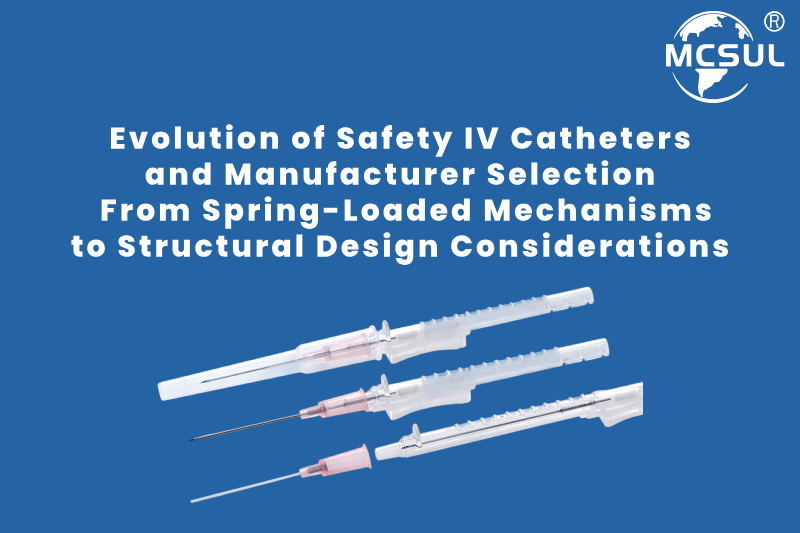
Quick Overview : Five important considerations to make when choosing a safety IV catheter manufacturer are: Reliability of the safety mechanism, Quality of the design, Regulatory compliance, Manufacturing capacity and supplier support. A good manufacturer should provide consistent product performance, technical documentation and long-term reliability of supply.
If you are sourcing safety IV catheters for a hospital, healthcare distribution business, or OEM/private-label project, your decision involves much more than selecting a device with a protective mechanism.
Today you have to think about several things at once: How effective is the safety mechanism at reducing exposure to sharps?
- How consistent is the product quality across manufacturing batches?
- Does the catheter design support clinician workflow?
- Can the manufacturer provide reliable supply and support in technical area?
- Does the supplier have the regulatory experience required for your target market?
The safety IV catheter market has evolved significantly. Early products were primarily intended to prevent accidental needlestick injuries to health care workers. Modern designs combine the safety technology with improved ergonomics, manufacturing precision and user-oriented engineering.
When you choose a safety IV catheter manufacturer, you are not only selecting a medical device. You are selecting a partner that can influence your product quality, customer satisfaction, regulatory process, and long-term supply stability.
Understanding how safety IV catheter has developed can help you make a more informed purchasing decision.
What Is the Fastest Way to Choose a Safety IV Catheter Manufacturer?
The fastest way to choose a safety IV catheter manufacturer is to confirm three things first. Check for a passive safety mechanism, not one that depends on a spring alone. Confirm compliance with ISO 10555-5 and ISO 23908. Confirm a current ISO 13485:2016 certificate tied to the real factory making your order.
Everything past this point is detail. But skipping any of these three checks is risky. It is how buyers end up with a catheter that looks safe on paper. Then it performs poorly at the bedside.
How Did Safety IV Catheter Design Evolve From Spring-Loaded Mechanisms?
Safety IV catheter design evolved from a simple spring-loaded shield. That design first appeared in the 1990s. Early versions bolted a metal spring onto a standard catheter needle. The spring pushed a plastic guard over the needle tip after withdrawal.
This first generation solved part of the problem. But it created a new one. A spring is a single point of failure. If the spring lost tension during shipping or storage, the guard could activate slowly. Sometimes it failed to lock at all. Early patents from this era describe exactly this weakness. Some guards could be pushed back off the needle tip after use.
What Changed With Passive vs. Active Safety Mechanisms?
Passive and active mechanisms differ in who triggers the protection. A passive mechanism activates on its own. It fires the moment the needle leaves the vein. An active mechanism needs the clinician to act. They must press a button, slide a lever, or pull a shield by hand.
Active designs still exist. They work well when used correctly. The problem is human factors. A busy nurse under time pressure can forget the manual step. This risk grows during a difficult stick or an emergency. A safety IV catheter needle with a passive shield removes this risk. The shield locks the moment the needle clears the catheter hub. No extra step is needed.
Why Does Structural Design Matter More Than the Spring Today?
Structural design now matters more than the spring. It removes the single point of failure from first-generation devices. A structural safety catheter does not rely on one metal coil. It uses the shape of the housing itself. Guide rails, locking tabs, and a shaped barrel do the work together.
This shift has a clear benefit. A structural mechanism keeps working under variable manufacturing tolerances. It also holds up better under rough handling in transit. A spring-only design has less room for error. One weak coil in a batch can lead to an unprotected needle. That needle can reach a hospital floor.
Modern designs also add a flashback chamber. This gives faster, clearer confirmation of blood return. Many now use a push-button shielding system. This releases the needle into a locked safety barrel the instant it is withdrawn. It pairs a structural shield with a simple trigger. Buyers get passive-level reliability without adding steps to insertion.
How Does a Retractable Safety IV Catheter Compare to Manual and Closed-System Designs?
A retractable safety IV catheter pulls the needle fully back into a barrel after use. No exposed sharp remains at all. This differs from a manual safety catheter. There, a clinician slides or clicks a shield into place by hand. It also differs from a closed IV catheter system. There, the focus shifts to blood containment and a needle-free access point, not needle retraction.
Each design solves a different part of the risk. Retraction removes the sharp from the equation. Manual shielding is simpler to make, but it leans on clinician habit. A closed system adds a pre-attached extension line and a needle-free connector. This cuts how often blood meets open air during and after insertion.
| Design Type | How It Works | Main Advantage | Main Trade-Off |
|---|---|---|---|
| Retractable safety IV catheter | Needle pulls back into the housing after withdrawal | No exposed sharp remains at any point | Adds mechanical parts, so tolerance control matters more |
| Manual (active) safety catheter | Clinician manually slides or clicks a shield over the tip | Lower part count, simpler to manufacture | Depends on a consistent manual step every time |
| Closed IV catheter system | Pre-attached extension tubing and needle-free connector limit open blood exposure | Fewer disconnections, supports longer dwell times | Higher per-unit cost and a bulkier insertion package |
A retractable safety IV catheter manufacturer worth shortlisting should show you retraction-force test data. A demo video is not proof. Ask how the design performs across a full production run, not just a hand-picked sample. For a full safety mechanism comparison across all three types, the right pick often comes down to dwell time needs. It also depends on how much control you have over staff training on the floor.
What Evaluation Criteria Matter Most for a Safety IV Catheter?
The top evaluation criteria are four things. These are mechanism reliability, material safety, insertion performance, and standards compliance. Weigh all four together. One weak factor can outweigh three strong ones.
| Evaluation Criterion | What It Tells You | Why It Matters |
|---|---|---|
| Mechanism type (passive vs. active) | How the shield activates | Passive designs remove reliance on clinician memory. |
| Catheter material | PU vs. FEP vs. PTFE | Affects dwell time, softening in the vein, and comfort. |
| Bevel and tip geometry | Insertion force and vein trauma | Back-cut bevels lower penetration force and pain. |
| Flashback visibility | Speed of confirming successful venipuncture | Faster confirmation means fewer failed sticks. |
| DEHP-free construction | Presence of plasticizers in the catheter | Lowers patient exposure risk during infusion. |
| Standards compliance | ISO 10555-5, ISO 23908, ISO 13485 | Confirms real testing, not just a “safety” label. |
Ask any supplier to walk through this table item by item. Ask for their own test data, not general claims. Vague talk about “safety” and “comfort” is not proof of real work.
How Should You Vet a Safety IV Catheter Manufacturer?
Vet a safety IV catheter manufacturer by checking three layers. Check the product standards and the plant’s quality system. Check the regulatory filing for your target market. Each layer catches a different kind of risk.
Product-level standard
It confirm the device itself was tested right:
- ISO 10555-5:2013 sets rules for over-needle peripheral catheters. It covers tensile strength between the needle and hub. It also covers leak testing at the connector.
- ISO 23908 sets test methods for sharps-injury protection. It confirms the shield blocks needle exposure. A shield that just exists is not enough.
Plant-level quality system
Confirm the factory can repeat that result, batch after batch:
- ISO 13485:2016 is the core quality standard for device makers. Ask to see the current certificate directly. Do not accept a summary claim. A supplier’s certificates page should show this detail upfront.
Regulatory filing
Confirm the device is legally cleared for your market:
- In the U.S., safety IV catheters fall under 21 CFR 880.5200. This is a Class II, general hospital device. It is often listed under product code FOZ. A U.S. supplier needs a cleared 510(k) for your exact device. A related model is not enough.
- U.S. hospital buyers should also know one more rule. The Needlestick Safety and Prevention Act works through OSHA’s Bloodborne Pathogens Standard, 29 CFR 1910.1030. It requires employers to use engineered sharps protection when feasible. Choosing a compliant catheter is not just good practice. It supports your own facility’s legal duty.
| Layer | Standard or Rule | What to Ask For |
|---|---|---|
| Product | ISO 10555-5:2013 | Tensile and leak test data for your model. |
| Product | ISO 23908 | Sharps-shield activation force test results. |
| Plant | ISO 13485:2016 | Current, unexpired certificate with issuing body. |
| U.S. market | 21 CFR 880.5200, Class II | 510(k) number for your specific device. |
| U.S. facility | 29 CFR 1910.1030 | Proof your device supports safer-device compliance. |
What Mistakes Do Buyers Make When Choosing a Safety IV Catheter Supplier?
The most common mistake is simple. Buyers trust the word “safety” without asking how it works. Other frequent mistakes include:
- Skipping the activation-force test. A shield that locks but needs too much force gets bypassed by busy staff.
- Confusing an active mechanism for a passive one. Marketing copy can blur this line. Ask the supplier to show you the exact sequence.
- Ignoring the dwell-time rating. A short-dwell catheter used for long infusion raises complication risk.
- Not confirming the 510(k) covers the safety model. Some suppliers hold clearance for a plain catheter only. Not the safety-shielded version you actually want.
- Skipping sample testing. A spec sheet is not proof of real performance in your own staff’s hands.
Which Safety IV Catheter Design Fits Your Care Setting?
The right design depends on your patient population and your staff’s insertion volume. It also depends on dwell-time needs. A busy emergency department has different priorities than a pediatric unit. A home infusion program has different needs too.
| Care Setting | Priority Feature | Suggested Design Direction |
|---|---|---|
| Emergency department | Fast insertion, clear flashback | Passive shield with wide-bore gauge options. |
| ICU / long-term infusion | Extended dwell time, low irritation | PU biomaterial catheter for longer indwelling use. |
| Pediatric care | Smaller gauge, gentle insertion | Back-cut bevel with reduced penetration force. |
| Home infusion / outpatient | Simple, foolproof activation | Fully passive, single-step deployment. |
| Veterinary use | Durable materials, visible sizing | Color-coded hub with radiopaque line. |
For emergency departments and general adult wards, the MCSUL (Formerly KDL) Safety IV Catheter is the right pick. It pairs a universal bevel with a flashback window for fast, clear confirmation.
For ICU and long-term infusion patients, the same MCSUL (Formerly KDL) Safety IV Catheter line is the right pick. Its PU biomaterial catheter is built for longer indwelling periods.
For pediatric care, the MCSUL IV Catheter Needle is the right pick. Its back-cut needle lowers penetration force for a gentler insertion.
For home infusion and outpatient settings, the MCSUL Safety IV Catheter Needle is the right pick. Its fully shielded, DEHP-free design needs no extra step from the caregiver.
For veterinary practices, the MCSUL Veterinary IV Catheter is the right pick. It has a color-coded hub for fast size checks and radiopaque lines for X-ray use.
Facilities with longer indwelling needs should confirm dwell-time rating and material before ordering in bulk. Need custom gauge or shield work outside a standard catalog? Ask about OEM/ODM development. This lets you adjust gauge, hub color, and packaging fast.
What Should Your Final Decision Checklist Include?
Your final checklist should confirm four things before you sign a purchase order. Confirm mechanism type, standards compliance, sample performance, and supply reliability. Use this list for any new supplier. Run it again each year for existing ones.
- Mechanism confirmed as passive, not dependent on manual activation.
- Structural shield design verified, not a spring-only first-generation part.
- ISO 10555-5:2013 test data available for the specific model.
- ISO 23908 sharps-shield activation testing on file.
- Current ISO 13485:2016 certificate confirmed with the issuing body.
- FDA 510(k) number verified for the exact device, if selling in the U.S.
- DEHP-free material confirmed, if your patients need it.
- Sample batch tested by your own clinical staff first.
- Gauge range and dwell-time rating matched to your care setting.
- Lead time and export paperwork confirmed in writing.
A supplier who checks every line without hesitation has done the real work. One who stalls on even one item deserves a second look. Do this before you commit to volume.
Key Takeaways
- Early safety IV catheters used a metal spring to retract the needle. Modern designs use structural geometry instead. The shield activates even if the spring is weak or missing.
- ISO 10555-5:2013 governs over-needle peripheral IV catheters. ISO 23908 governs sharps-injury protection testing.
- In the U.S., safety IV catheters fall under 21 CFR 880.5200. This is a Class II device, product code FOZ.
- The Needlestick Safety and Prevention Act requires U.S. healthcare employers to use engineered sharps protection. This applies whenever it is feasible, under 29 CFR 1910.1030.
- Passive safety mechanisms activate on their own. Active mechanisms need a manual step from the clinician. This raises the chance of a missed activation.
- Vet a manufacturer on three things. Check mechanism type. Check named standards compliance. Check a verifiable ISO 13485:2016 certificate for the real plant.
- Match catheter gauge, dwell time, and flashback design to your care setting. Do not rely on a generic “hospital-grade” label.
Final Thoughts
The story of the safety IV catheter is a story about removing points of failure. A spring alone was never going to work for every batch and every shift. Structural design closed that gap. It builds protection into the shape of the device itself.
When you check your next safety IV catheter manufacturer, look past the word “safety” on the box. Ask how the mechanism works. Ask for the ISO 10555-5 and ISO 23908 test data. Confirm the ISO 13485:2016 certificate covers the real plant making your order.
For related product options and current specs, see MSCUL’s IV infusion product line. The team is reachable through the contact page for a sample request or quote.