 +86-791-8686-1216


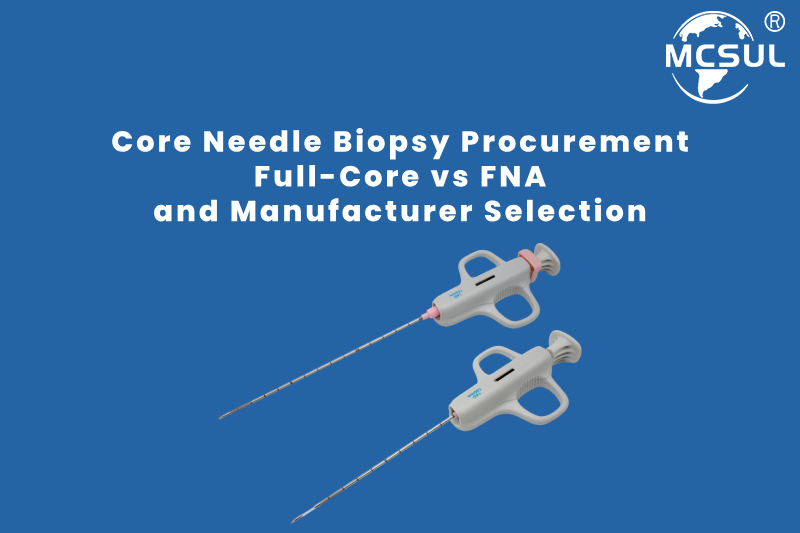
Choosing between a full-core biopsy needle and a fine needle aspiration (FNA) device is not a small line item. It shapes sample quality and diagnostic accuracy. It can also decide how often a patient has to repeat a painful test. Buyers often compare price sheets side by side. They miss the clinical trade-off underneath. This guide breaks core needle biopsy procurement into three parts. First, the mechanical difference between full-core and FNA systems. Next, what the clinical data shows. Last, how to judge a manufacturer.
What Is Core Needle Biopsy Procurement and Why Does the Needle Choice Matter?
Core needle biopsy procurement is the process of sourcing needles that pull a solid tissue sample for lab review. This differs from needles built only for cell aspiration. The choice affects three things. It sets how much tissue the lab gets and also set how many passes a patient needs. It sets how fast a diagnosis comes back. A buyer who treats a core biopsy needle and an FNA needle as the same thing risks a costly mismatch. Hospitals, distributors, and OEM buyers all face this choice. The core question stays the same. Which device gives the best sample for the least trauma? And at what cost?
What Is the Difference Between Full-Core Biopsy Needles and Fine Needle Aspiration?
A full-core biopsy needle vs fine needle aspiration comparison comes down to what leaves the body. A core needle pulls out a solid tissue core. An FNA needle pulls out loose cells. A core needle uses a spring-fired or manual cutting action. This shears off a small cylinder of tissue. An FNA needle uses vacuum suction through a much thinner needle. This draws cells into a syringe. The core sample keeps tissue structure intact. Pathologists need this for grading and staging a tumor. The FNA sample is a cytology smear. A lab reads it for the presence of abnormal cells.
| Factor | Full-Core Biopsy Needle | FNA Needle |
|---|---|---|
| Sample type. | Solid tissue core. | Loose cells, fluid. |
| Typical gauge. | 14G to 20G. | 21G to 27G. |
| Mechanism. | Spring-fired or manual cutting. | Manual vacuum aspiration. |
| Analysis method. | Histopathology. | Cytopathology. |
| Tissue structure kept intact. | Yes. | No. |
| Typical trauma. | Moderate. | Low. |
| Best suited for. | Deep organ masses, staging. | Thyroid nodules, superficial masses. |
Our FNA biopsy needle guide covers gauge choice for aspiration-only procedures in more depth. For a closer look at spring-fired core devices, see our semi-automatic biopsy needle guide.
What Does the Core Needle Biopsy vs FNA Accuracy Comparison Show?
A core needle biopsy vs FNA accuracy comparison usually favors core biopsy on sensitivity. Both methods tend to show similar specificity. A pooled review of breast lesion studies found core biopsy sensitivity near 87%. FNA cytology scored near 74% in the same review. Both methods held specificity between 96% and 98%. A separate review on neck lymph node sampling found a similar pattern. Pooled sensitivity was about 94% for core biopsy and 72% for FNA. Neither method wins in every setting, though. FNA still wins on speed, cost, and comfort for shallow, easy-to-reach lesions.
What Does the FNA vs Core Biopsy Diagnostic Yield Clinical Study Data Show?
An FNA vs core biopsy diagnostic yield clinical study usually finds fewer failed samples with core biopsy than with FNA. A failed or unclear sample forces a repeat procedure. That adds cost. It also adds delay. One study on armpit lymph node checks looked at this directly. Core biopsy cut the rate of unclear samples compared with FNA. Both techniques still kept complication rates low. A study on bone and soft tissue tumors found accuracy of 86.6% for FNA cytology. Core needle biopsy scored 93.8% in the same study. These numbers support one simple rule for buyers: stock both device types. Match the device to the lesion, not the other way around.
What Design Factors Should Buyers Check When Procuring a Core-Needle Biopsy System?
Four design factors decide how a core biopsy needle performs in the hand. These are gauge range, firing mechanism, notch depth, and depth control. Gauge sets the trade-off between sample size and tissue trauma. A 14G needle pulls a larger, more intact core. An 18G to 20G needle causes less trauma. It also yields a smaller sample.
1. Firing mechanism
Semi-automatic needles let the doctor place the stylet by hand. The spring then fires the outer cannula. Fully automatic needles fire both parts at once. This trades some placement control for speed. Manual Tru-Cut style needles give the most control. They also have the slowest cut. Our guide to choosing the right biopsy needle walks through this trade-off by procedure type.
2. Notch depth
A deep, well-shaped notch on the inner stylet holds the tissue sample whole. This happens before the outer cannula makes its cut. A shallow notch risks a broken or crushed core.
3. Depth control
Centimeter marks help the operator match needle reach to the target depth. Some designs also offer an adjustable throw length. This matters most for deep-organ targets. A small overshoot there can mean a repeat procedure.
4. Coaxial compatibility
Many buyers pair a core biopsy needle with a coaxial introducer. This lets several passes happen through one skin puncture. Buy the introducer and the main needle as one matched, tested set. A mismatched pair might compromise fit and cut quality.
What Certifications Should a Core-Needle Biopsy System Manufacturer Hold?
A credible manufacturer should hold named FDA and ISO certifications for both core and aspiration needle lines. Avoid any supplier who only claims to “meet industry standards.” In the United States, core biopsy needles fall under 21 CFR 876.1075. This is the Gastroenterology-Urology Biopsy Instruments rule. It sets these needles as Class II devices. The product code is KNW. Aspiration and injection needles, the kind used for FNA, sit under a separate rule. This is 21 CFR 878.4800. This is the Gastroenterology and Urology Biopsy Instruments rule. It sets these needles as Class I devices. Buyers who source both device types from one supplier should confirm both filings are on record.
On the manufacturing side, look for these named standards:
- ISO 9626:2016. Covers stainless steel needle tubing, the raw material for the needle shaft.
- ISO 10993-1. Confirms the needle materials are safe for contact with human tissue.
- ISO 11607-1. Confirms the sterile packaging holds up through shipping and storage.
- ISO 6009:2016. Sets the color code for needle hub by gauge.
- ISO 13485. Covers the quality system for the whole factory, not just one product line.
These standards are easy to check. A marketing claim is not. You can review our own quality documents on our certificates page.
How Do You Compare Core-Needle Biopsy Manufacturers Side by Side?
Compare manufacturers on regulatory class, named material standards, device range, and OEM support first. Compare price last. The table below shows how KDL (Nanchang Kindly Medical) lines up on each point.
| Buyer Criteria | What to Look For | KDL (Nanchang Kindly Medical) |
|---|---|---|
| Core Needle Classification. | Class II, correct product code. | 21 CFR 876.1075, product code KNW. |
| FNA/Aspiration Needle Classification. | Class I, named regulation. | 21 CFR 878.4800. |
| Material Standard. | Named ISO standard for tubing. | ISO 9626:2016. |
| Biocompatibility. | Verified biological safety testing. | ISO 10993-1. |
| Sterile Packaging. | Verified sterile barrier standard. | ISO 11607-1. |
| Device Range. | Both full-core and FNA lines available. | Core, semi-automatic, and FNA needles. |
| OEM/ODM Support. | Custom specs and private label available. | Yes, OEM and ODM both offered. |
| Export Reach. | Active in multiple countries. | 50+ countries served. |
Looking for an OEM/ODM Core-Needle Biopsy Manufacturer?
At KDL we offer flexible OEM/ODM manufacturing for both full-core biopsy needles and FNA and aspiration biopsy needles. This includes custom gauge, length, and packaging options.
Request an OEM/ODM Quote →What Common Mistakes Do Buyers Make When Choosing Between Full-Core and FNA Systems?
Standardizing on one device type
A hospital that stocks only core needles, or only FNA needles, will eventually mismatch a device to a lesion. Keep both on the shelf. Let the case decide which one to use.
Comparing unit price alone
A cheaper needle that gives more failed samples costs more later. Repeat procedures and extra lab work add up fast.
Skipping clinical evidence
Bench specs do not always predict real-world accuracy. Request published or in-house statistics on sensitivity, specificity, and failed sample rate.
Overlooking sterile packaging
A poor sterile barrier may fail before the needle enters the treatment room. Check for ISO 11607-1 compliance and shelf life test results.
Assuming FNA is always the gentler choice
FNA causes less trauma per pass. But a higher failed-sample rate can mean more total needle passes across a patient’s care, not fewer.
For more sterile biopsy needle options, browse our single-use sterile biopsy needles.
Key Takeaways
- Full-core biopsy needles pull a solid tissue core for lab review under a microscope slide. FNA needles aspirate loose cells for cytology review.
- In comparative research, core needle biopsy often outperforms FNA. Specificity tends to stay similar between the two.
- FNA still wins on speed, cost, and comfort for shallow, easy-to-reach lesions.
- Check gauge range, firing mechanism, notch depth, and depth control before you compare price.
- Core biopsy needles fall under FDA 21 CFR 876.1075, Class II, product code KNW. Aspiration needles fall under 21 CFR 878.4800, Class I.
- Named ISO standards to confirm: ISO 9626:2016, ISO 10993-1, ISO 11607-1, ISO 6009:2016, and ISO 13485.
- Stock both device types. Match the tool to the lesion, not the other way around.
Final Thoughts
Core needle biopsy procurement does not include selecting between one “better” needle and one “worse” needle. It is a choice between two tools built for different jobs. Full-core needles give pathologists intact tissue structure. They also tend to score higher on diagnostic sensitivity. FNA needles give clinicians speed, low cost, and low trauma for the right lesion. Check the mechanical specs first. Ask for real clinical data next. Confirm named regulatory standards before you sign a purchase order. That approach protects your patients and your supply chain at the same time.
Ready to compare specs? Browse KDL’s biopsy needle range for gauge, length, and packaging options across both core and FNA lines.