 +86-791-8686-1216


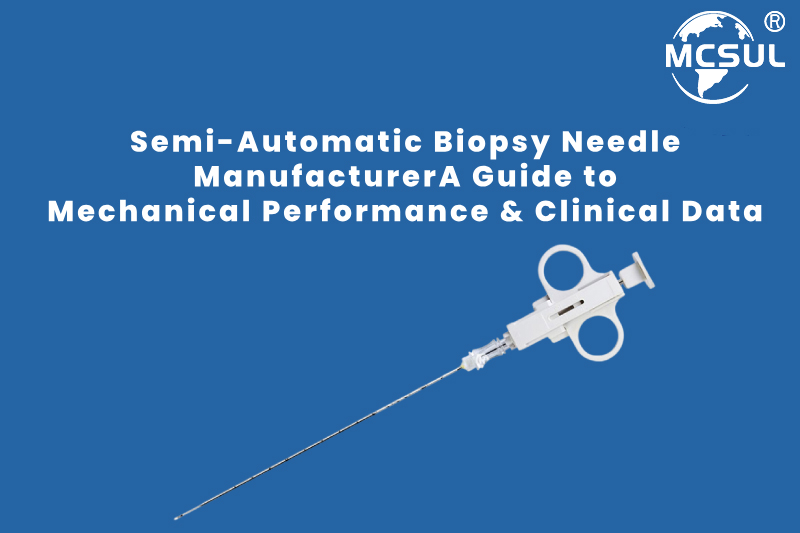
Choosing a semi-automatic biopsy needle manufacturer is not just a purchasing task. It affects sample quality and patient comfort. It can even change how fast a diagnosis is reached. On a specification sheet, two needles may seem almost identical. On the table, they can perform very differently. This guide covers how these needles have evolved. It also gives you a clear way to judge a maker. The focus is on mechanical performance and clinical data, not just price. Our own notes come from over 30 years of building needles for hospitals and OEM partners, so the checks below are the same ones our own team runs before a design ships.
What Is a Semi-Automatic Biopsy Needle?
A semi-automatic biopsy needle is a core needle biopsy device. It takes a small piece of tissue from the body. It mixes hand control with a spring-fired action. The doctor puts the needle in by hand. They also place the thin inner rod, the stylet, by hand. Then they pull a trigger. The spring drives the outer tube forward in a snap. This cuts the tissue sample in one fast, clean move. Doctors keep strong control over where the needle goes. The fast cut still keeps the sample clean and whole. You can read more in our guide on how a semi-automatic biopsy needle works.
How Have Semi-Automatic Biopsy Needles Evolved Technically?
These needles evolved from hand-made designs to spring-fired ones. Early biopsy needles were fully manual. The doctor moved both parts by hand: the thin rod and the outer tube. This gave good control. But it had one flaw. The slow cut let soft tissue slip or bend first.
The next step was full auto-fire. One trigger fires both parts at once. This is fast. It is also easy to repeat, cut after cut. But it takes away some control over exact needle placement.
Semi-automatic needles sit in between. The doctor places the thin rod by hand, guided by scans. Only the outer tube fires by spring. This keeps the hand control of a manual tool. It adds the fast, clean cut of an auto tool. Over time, makers added more useful parts:
- Adjustable throw length. One device can now take short or long samples.
- Coaxial introducer compatibility. This allows several tissue passes through one skin puncture. For coaxial biopsy needle system procurement, buy the introducer and the main needle as a matched, tested set. A mismatched pair can hurt fit and cut quality.
- Echogenic and radiopaque markers. These keep the needle tip visible under ultrasound or CT.
- Centimeter depth markings. These help the team track how deep the needle has gone.
This history shows why the maker you pick matters today. An old spring design does not feel the same in the hand as a newer, refined one. Both may have the same “semi-automatic” classification. Even yet, the outcomes might vary greatly.
What Mechanical Performance Factors Should You Check From a Semi-Automatic Biopsy Needle Manufacturer?
Four things matter most: spring force, notch shape, tube stiffness, and depth control. Together, they set how clean the cut is. They also set how much good tissue you get.
Spring force and firing time : A stronger, faster spring cuts tissue before it can bend or slip away. Ask the maker for the exact firing time. Do not settle for the term “spring-loaded” on its own.
Notch shape : The notch is the open slot on the inner rod. It holds the tissue sample just before the outer tube cuts it. A deep, well-shaped notch keeps the sample whole. Our semi-automatic disposable biopsy needle line uses a deep groove built for this exact job.
Tube stiffness and tip sharpness : A stiff outer tube resists bending in dense tissue. This keeps the needle on target. A sharp tip needs less force to go in. Less force means less risk of a tear.
Depth control : Look for depth marks along the shaft. Adjustable or dual-depth options are even better. These help the doctor match the needle’s reach to the size of the target.
What Does a Semi-Automatic vs Fully Automatic Biopsy Needle Comparison Show?
A semi-automatic vs fully automatic biopsy needle comparison comes down to one trade-off: hand control versus raw speed. Semi-automatic needles let the doctor place the stylet by hand first. The spring fires next, so aim stays tight. Fully automatic needles fire both parts at once. This is faster. But it leaves less room to adjust at the last moment.
| Mechanism Type | Trigger Action | Control Level | Typical Speed | Best Suited For |
| Manual (Tru-Cut style) | Stylet and cannula both moved by hand | Highest | Slowest | Superficial, easy-to-target lesions |
| Semi-automatic | Stylet placed by hand, cannula fires by spring | High | Fast | Liver, kidney, breast, lung core biopsies |
| Fully automatic | Stylet and cannula fire together | Moderate | Fastest | High-volume, deep-organ sampling |
Needle Gauge and Color Code Reference
Needle gauge affects both sample size and patient comfort. Color coding follows ISO 6009:2016. This is the international standard for needle hub colors by gauge.
| Gauge | Hub Color (ISO 6009:2016) | Typical Use |
| 14G | Green | Larger core samples, liver, tissue near bone marrow |
| 16G | Purple | Breast, kidney, general soft tissue |
| 18G | Pink | Liver, prostate, lymph node |
| 20G | Yellow | Smaller or more delicate targets |
What Clinical Data Should You Request From a Semi-Automatic Biopsy Needle Manufacturer?
Ask for diagnostic yield, sample quality, and complication rates. These should come from real patient data, not just lab tests. A lab test shows how a needle acts on a test block. Real clinical data shows how it acts in a real patient.
The main semi-automatic biopsy needle clinical advantage is simple: a fast, clean cut plus steady hand control over placement. This mix tends to raise diagnostic yield. It can also cut down on repeat passes. Still, ask for real numbers to back this up, not just the design pitch.
Ask the maker for:
- Diagnostic yield. The share of biopsies that gave a sample good enough for a clear diagnosis.
- Sample adequacy and tissue area. A larger, more intact core usually supports a clearer lab read.
- Complication rates. This includes bleeding, bruising, and how often a repeat biopsy was needed.
- Comparative studies. Data against other needle types or gauge sizes, if available.
Real studies back this up. One study used a 21-gauge Menghini-type biopsy needle. It gave a clear result in all 14 patients tested. A standard 22-gauge needle gave a clear result in just 57% of cases in the same study. The Menghini-type needle also pulled a much larger area of tissue per pass. Small design choices like this matter a lot. They can decide if you get a clear answer on the first try, or need to try again.
If a maker has no data to share, treat that as a red flag. Raise it before you place a large order.
What Certifications Should a Semi-Automatic Biopsy Needle Manufacturer Hold?
A good manufacturer should hold ISO marks for both parts and cleaning. Their needle should also carry the right FDA class. In the U.S., biopsy tools fall under 21 CFR 876.1075. This is the Gastroenterology-Urology Biopsy Instruments rule. These needles are Class II devices, under code KNW. This class exists because a biopsy needle goes inside the body. It plays a role in each patient’s test result. So the FDA asks for a full safety check before sale.
On the manufacturing side, look for these named standards:
- ISO 9626:2016. Covers stainless steel needle tubing, the raw material used for the needle shaft.
- ISO 10993-1. Confirms the needle materials are safe for contact with human tissue.
- ISO 11607-1. Confirms the sterile packaging holds up through shipping and storage.
- ISO 6009:2016. Sets the color code for needle gauge, shown in the table above.
- ISO 13485. Covers the quality management system for the whole factory, not just one product line.
This is easier to trust than a vague “we meet industry standards” line. It is also easier to audit. You can review our own quality documents on our certificates page.
What Should You Check When Comparing a Semi-Automatic Biopsy Needle Manufacturers?
Use a short checklist to compare makers side by side. Check regulatory class, named material standards, gauge range, and OEM/ODM support. The table below shows how KDL (Nanchang Kindly Medical) lines up on each point. Check it against any other supplier’s own documents too.
| Buyer Criteria | What to Look For | KDL (Nanchang Kindly Medical) |
| FDA Classification | Class II device, correct product code | 21 CFR 876.1075, product code KNW |
| Material Standard | Named ISO standard for needle tubing | ISO 9626:2016 |
| Biocompatibility | Verified biological safety testing | ISO 10993-1 |
| Sterile Packaging | Verified sterile barrier standard | ISO 11607-1 |
| Gauge Range | Multiple gauges from one supplier | 14G to 20G, several lengths |
| OEM/ODM Support | Custom specs and private label available | Yes, OEM and ODM both offered |
| Export Reach | Active in multiple countries | 50+ countries served |
Looking for an OEM/ODM Semi-Automatic Biopsy Needle Manufacturer?
At KDL we provide flexible OEM/ODM manufacturing services for semi-automatic biopsy needles, including custom gauge and length configurations, private-label branding, and customized packaging.
Request an OEM/ODM QuoteWhat Are Common Mistakes When Selecting a Semi-Automatic Biopsy Needle?
Comparing only the price per unit. A cheaper needle that gives more failed samples costs more later. Repeat procedures and extra lab work add up fast.
Ignoring the firing mechanism details. The word “spring-loaded” tells you very nothing by itself. Enquire about firing time, throw length choices, and notch depth.
Skipping clinical evidence. Bench specs do not always predict real-world results. Ask for published or in-house clinical data whenever it exists.
Overlooking packaging and shelf life. A weak sterile barrier can fail before the needle reaches the procedure room. Check for ISO 11607-1 compliance and shelf-life test data.
Not checking the full gauge and length range. A supplier who only offers one size limits your options. Look for a full range of biopsy needle sizes and lengths from one steady maker.
Key Takeaways
- Judge a semi-automatic biopsy needle manufacturer on mechanical performance and clinical data, not price alone.
- The design evolved from manual Tru-Cut needles to spring-fired semi-automatic ones. This balances control with cutting speed.
- Spring firing force, notch design, cannula stiffness, and depth control are the key mechanical factors to check.
- Diagnostic yield, sample adequacy, and complication rates are the clinical data points worth asking for.
- Look for named certifications: FDA 21 CFR 876.1075, Class II, product code KNW, ISO 9626:2016, ISO 10993-1, and ISO 11607-1.
- Semi-automatic wins on control. Fully automatic wins on raw speed.
- For coaxial systems, always buy the introducer and needle as one matched set.
Final Thoughts
Semi-automatic biopsy needles have come a long way from early manual designs. The gap between manufacturers today is real, not just cosmetic. Take time to check mechanical specs before you buy. Ask for clinical data too. This small step protects both diagnostic accuracy and your patients. For more detail on choosing the right biopsy needle for your procedures, explore our full product and guidance library at kdlnc.com.